Make Your Home Smarter, One Step at a Time

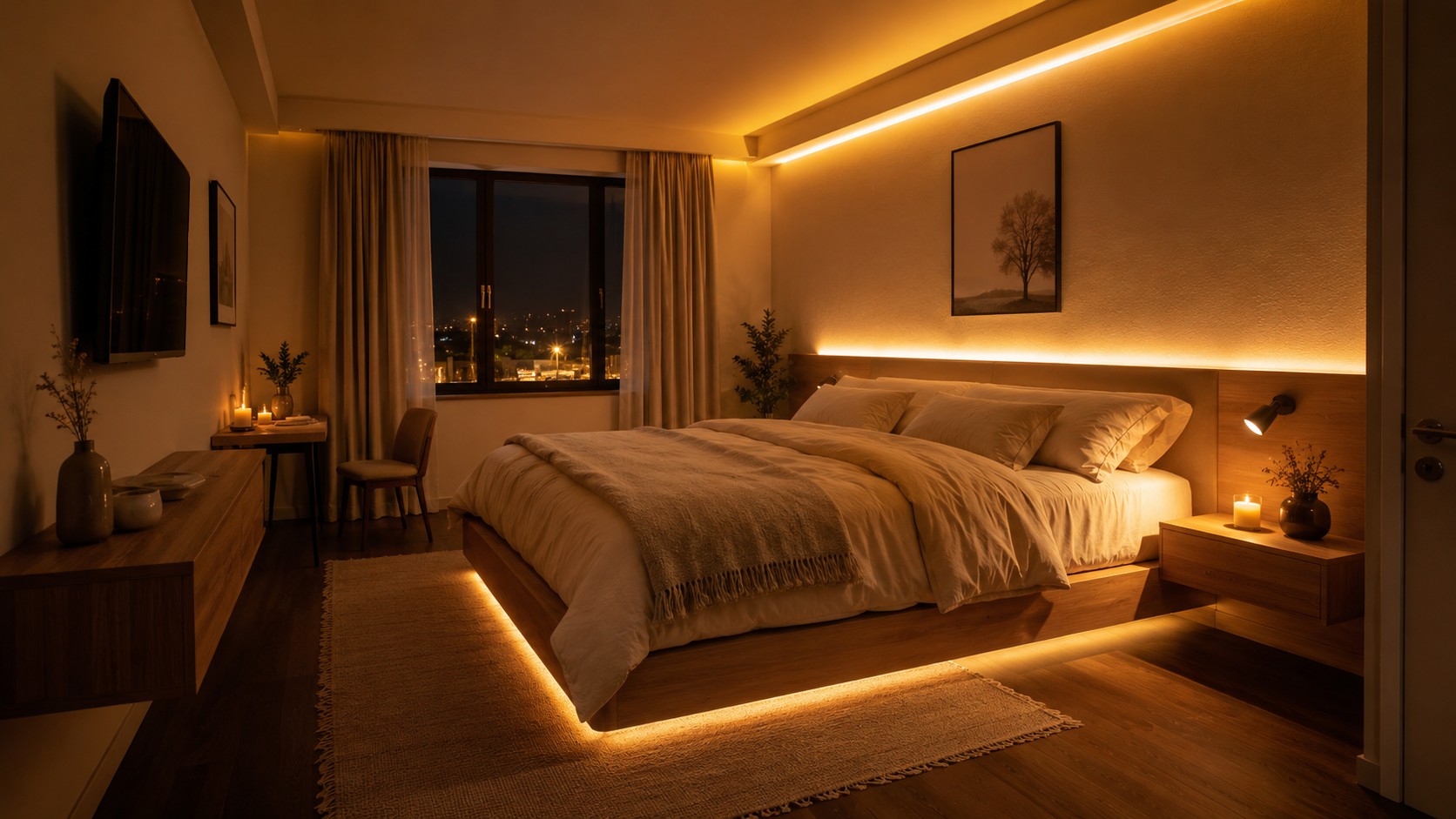
Table of Contents
That One Change That Made My Tiny Room Feel Like a Different Place
I remember standing in the doorway of my first apartment — a 9×10 bedroom that somehow needed to be a sleeping space, a home office, and a living area all at once. The overhead bulb buzzed. The walls felt like they were closing in. I’d tried everything: mirrors, light curtains, decluttering. Nothing worked.
Then I tried small room LED strip lighting ideas I’d seen buried in a Reddit thread. I spent $35, took two hours, and the next morning I genuinely didn’t recognize my own room.
That’s the power most people don’t realize LED strips have. They don’t just add light — they reshape how a space feels. In this guide, I’ll show you exactly how to use them, where to place them, what to avoid, and which setups give you the most impact for the least money.
Settings saved.
Why Small Rooms Need a Different Lighting Strategy
Most small rooms have one central ceiling fixture. And that single source of light is quietly sabotaging your space every single day.
Here’s the problem: overhead lighting creates downward shadows that flatten walls, highlight clutter, and draw attention to the floor — the smallest part of any room. Your eye naturally follows the light, and if all the light is coming from above, the room feels short, cramped, and heavy.
Small room LED strip lighting ideas work differently. They distribute light horizontally — across walls, under furniture, along edges — which draws the eye outward and creates the visual illusion of more space.
The science is simple: rooms feel larger when light touches more surfaces. LED strips do exactly that, and they do it without taking up a single inch of your floor space.
What to Look for Before You Buy
Before we get into the ideas, let’s make sure you buy the right strips. This is where most beginners go wrong — and it’s an easy mistake to avoid.
Color Temperature
This single setting controls the entire mood of your room.
- 2700K–3000K (Warm White) — cozy, relaxing, perfect for bedrooms
- 3500K–4000K (Neutral White) — balanced, great for home offices and living areas
- 5000K–6500K (Cool/Daylight White) — crisp and alert, ideal for focused work or kitchens
- RGB / RGBW — full color control via app; RGBW adds a dedicated white LED for cleaner whites
Key Specs to Check
- CRI 90+ — ensures colors look accurate and natural under the light
- Lumens per meter — 400–800 lm/m for ambient; higher for task lighting
- IP Rating — IP20 for dry rooms; IP65 for bathrooms or near kitchen sinks
- Smart compatibility — look for Alexa, Google Home, or Apple HomeKit support
Brands Worth Trusting
Govee, Philips Hue, LIFX, and Kasa consistently deliver on quality. Avoid no-name strips from unknown sellers — uneven brightness and peeling adhesive are common complaints.
9 Small Room LED Strip Lighting Ideas Worth Trying
1. Under-Bed Lighting — The Floating Effect
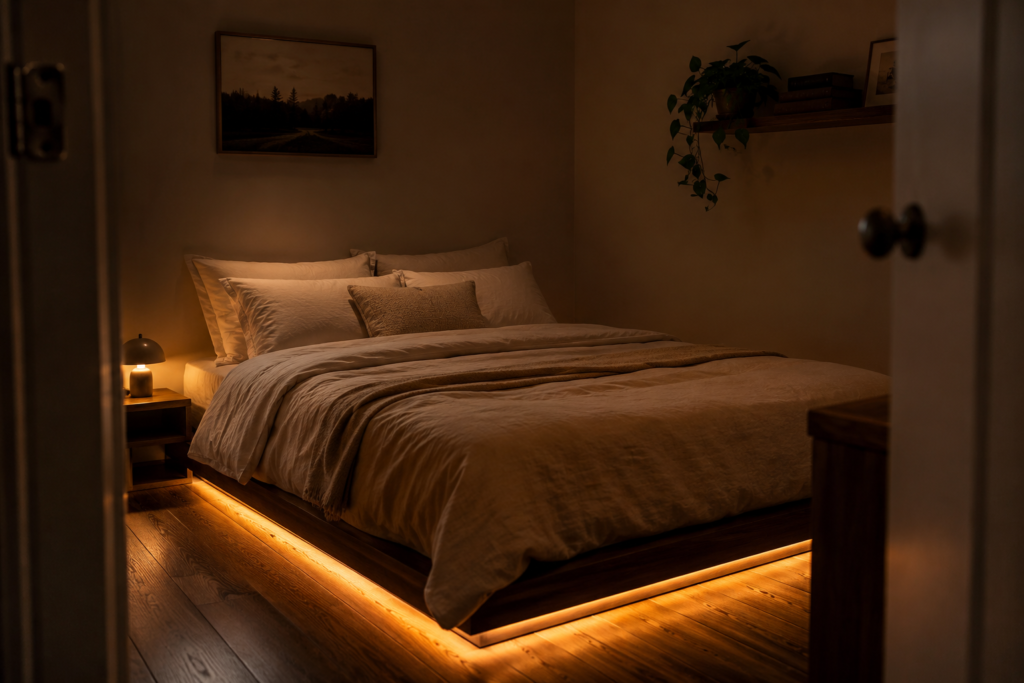
This is where I always tell people to start. Place LED strips along the inner base of your bed frame, facing downward. The glow that hits the floor creates a “floating” illusion — the bed appears lifted, the floor looks wider, and the entire room instantly feels more open.
Use warm white at 30–50% brightness for the best result. Full brightness here looks harsh; the goal is a soft, diffused glow you feel more than see.
What you need: 2–3 meters of warm white strips, adhesive clips, smart plug with timer.
Pro Tip: Set a timer so the under-bed light fades on gently at night and switches off automatically after you fall asleep. It doubles as a calming sleep ritual.
2. Ceiling Cove Lighting — Borrowed from Hotel Design
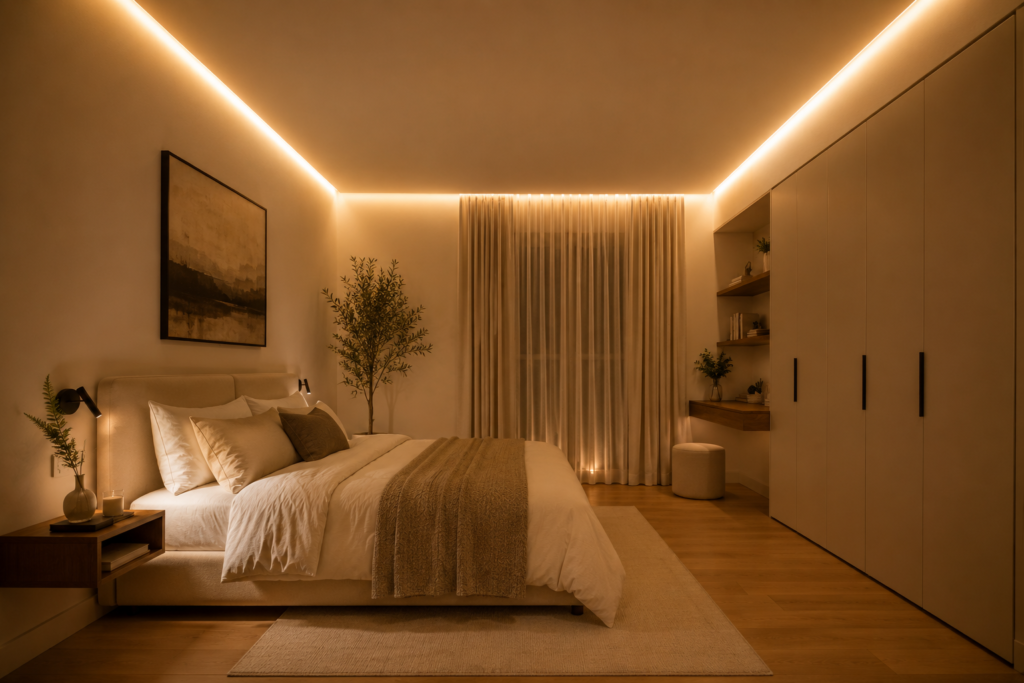
Walk into any well-designed hotel room and look up. You’ll almost always see indirect light bouncing off the ceiling from a hidden strip. That’s cove lighting — and it’s one of the most transformative small room LED strip lighting ideas you can implement at home.
Mount strips along the top edge of your walls using an aluminum channel angled upward. The light bounces off the ceiling and diffuses downward evenly, eliminating harsh shadows and making the ceiling feel higher.
Why it works so well in small rooms:
- No glare — you never see the light source directly
- Even, wrap-around illumination that removes visual boundaries
- Creates depth on every wall simultaneously
Common mistake: Skipping the aluminum diffuser channel. Without it, you’ll see individual dots of LED light, which looks unfinished. The diffuser blends them into one clean, continuous line.

- 【Brighter, Lower Voltage Drop】PAUTIX 24V 480 LEDs/m (total 2400 LEDs) COB (chip on board) LED strip light has lower volt…
- 【Lead-free Materials & UL Listed】Designed with lead-free materials, PAUTIX COB LED strip lights are more environmentally…
- 【Dimmable with RF Remote Control】The RF (radio frequency) remote control with 13 keys allows you to control the strip li…
$25.99
3. Behind Your TV or Monitor — Bias Lighting
If you watch TV or work at a screen in your small room, this placement is non-negotiable. Bias lighting — strips placed behind your screen facing the wall — reduces eye strain by softening the contrast between the bright display and the dark room behind it.
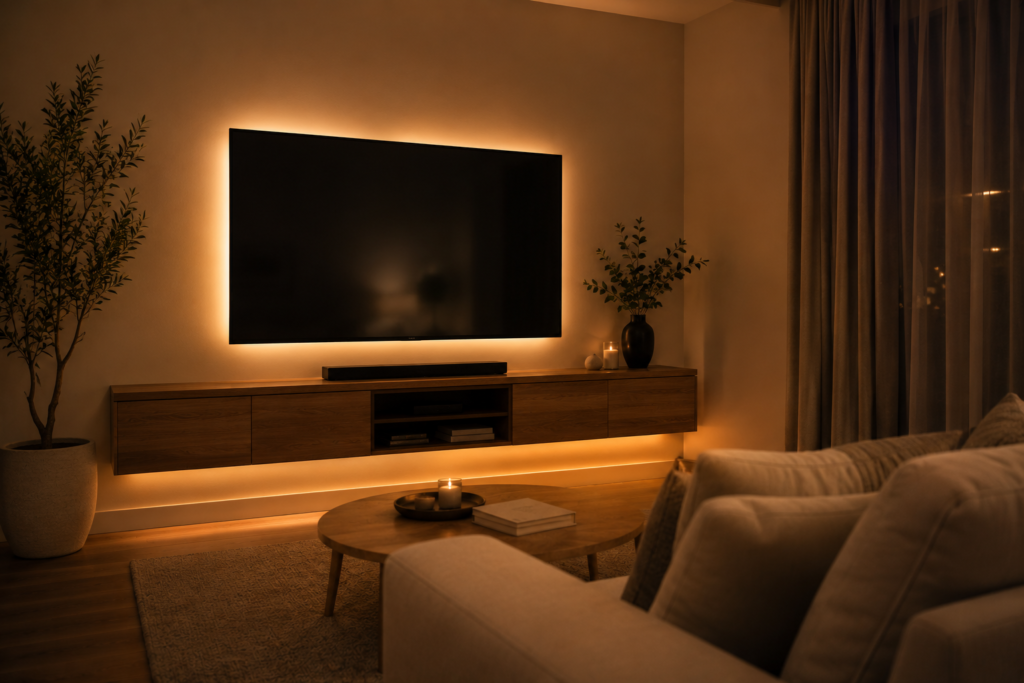
Beyond the health benefit, it adds a sleek, premium look that makes even a budget setup feel intentional.
Best options:
- Static neutral white (6500K) — reduces eye strain, most accurate colors
- Sync strips (Govee DreamView, Philips Hue Play) — LEDs that change color to match what’s on screen in real time
Real-life example: My home office is 8×8 feet. Adding bias lighting behind my monitor was the single best upgrade I made — it reduced headaches during long work sessions and made the corner feel designed rather than thrown together.

- Ultra-High Resolution Lens: Industry-leading dual hybrid lens with 4MP high-resolution optical performance. Hybrid lens …
- Smart AI Color-Mapping: Govee TV Backlight 3 innovative algorithm divides the screen into 24 zones for independent color…
- High-Density RGBWIC Strip: This tv led backlight features 60 LEDs/m with 4-in-1 beads. Dedicated white channel delivers …
$109.99
4. Under-Cabinet and Shelf Lighting — Depth on Every Surface
Floating shelves and wall-mounted cabinets are space-saving essentials in small rooms. Adding LED strips underneath them adds a layer of visual depth that flat, overhead lighting can never achieve.
The light cascades downward onto whatever is below — a desk, a countertop, a bookshelf — creating a warm pool of illumination that feels intentional and layered.
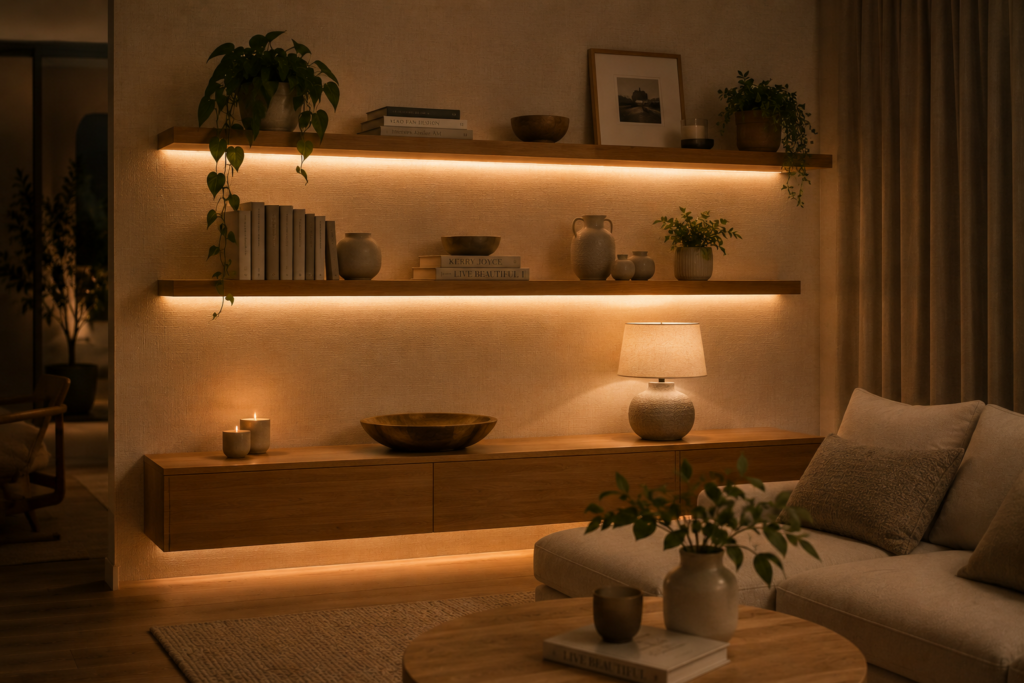
Placement tips:
- Position strips at the front edge of the shelf, angled slightly downward
- Use a frosted diffuser channel to avoid the “dotted line” effect
- Warm white (3000K) for decorative shelves; neutral white (4000K) for work surfaces
Comparison — shelf lighting with vs. without LED strips:
| Aspect | Without LED Strips | With LED Strips |
|---|---|---|
| Visual depth | Flat, one-dimensional | Layered, dimensional |
| Ambiance | Functional only | Warm and designed |
| Object visibility | Poor in shadows | Clear and highlighted |
| Room perception | Smaller | More spacious |
5. Wardrobe Interior Lighting — Function Meets Style
A dark wardrobe in a small room creates a double problem: you can’t find what you need, and the dark interior visually “absorbs” that corner of the room.
LED strips inside your wardrobe solve both issues at once. Light the interior and the whole corner of your room brightens up — even with the doors open.
Best setups:
- Top rail strip — illuminates hanging clothes from above
- Shelf edge strips — layers light across folded items
- Motion-activated strips — lights come on when you open the door, off when you close it (battery-powered options require zero wiring)
I installed motion-activated strips in my wardrobe last year and it’s one of those upgrades that seems small but improves your morning routine every single day.
6. Staircase and Step Lighting
If your small room is part of a loft, mezzanine, or has interior steps, LED strips along the stair risers are one of the most dramatic placements in this entire list.
Each step gets its own strip of light, creating a cascading glow that looks architectural and intentional — like something out of a design magazine.
Practical benefits:
- Eliminates the need for a wall sconce or overhead stairwell light
- Motion-activated versions only light up when in use, saving energy
- Aluminum recessed channels keep strips flush with the step surface for a clean, built-in look
Use warm white for a residential feel or cool white for a modern, minimal aesthetic.
7. Window Frame Lighting — Multiply Your Natural Light
Window framing is one of the most overlooked small room LED strip lighting ideas — yet one of the most rewarding. Framing a window with LED strips is simple, affordable, and one of the most effective upgrades you can make to a tight space.
Place strips along the inner frame of the window, facing inward. At night, the light mimics the soft glow of daylight coming through, keeping the window as a visual focal point even after dark. The wall around the window gets illuminated, which visually expands that entire side of the room.
Pro Tip: Match your strip color temperature to your window’s natural light exposure. North-facing windows get cooler light — use 4000K strips. South-facing windows are warmer — use 2700K–3000K.
For an advanced setup, use a smart strip on a schedule that gradually increases brightness as sunset approaches, seamlessly transitioning from natural to artificial light. When it comes to small room LED strip lighting ideas that work around the clock — day and night — window frame lighting is hard to beat.
8. Behind Headboard Lighting — The Boutique Hotel Trick
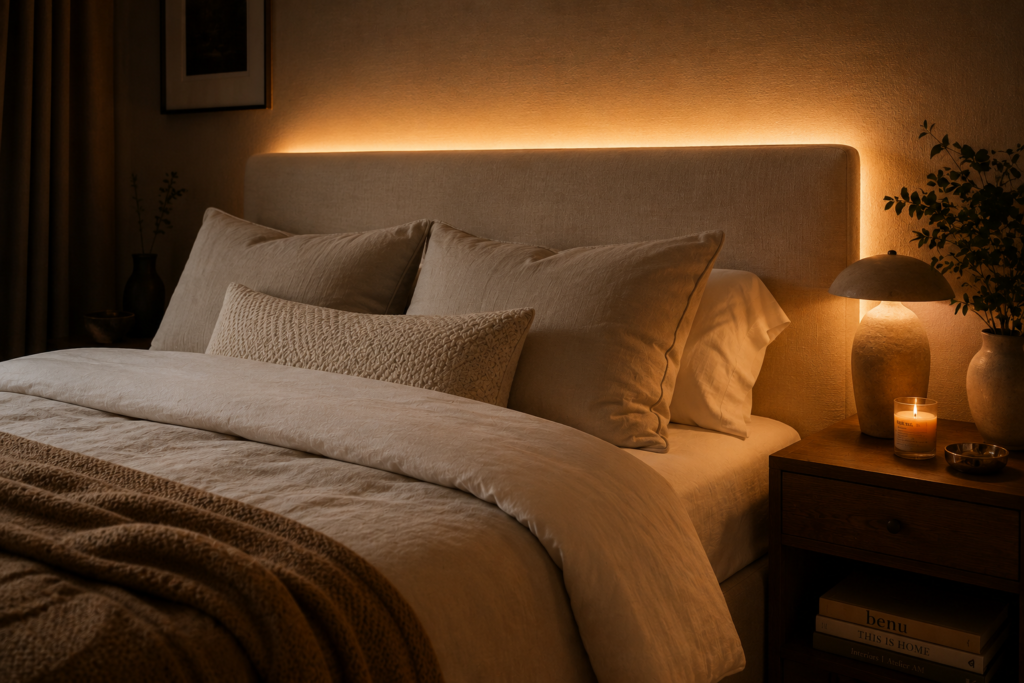
A strip of warm LED light behind your headboard, glowing softly onto the wall, is one of the fastest ways to make a small bedroom feel like a boutique hotel room.
Mount the strip along the back edge of your headboard or directly on the wall behind it. Use warm amber (2200K–2700K) for the most relaxing, sleep-friendly atmosphere.
This placement also creates a natural focal point — the bed becomes the visual anchor of the room, which is good design strategy in a space where you want one thing to command attention rather than everything competing at once.

- 【Modern long LED wall Light】This plug in wall lamps has a minimalist style, has a variety of installation methods, and c…
- 【Wall Light Size】L39.37 X H1.77 X W1.18 inches.Power:20W, Voltage: 85V~265V, 50/60Hz, Light Color: Natural Light, Color …
- 【Installation method】 This plug in wall Light adopts 59” plug wire, which does not require slotted wiring, which can ea…
$53.98
9. Desk Perimeter Lighting — A Workspace That Works for You
Working in a small room means your desk setup needs to do a lot. Adding LED strips to your desk — aRounding out our small room LED strip lighting ideas is the desk setup — often overlooked, always impactful. Working in a small room means your desk needs to do a lot, and adding LED strips along the back edge facing the wall, or underneath the surface, transforms a cramped corner into a focused, professional workspace.
Best desk lighting placements:
- Back edge facing wall — creates a soft backlight that reduces screen glare
- Under-desk surface — illuminates your keyboard without a separate lamp
- Along a pegboard or wall panel — makes your workspace feel intentional and organized
Use a neutral white (4000K) here. It keeps you alert without feeling harsh, and it renders colors accurately — important if you do any design, photography editing, or detail work. Of all the small room LED strip lighting ideas in this guide, this one quietly improves your focus and productivity every single day.
The 5 Mistakes That Ruin LED Strip Lighting in Small Rooms
I’ve made every one of these. Learn from my experience so you don’t have to:
Mistake 1: Buying the cheapest strips available Low-cost strips from unknown brands often have uneven brightness, inconsistent color temperature across the strip, and adhesive that fails within weeks. The $10 you save will cost you hours of frustration.
Mistake 2: Mixing color temperatures in the same room Warm white near the bed and cool white at the desk creates a jarring, unfinished look. Choose one color temperature for your main ambient lighting and stick to it.
Mistake 3: No diffuser channel Strips without a frosted aluminum channel show individual LED dots. It looks cheap and unfinished. A $5–$10 aluminum profile with a frosted cover transforms the result completely.
Mistake 4: Pointing strips directly at the viewer LED strips should light surfaces, not eyes. Light should bounce — off a ceiling, wall, or floor — never shine directly toward anyone in the room.
Mistake 5: No dimming control Fixed-brightness strips severely limit how you use your room. Always choose dimmable strips with a smart controller so you can shift from bright and functional to soft and relaxing with one tap.
My Honest Opinion: Where to Start If You’re Overwhelmed
If you read this whole guide and still aren’t sure where to begin, here’s my honest recommendation: pick two placements and do them properly rather than five placements done poorly.
Start with under-bed lighting and cove lighting. These two alone — done with quality strips, proper diffusers, and a warm color temperature — will change how your room feels more than almost any other single upgrade you could make.
Once you see the difference, you’ll naturally want to add more. But those two placements are the foundation of any successful small room LED strip lighting ideas setup, and they work in almost every room regardless of style, layout, or budget.
Lighting is the most underinvested-in element of most people’s homes. It costs less than new furniture, takes less time than a paint job, and has more impact than almost anything else you can change. Start there.
Expert Tips: Maximizing Impact in Small Spaces
- Layer your lighting — combine LED strips with a ceiling fixture and one floor or table lamp. Three sources of light always feel more designed than one.
- Use circadian schedules — program your smart strips to shift from cool white in the morning to warm white in the evening. It supports your sleep cycle and feels effortless.
- Conceal every wire — visible cables instantly undermine even the best lighting setup. Use cable channels or route wires behind furniture.
- Measure before you buy — count your linear meters carefully, including corners. Running out mid-installation is frustrating and wastes time.
- Test placement with tape first — before committing adhesive strips to your walls, use painter’s tape to mock up the position and live with it for a day.
Suggested Internal Links
- Creative LED Strip Lighting Ideas for Bedrooms 2026
- “Best Smart Lighting Setups for Studio Apartments”
- “How to Choose the Right Color Temperature for Every Room”
- “Beginner’s Guide to Smart Home Lighting on a Budget”
Authoritative Sources Worth Referencing
- U.S. Department of Energy (energy.gov) — LED efficiency data and energy saving comparisons
- WELL Building Standard — research on circadian lighting and color temperature’s effect on health and sleep
FAQs: Small Room LED Strip Lighting Ideas
Q1: Will LED strips actually make my small room look bigger? Yes — when placed strategically. The best small room LED strip lighting ideas for creating a sense of space are cove lighting (draws the eye upward), under-furniture lighting (creates visual floor space), and window framing (expands the wall around the window). Each technique works by drawing the eye toward the edges of the room rather than its center.
Q2: How many LED strips do I need for a small room? For a single placement in a 10×10 ft room — like cove lighting or under-bed lighting — one 5-meter strip is typically sufficient. For multiple placements, plan 2–3 strips of 2–5 meters each. Always measure your specific run before purchasing and add 10–15% extra for corners and adjustments.
Q3: Are LED strips safe to leave on all night? Quality LED strips generate very little heat and are designed for extended use. That said, using a smart plug with a scheduled timer is best practice — it conserves energy, extends the lifespan of the strips, and removes any small residual risk from prolonged use while unattended.
Q4: What’s the easiest LED strip placement for a complete beginner? Under-bed lighting is the most beginner-friendly of all small room LED strip lighting ideas. It requires no special tools, uses the strip’s built-in adhesive, and delivers an immediate, visible result. Total installation time: under 20 minutes.
Q5: Can I use LED strips in a rented apartment without damaging walls? Yes. Use 3M Command adhesive strips or purpose-made LED mounting clips instead of relying solely on the strip’s own adhesive backing. Aluminum channels also protect the wall surface. When you move out, strips and channels remove cleanly without leaving marks on painted walls.
Q6: RGB or RGBW — which is better for a small bedroom? For a small bedroom where you’ll mainly use white light, RGBW is the better choice. Standard RGB strips produce white by mixing red, green, and blue LEDs — the result is often cold, slightly greenish, and unflattering. RGBW strips include a dedicated white LED that produces clean, accurate white light. Use the RGB colors for mood and atmosphere; use the W channel for everyday lighting.
Conclusion: Small Room, Unlimited Potential
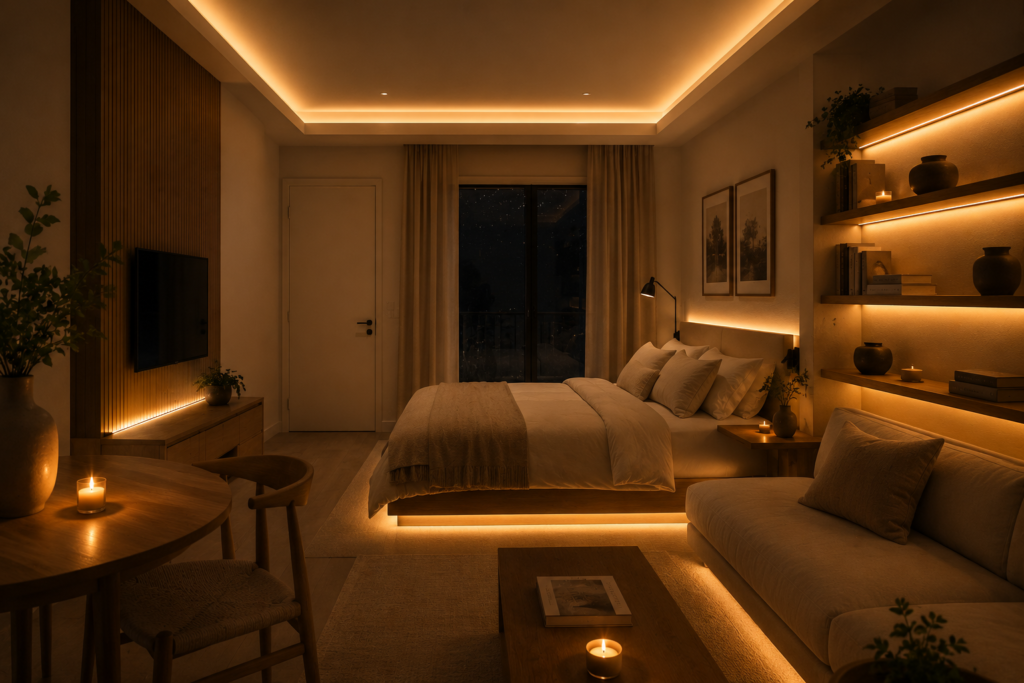
Here’s what I’ve learned after years of experimenting with lighting in small spaces: the room you have is almost never the problem. The lighting usually is.
Small room LED strip lighting ideas are not a trend or a gimmick. They are a legitimate, affordable, and remarkably effective design tool — one that professional interior designers have used for decades and that is now accessible to anyone with $30 and an afternoon.
Pick your starting placement. Buy quality strips. Use a diffuser. Control the color temperature. And then watch what happens to a room you thought couldn’t be improved.
The smallest rooms often have the most potential — they just need the right light to show it.
Ready to transform your space? Browse our full collection of smart lighting guides and home design tips at TechNest Decor — and find the perfect LED strip setup for your room, your budget, and your style.