Make Your Home Smarter, One Step at a Time


Table of Contents
I still remember the first time I unlocked my dorm room door. Cinderblock walls the color of oatmeal. A mattress that felt like it had been sat on by three generations of students. A window that looked out onto a parking lot. And somehow, by the end of move-in weekend, that same room had string lights, a gallery wall, and a corner that actually felt like home.
That’s the thing nobody tells you about college bedrooms: they’re small, they’re not yours to paint or drill into, and you’re usually splitting the square footage with a total stranger. But that doesn’t mean the space has to feel like a hospital waiting room. With the right college bedroom ideas, even a 10-by-12 box can become the place you actually want to study, nap, and hang out in.
So let’s get into it — the real, practical stuff that works in an actual dorm, not just in a Pinterest fantasy.
Settings saved.
Key Takeaways
- Most dorm rooms come as a bare frame — a bed, a desk, a closet — so almost everything about the vibe is up to you.
- Vertical space and multi-use furniture matter more than square footage in small college bedrooms.
- Command strips, tension rods, and removable adhesive are your best friends (and usually the only decor tools your lease allows).
- Lighting changes a room more than almost any other single upgrade.
- A few well-chosen personal touches beat a room stuffed with stuff every time.
How We Chose These Ideas
Before we dive in, a quick word on where all of this actually comes from. Every idea in this guide got filtered through the same five questions: Is it practical in a room you can’t renovate? Is it affordable on an actual student budget, not a design-blog budget? Does it survive the restrictions most colleges put on dorms (no nails, no paint, no open flames)? Does it hold up to real student life — roommates, finals week, and moving out every May? And does it actually function, or is it just something that photographs well for five minutes?
Anything that only passed one or two of those tests got cut. What’s left is the stuff that’s genuinely lived-in-tested: the tricks that survive an entire school year, not just move-in day.
What Does a Dorm Room Actually Look Like Before You Touch It?
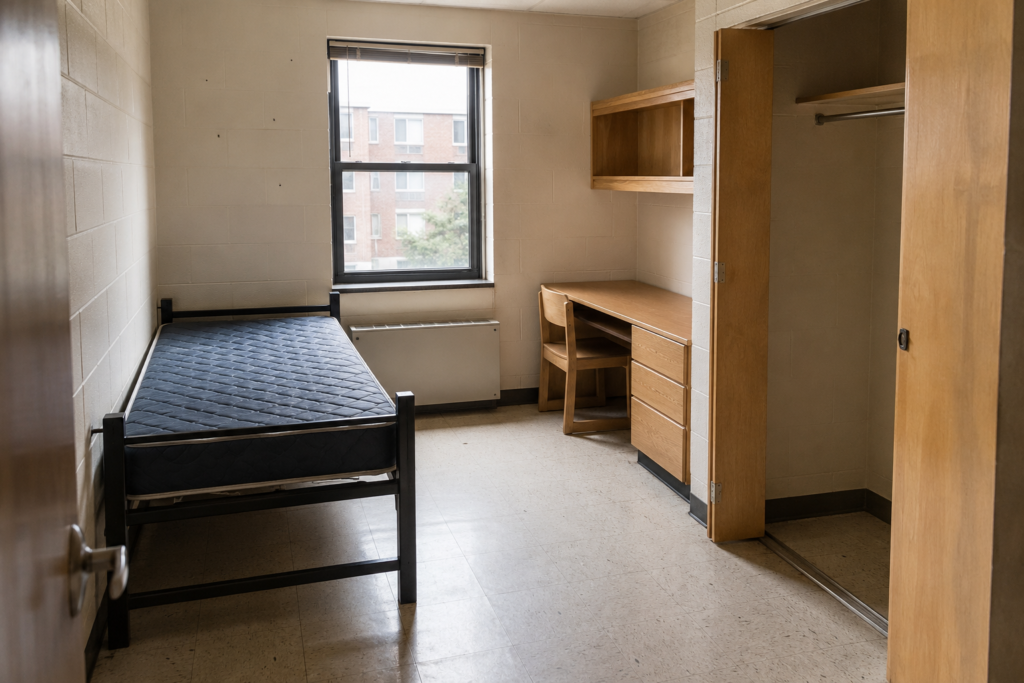
Before we get to the fun part, it helps to know what you’re actually working with. Most college bedrooms — whether the school calls them dorms, residence halls, or “student housing units” — follow a pretty predictable formula: a twin XL bed (slightly longer than a standard twin, so don’t buy sheets before you check), a built-in desk and chair, a closet or wardrobe, and a dresser. Some rooms have a private bathroom, but plenty share a hall bathroom with an entire floor.
Square footage tends to run somewhere between 130 and 250 square feet for a shared double, which sounds bigger on paper than it feels once two people, two desks, and two closets are crammed into it. Ceilings are usually low, walls are usually cinderblock or drywall you can’t paint, and the flooring is almost always some version of tile or thin carpet that’s seen better days.
Once you know the baseline, the decorating challenge becomes clear: you’re not designing a room from scratch, you’re transforming a shared, rented, temporary box. That reframing actually makes it easier — you’re not chasing perfection, you’re chasing personality.
Start With What You Can’t Change (So You Know What You Can)
Here’s the thing — almost every college has rules about what you can and can’t do to the walls. Nails, screws, paint, and wallpaper are usually off the table, along with candles, string lights that aren’t LED, and anything that could be a fire hazard. It’s worth pulling up your specific housing handbook before you buy a single thing, because getting hit with a damage fee at move-out kind of ruins the whole “cozy room” vibe.
The good news is that decorating without damage has become its own entire industry. Command strips and hooks hold surprising amounts of weight now. Removable, repositionable wallpaper peels off clean. Tension rods create curtain rods, closet dividers, and even makeshift headboards without a single screw. Once you accept these as your toolkit, you stop feeling limited and start feeling like you’re solving a fun puzzle.
Small Dorm Layout Ideas
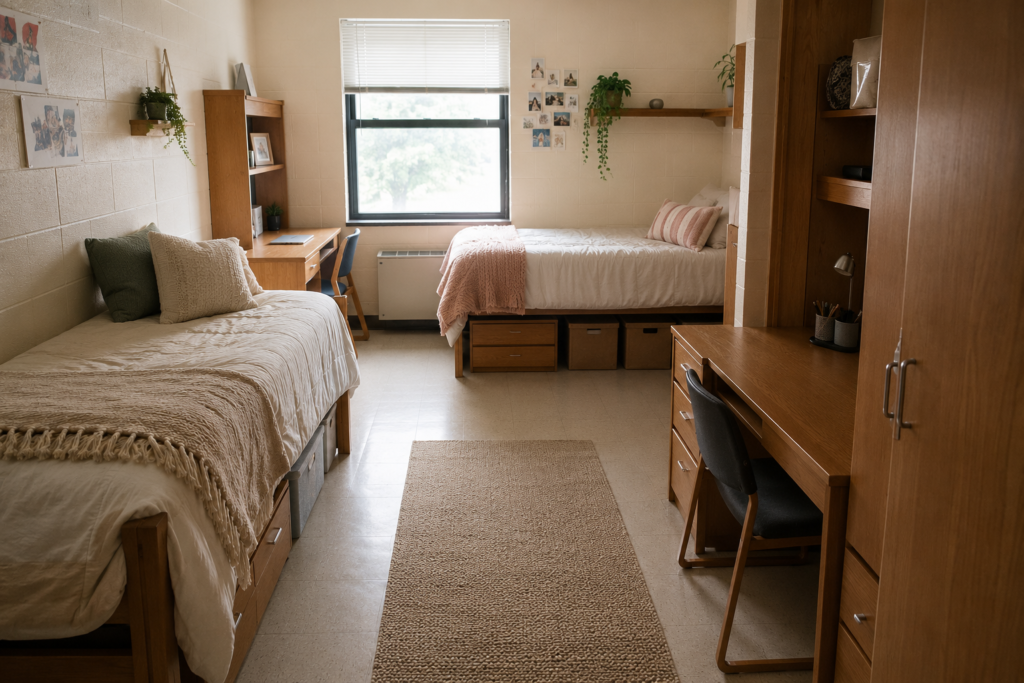
Layout is the part people skip past to get to the fun stuff, but honestly, it’s the difference between a room that feels cramped and one that feels intentional. The first move is almost always the same: get the bed out of the middle of the traffic path. Pushing it against the longest wall, or into a corner, frees up a walkable strip down the center of the room that instantly makes the whole space feel bigger.
If you’re in a double, try an “L-shape” instead of mirroring each side of the room. Two beds along adjacent walls, desks pushed into the opposite corners, leaves a real shared space in the middle instead of a narrow hallway between two symmetrical setups. If your bed frame allows it, lofting or bunking is the single biggest layout unlock — it turns unusable air above your head into a couch, a second desk, or storage on the ground. More on exactly how that works in the bed section just below.
A few other layout tricks worth stealing: float furniture away from walls slightly rather than pushing everything flush, since a sliver of shadow behind furniture reads as more spacious than furniture jammed into corners. Keep your desk near natural light if you have a window, even if that means the bed goes in the darker corner — you’ll use the desk more hours in the day than you’ll be awake in bed. And resist the urge to fill every open patch of floor; one empty corner with just a rug and a floor cushion often makes a room feel more finished than one that’s fully packed.
Layer Your Lighting Instead of Relying on the Overhead Fixture
If there’s one upgrade that changes a dorm room more than any other, it’s lighting. That single overhead fluorescent fixture most schools install is doing you no favors — it’s flat, harsh, and makes even a nicely decorated room look like a break room
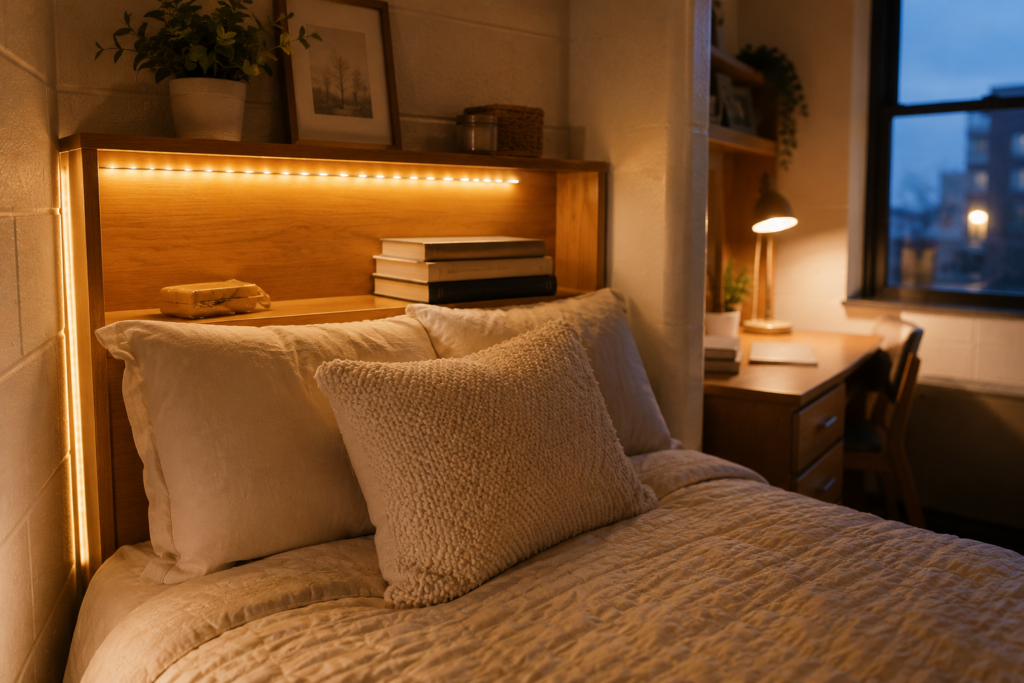
Instead, think in layers. A warm-toned desk lamp for actual studying — look for one with adjustable brightness so it works for both late-night cramming and casual evening reading. A soft floor lamp or clip lamp for ambient light in the evening. LED strip lights along a shelf or behind a headboard for that low, cozy glow when you just want to relax. Battery-operated or plug-in options exist for almost every fixture now, which matters because most schools ban actual light installation.
If you go the LED strip route, it’s worth spending a little time comparing options — some are dim and washed-out, others actually put out the warm, saturated glow you’re picturing. We put together a full breakdown of the best LED strip lights on Amazon if you want to skip the trial and error.
Honestly, swapping out cool white bulbs for warm ones might be the cheapest, highest-impact change you can make. It sounds small. It’s not.
Make the Bed the Centerpiece, Not an Afterthought
Your bed takes up more visual real estate than anything else in the room, so it’s worth treating it like the centerpiece rather than just “the thing you sleep in.” A good mattress topper solves two problems at once — comfort and that slightly institutional look dorm mattresses tend to have. Look for something 2 to 3 inches thick; anything thinner barely registers, and anything much thicker can make it awkward to fit sheets designed for a standard mattress depth. And whatever you do, double-check you’re buying Twin XL bedding specifically (39 by 80 inches, not the 39 by 75 of a standard twin) — regular twin sheets will leave a good five inches of bare mattress at the foot of the bed, which is a small thing that somehow bothers you every single night.
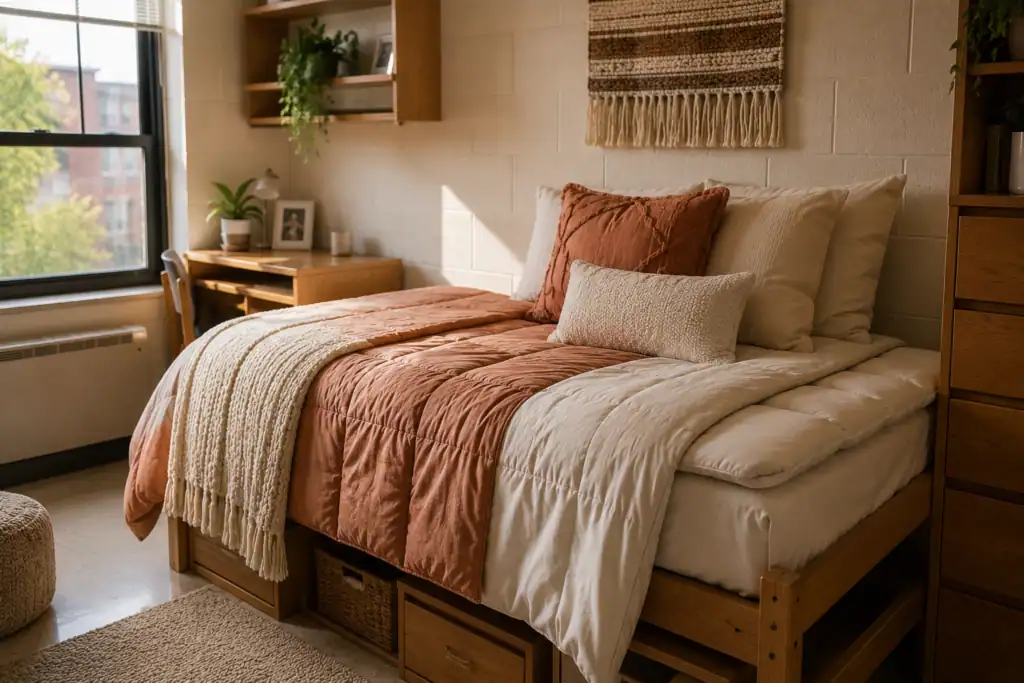
Layer in a duvet or comforter in a color that actually reflects your taste (not just whatever was on sale), a few throw pillows that aren’t just for decoration but that you’ll actually use while reading or scrolling your phone, and a bed skirt if your frame has that awkward gap underneath where storage bins tend to live in plain view.
As we touched on in the layout section above, if your bed can be lofted or bunked — many schools allow this — that single move can free up an entire section of floor for a mini couch, a rug, or extra storage. It’s one of the most underrated college bedroom ideas out there, mostly because people don’t realize it’s an option until their roommate mentions it in week three. If you do loft the bed, check your school’s weight limit on any bed risers first — most cap out around 250 to 300 pounds per riser, which matters if you’re stacking storage bins underneath.
Treat Storage as a Design Problem, Not Just a Logistics One
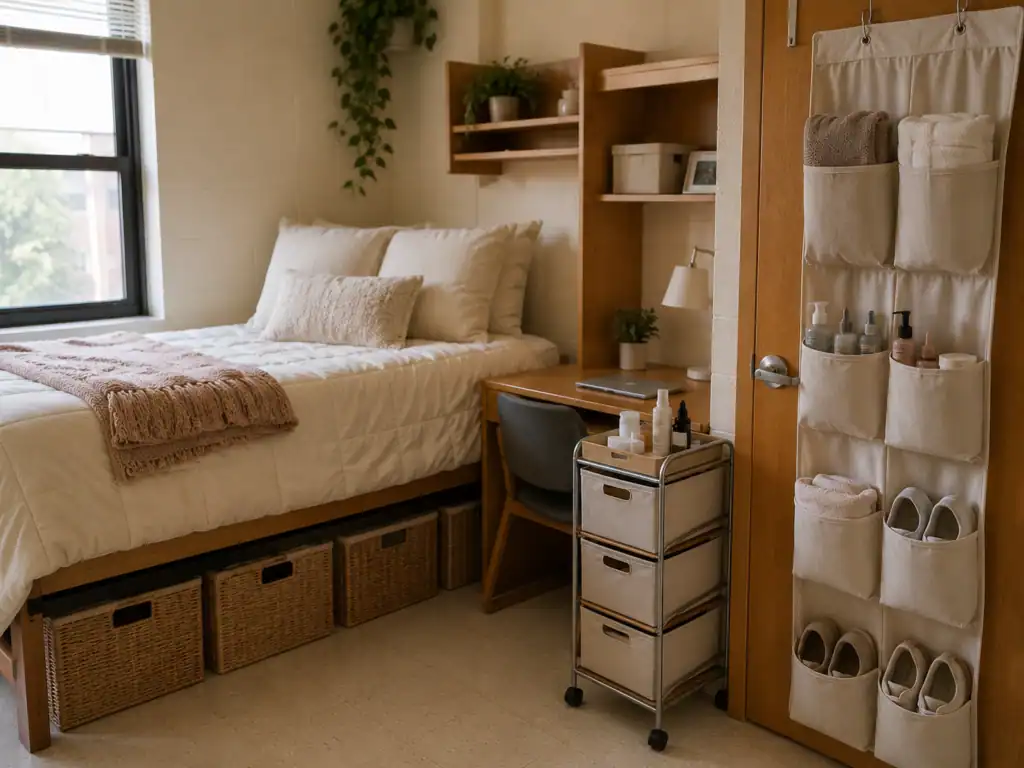
Small rooms live or die on storage, but that doesn’t mean storage has to look like a logistics warehouse. Low-profile under-bed storage bins solve the “where do I put off-season clothes” problem without eating floor space — most standard dorm frames give you 6 to 8 inches of clearance, so look for bins in that range (7-inch bins are the safest bet across most bed heights) and measure before you buy rather than after. A hanging closet organizer doubles your closet’s usable space instantly, and a 6-shelf version usually fits standard dorm closet rods without needing to be trimmed. An over-the-door shoe organizer works just as well for skincare products, snacks, and school supplies as it does for shoes — just check the door thickness first, since some fit over standard doors only and won’t clear a fire door.
Baskets and bins in colors or patterns you actually like turn “storage” into “decor” — instead of hiding clutter in ugly plastic tubs, you’re displaying it in something that matches your comforter. A rolling storage cart tucked beside the desk can hold everything from art supplies to extra chargers, and it moves when you need floor space for guests or vacuuming. Look for a cart around 11 to 12 inches wide with 3 drawers — narrow enough to slide into the gap beside most built-in desks, but deep enough to actually hold something.
Build a Study Corner You Actually Want to Sit In
Most built-in dorm desks are functional but soulless — bare wood or laminate, a single overhead shelf, and a chair that wasn’t designed with comfort in mind. A cushion or seat pad instantly makes the provided chair usable for more than twenty minutes at a time.
Add a small desk organizer for pens and notebooks, a corkboard or magnetic board (usually allowed since it doesn’t damage walls) for reminders and photos, and a plant — real if your window gets light, faux if it doesn’t — and suddenly the desk stops looking like a workstation and starts looking like a spot you’d choose to sit in on purpose. For the desk lamp itself, aim for somewhere around 450 to 800 lumens with an adjustable color temperature between 3000K (warmer, better for evening) and 5000K (cooler, better for focused daytime work) — a lamp that only does one temperature will eventually annoy you at either 8am or 11pm.
One unglamorous but genuinely essential purchase here: a power strip with surge protection. Dorm rooms are famously short on outlets, and you’re about to plug in a laptop, a lamp, a phone charger, and probably a mini fridge into the same wall. Look for one with at least 6 outlets and a joule rating of 900 or higher, and check your housing handbook before you buy — most schools explicitly ban power strips without a circuit breaker, and all of them ban space heaters and extension cords that aren’t surge-protected, since those are the actual fire-risk culprits in dorm buildings.
Cover the Walls Without Committing to Them
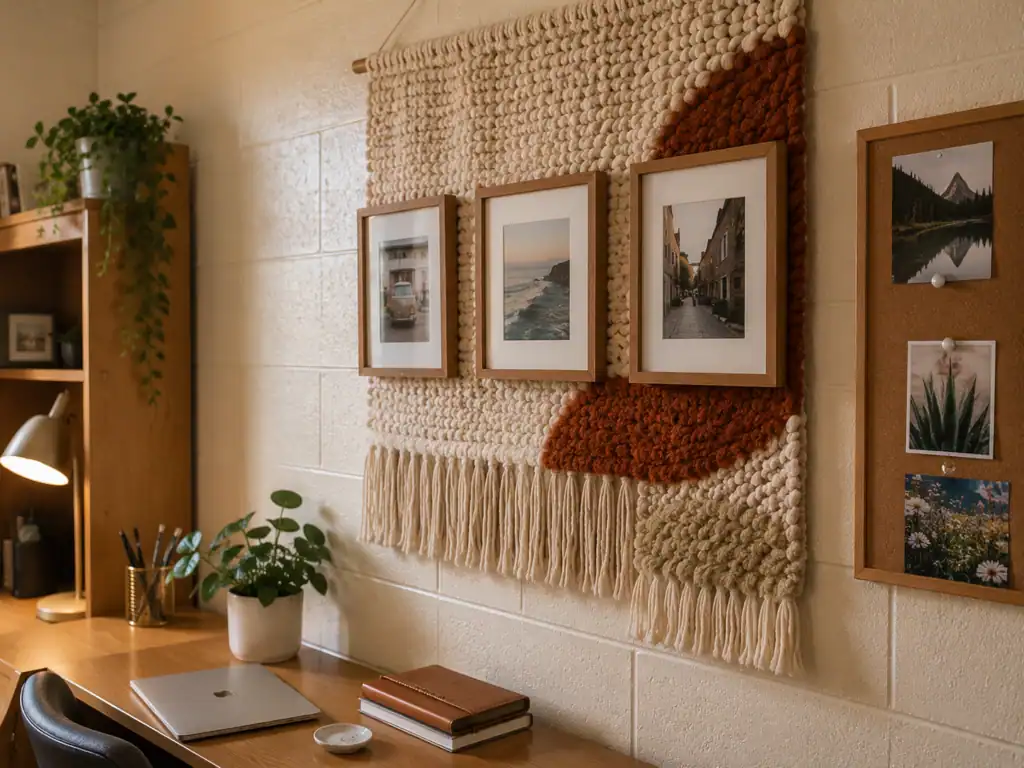
Walls are usually the biggest canvas in a college bedroom and also the most restricted. This is where removable decor earns its keep. A large wall tapestry — a 51×59 inch size covers most of a standard dorm wall section without looking sparse, while a 71×91 inch works better behind a lofted bed — covers huge sections of wall instantly and adds texture without a single nail. Command hooks and picture-ledge strips let you display photos and art like a little gallery, and everything comes down clean at move-out. Match the rated weight to what you’re actually hanging: small strips hold about 1 pound, medium around 3 pounds, and large strips or hooks up to 5 to 7 pounds — that’s the detail people skip and then regret when a frame ends up on the floor at 2am.
Peel-and-stick wallpaper on just one accent wall — or even just behind the headboard — gives the illusion of a fully designed room for a fraction of the cost and effort of wallpapering the whole space. Poster frames with clips are another underrated trick: swap the poster inside whenever you get bored, no new holes required. A tension rod is another quiet workhorse here — a 24 to 36 inch adjustable rod fits most closet alcoves and bed-frame gaps, while a wider 42 to 72 inch rod spans the underside of a lofted bed for a curtain or privacy divider, all without touching the wall at all.
Best Dorm Room Color Schemes
Once the walls are sorted, color is really what ties a dorm room together — and it’s also the cheapest way to make a rented, temporary space feel deliberate rather than default. Here’s how to actually pull off each of these on a student budget, not just what they look like.
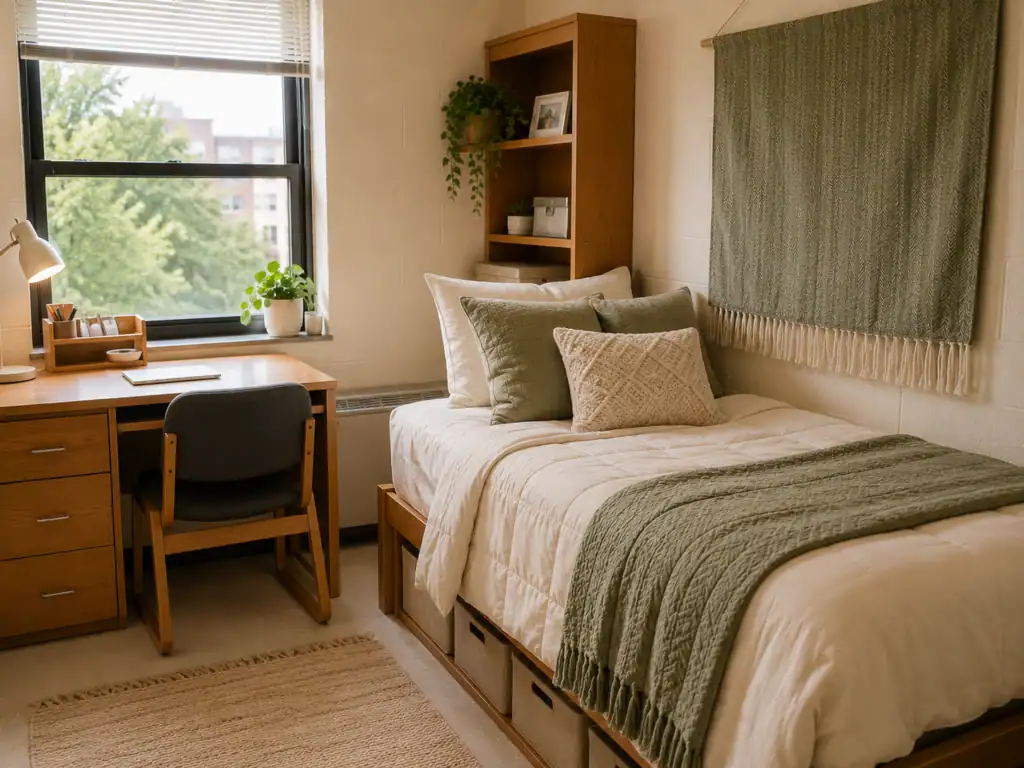
- Warm neutral (cream, terracotta, soft brown): Get there with one terracotta or rust comforter and cream sheets — that’s your biggest color investment, and it’s usually the same price as any other bedding set. Fill in with a thrifted wooden picture frame or two (a coat of $6 spray paint in a warm brown fixes any frame that doesn’t match) and a jute or woven rug, which reads as “warm neutral” instantly and is one of the cheaper rug materials available.
- Sage and cream: A sage green tapestry or a couple of sage throw pillows against white or cream bedding gets you 90% of the way there — you don’t need to repaint or wallpaper anything green since fabric carries the color for you. Add a cream rug and one light wood accent (a bamboo desk organizer or a light wood frame) to finish it.
- Moody academia (navy or forest green with brass/gold): This one’s cheapest to fake with accessories rather than big pieces — navy or forest bedding plus a couple of brass or gold Command hooks and picture frames (gold spray paint works fine on plain black frames) gets the look without a big furniture spend. Best saved for rooms with a real window, since the darker palette needs actual daylight to avoid feeling like a cave.
- Soft pastel (blush, lavender, baby blue): White bedding as your base, then one pastel item doing the heavy lifting — a lavender or blush comforter, or a pastel tapestry if you’d rather keep sheets neutral and swappable. Pastel accessories (a desk organizer, a lamp shade) are usually cheaper secondhand finds than pastel furniture, so shop thrift stores for the smaller pieces first.
- Monochrome with one accent (black/white/gray plus one bold color): The cheapest palette on this list to execute, since black, white, and gray bedding and frames are the most common secondhand and clearance finds. Pick one accent color — mustard, rust, or cobalt — and let it show up in exactly two or three spots: one pillow, one frame, one small rug. Resist adding a fourth; that’s what keeps this palette looking curated instead of random.
Whichever palette you pick, let it show up in three places minimum — bedding, wall art, and one storage piece — and the room will read as coordinated even if you bought everything from five different stores over three separate weeks.
Add the Small Touches That Make It Feel Like Yours
This is the part people skip because it feels less “productive” than furniture and storage, but it’s honestly the part that matters most. A few framed photos of people you love. A small speaker for music while you get ready. A scent — whether that’s a plug-in, a wax warmer where allowed, or just really good laundry detergent — that becomes the smell you associate with home.
You don’t need fifty decorations. You need five or six things that are actually meaningful, displayed with intention, rather than a cluttered shelf of stuff you bought because it looked good in someone else’s dorm room video. A soft area rug is worth including on that short list, too — it covers cold, scuffed dorm flooring, softens the acoustics of a hard-walled room, and does more to make a space feel “finished” than almost anything else on this list. Size-wise, a 5×7 rug works well if it’s just anchoring your side of a shared double, while a 4×6 or even 3×5 is a better fit for a single or a genuinely tiny room — err smaller rather than bigger, since a rug that gets tucked half-under furniture looks like an accident rather than a choice.
Coordinate (Gently) With Your Roommate
If you’re sharing the space, a five-minute conversation before move-in saves a lot of awkwardness later. You don’t need matching bedding, but agreeing on a rough color palette — even just “cool tones” versus “warm tones” — keeps the room from feeling visually chaotic when you’re staring at two completely clashing halves of a tiny box.
It’s also worth splitting a few shared items instead of doubling up: one mini fridge, one bigger rug that spans both sides, one set of closet organizers you split evenly. It stretches your budget further and usually ends up looking more intentional than two separately decorated halves.
But the color palette conversation is really just the easy part. Here’s where things actually get tested during the year, and what tends to work:
One of you is messy, one of you isn’t. This is probably the single most common source of roommate friction, and decor can genuinely help. Give the messier roommate generous, low-effort storage on their side specifically — an open-front bin is easier to actually use than a bin with a lid, since friction (even the tiny friction of removing a lid) is often the whole reason things end up on the floor instead. Don’t frame it as “fixing” them; frame it as making their system easier to keep up with.
Wildly different schedules. If one of you is up at 6am and the other’s still asleep at 10, a simple blackout curtain or eye mask solves more conflict than any conversation will. A small clip-on lamp instead of the overhead light lets an early riser get ready without lighting up the whole room for someone trying to sleep in.
Noise and light sensitivity in general. A cheap set of earplugs and a genuinely good eye mask, kept on hand from week one, prevent a lot of “can you turn that down” tension before it starts. It sounds almost too simple, but most roommate disputes about noise or light happen because neither person has an easy workaround, not because either person is being unreasonable.
Decor disagreements. If you disagree about a shared item — a rug, a fridge, a piece of furniture in the common space — the fairest fix is usually splitting the cost and picking something neutral enough that neither of you hates it, rather than one person “winning” and picking their favorite. Save the strong personal style choices for your own side of the room, where nobody else has to live with your opinion on color.
One item that’s worth buying individually rather than splitting, though: a proper laundry hamper. A collapsible one that fits in a closet corner keeps dirty clothes from becoming a visible pile on someone’s side of the room, which — trust me — is the single most common source of low-grade roommate tension nobody talks about. Look for a collapsible hamper around 13x13x24 inches; anything bigger tends to eat closet space you don’t have, and anything smaller fills up before laundry day actually rolls around.
And if a real conflict does come up that decor and workarounds can’t fix — genuinely incompatible sleep schedules, repeated boundary issues, anything beyond normal adjustment — most schools have an RA or housing office process specifically for this. Using it isn’t a failure; it’s what it’s there for.
Flying to Campus? Here’s How to Handle Bulky Items
If you’re not driving to school — flying in, taking a train, or just don’t have a car at home — the biggest items on this list (rugs, storage bins, a mattress topper) are the ones that’ll actually give you trouble, not the small decor pieces. A few ways around it:
Ship ahead instead of packing. Most colleges accept packages addressed to your name and dorm assignment before move-in day, often up to two or three weeks early — check your housing portal for the exact policy. Ordering the bulky stuff online and having it waiting for you when you arrive is far easier than trying to check a rug as luggage.
Order for local pickup near campus. If your school is in or near a city, retailers often have same-day pickup at a store within walking or rideshare distance, which means you can buy the heavy stuff after you land rather than transporting it yourself. It also means you can skip the rug or the cart if you decide, once you see the room, that you don’t actually need it.
Buy secondhand from students who are leaving. Every campus has some version of an end-of-year or move-out marketplace — a Facebook group, a bulletin board, an app — where graduating or departing students sell rugs, mini fridges, and storage carts for next to nothing rather than hauling them home. It’s often cheaper than buying new, and there’s zero shipping or carrying involved.
Prioritize what’s actually hard to replace with something small. Bedding, an LED strip, Command hooks, and a desk lamp all fit in a suitcase easily. Rugs, storage carts, and mattress toppers don’t — so if you can only bring what fits in checked luggage, that’s the group to buy locally or have shipped instead of packing.
Special Situations: Single Rooms, Triples, Transfers, and Moving In Late
Most of this guide assumes a standard shared double, but plenty of readers aren’t in that exact situation. Here’s how the approach shifts:
Single rooms. No roommate to coordinate with means no compromise on color palette or layout — but it also means no one splitting costs with you on a rug or a mini fridge. The upside is you can commit fully to one of the color schemes above without worrying about a clashing other half. The tradeoff is a slightly smaller decorating budget doing all the work alone, so lean harder into the “under $100” tier and add pieces gradually.
Triples. Three people in a room built for two means storage and layout matter more than decor, full stop. Vertical storage (over-the-door organizers, closet organizers, under-bed bins) stops being optional and becomes the only way to keep the room functional. Splitting shared items three ways — one rug, one mini fridge, one set of storage carts — also stretches noticeably further than the two-person math in the roommate section above.
Transfer students. If you’re coming in mid-year or as a junior transfer, you often get less lead time and less say in room assignment, sometimes moving into a room your new roommate has already half-decorated. Don’t feel obligated to match their exact style — a couple of coordinating accent pieces (one shared-color pillow, a frame in a similar tone) usually bridges two different aesthetics better than trying to redecorate their side to match yours.
Very small rooms. If your room runs on the smaller end of that 130-to-250-square-foot range, skip the rolling cart and the bigger rug tier entirely — a single multi-purpose piece (a storage ottoman that also seats a friend, an under-bed bin set instead of a cart) does more good than a room full of smaller single-purpose items competing for the same few square feet of floor.
Moving in after your roommate has already decorated. This happens more than people expect — a schedule conflict, a delayed flight, a room reassignment. If you’re arriving second, resist the urge to compete with what’s already up. Ask what color palette or vibe they’ve gone with, then build your side to complement rather than clash. It’s a much faster path to a room that feels cohesive than trying to out-decorate a head start.
Budget Breakdown
You don’t need a huge budget to make a college bedroom feel good. Thrifted frames, a secondhand rug, a couple of plants from a discount store, and a strand of warm LED lights can transform a room for well under a hundred dollars. The trick is prioritizing the few things that touch your senses most directly — lighting, bedding, and one or two personal touches — rather than spreading a small budget thin across dozens of tiny purchases. Here’s roughly what that looks like at three different spending levels.
Under $100: One strand of LED strip lights, a set of Twin XL sheets in a color you actually like, two or three Command hooks for photos, and a small plant. Skip the rug and the tapestry for now — they’re the first things to add once you have a little more room in the budget, and everything above still transforms the room noticeably on its own.
Around $250: Everything in the first tier, plus a proper mattress topper, a small area rug, a wall tapestry or a few framed prints, and a rolling storage cart or a couple of under-bed bins. At this level the room starts to feel genuinely designed rather than just “decorated.”
$500 and up: Everything above, plus a real investment piece — a quality desk lamp, a lofting kit if your bed allows it, a nicer comforter set, and a second layer of storage (hanging closet organizer plus a rolling cart). This is also the range where it’s worth spending a bit more on a genuinely good mattress topper, since you’ll be sleeping on it for nine months.
Here’s the same breakdown side by side, including what’s genuinely fine to wait on if you’re short on cash or time this week:
| Budget | Buy Now | Can Wait |
|---|---|---|
| Under $100 | Twin XL , LED strip lights, 2–3 Command hooks, a small plant | Rug, tapestry, mattress topper, storage cart |
| Around $250 | Everything above, plus a mattress topper, small area rug, wall tapestry or frames | Rolling cart, second storage layer, upgraded desk lamp |
| $500+ | Everything above, plus a rolling cart, hanging closet organizer, upgraded lamp | Lofting kit (only if you’re sure you’ll use it), nicer comforter set |
Dorm Room Mistakes to Avoid
Just as useful as knowing what to do is knowing what trips people up every single move-in season. It splits into two categories: mistakes made while decorating, and mistakes made while shopping — and they trip people up differently.
Decorating & Organizing Mistakes
- Decorating before measuring. A rug that’s too big, a rolling cart that doesn’t fit past the desk, a tapestry that swallows the whole wall — measure the room and your furniture before you order anything.
- Ignoring the housing handbook. Getting a move-out damage fee for nails or paint is an entirely avoidable expense. Read the rules once, at the start, rather than finding out the hard way in May.
- Overbuying decor and underbuying function. A gorgeous room with nowhere to put your laundry or charge your phone gets frustrating fast. Function first, aesthetics second — the two aren’t actually in competition if you plan for both.
- Skipping the roommate conversation. Buying everything before you’ve talked palettes and shared items almost always means someone’s stuff gets replaced or awkwardly clashes for a full semester.
- Forgetting the room isn’t permanent. Investing heavily in decor you can’t take with you, or that only fits this exact room’s dimensions, means starting from scratch again next year. Favor pieces that’ll move with you.
Shopping Mistakes
- Buying regular twin sheets instead of Twin XL. It’s the single most returned dorm purchase for a reason — always double-check the dimensions before you buy bedding.
- Ordering everything before you’ve seen the room. Photos from the housing portal rarely show true scale. If you can, wait until move-in day for anything with a firm size (rugs, carts) and order it for local pickup or fast shipping instead of packing it blind.
- Not checking the return policy on bulky items. A rug or storage cart that doesn’t fit is a real hassle to return once you’ve hauled it up three flights of stairs. Buy from retailers with easy returns for anything you’re not 100% sure about.
- Buying the cheapest version of daily-use items. A bargain mattress topper or desk chair cushion that flattens out by October costs more in the long run than a slightly better one up front. Save the ultra-budget choices for things you’ll touch occasionally, not daily.
- Duplicating big-ticket items with your roommate. Two mini fridges in one shared double is a common and entirely avoidable waste of both money and floor space — one quick message before you both order solves it.
Decorating Timeline
Good dorm decorating isn’t a single weekend sprint — it goes smoother when it’s spread out. Here’s roughly how to pace it:
6–8 weeks before move-in: Talk to your roommate about color palette and shared items. Take stock of what you already own that can be reused. Start browsing — but hold off on buying — bedding, lighting, and storage.
3–4 weeks before move-in: Order the big items: bedding, mattress topper, LED lights, and any large storage pieces. These are the things you don’t want to be scrambling for the week of, especially if anything needs to be returned or exchanged. If you’re flying in or shipping items ahead to campus, this is also the window to check your housing portal for package acceptance dates.
1–2 weeks before move-in: Order the smaller finishing pieces — Command hooks, a tapestry, a desk organizer, picture frames. Start packing decor items separately from everyday essentials so they’re easy to unpack first.
Move-in day: Set up furniture layout first, before a single decoration goes up. Get the bed, desk, and storage placed the way you want them, then layer in lighting, then wall decor, then the small personal touches last.
First two weeks of the semester: Live in the room before making final decisions on anything you’re unsure about. You’ll quickly learn where the natural light actually falls, which corner gets used and which doesn’t, and what still needs tweaking — much better to adjust in week two than to have over-committed on day one.
Dorm Essentials Shopping List
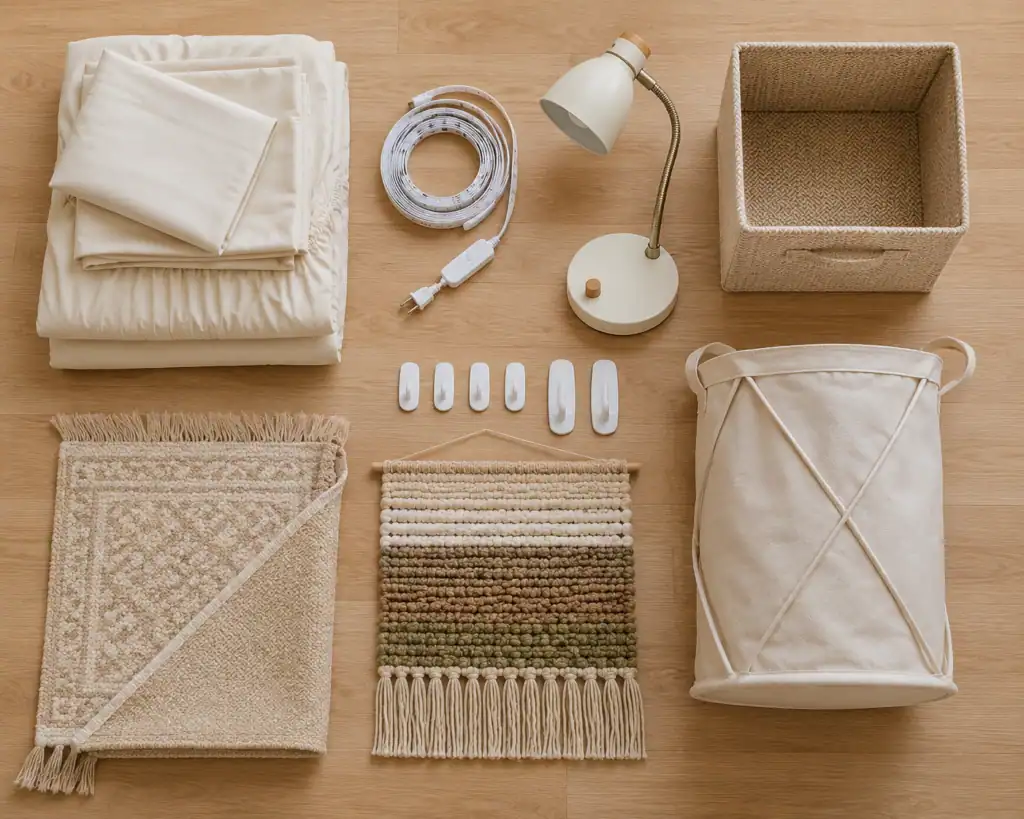
If you just want the condensed version to work from while you shop, here’s the full list in one place, with the quick specs worth remembering:
- Amazon Basics Twin XL Microfiber Sheet Set – College Dorm Bedding Essential
- PERLECARE 3-Inch Gel Memory Foam Mattress Topper – Twin XL
- Govee RGBIC Smart LED Strip Lights (16.4 ft) – Wi-Fi & Bluetooth, Works with Alexa & Google Assistant
- LitONES LED Desk Lamp with Clamp – Eye-Caring, Adjustable Gooseneck, Stepless Dimming & Color Modes
- TidyCorner 2-Pack Under Bed Storage Containers – Low Profile Fabric Storage Bins (4.5″ Tall)
- Command Medium Utility Hooks Value Pack (7 Hooks, 12 Command Strips) – Damage-Free Hanging
- YASONIC 3-Tier Rolling Storage Cart with Wheels – Multi-Purpose Metal Utility Organizer
- Household Essentials Mesh Pop-Up Laundry Hamper – Collapsible Laundry Basket with Carry Handles
- RELEANY Washable Area Rug – Vintage Abstract Non-Slip Living Room & Bedroom Rug (5′ x 7′)
- Ivilon Spring Tension Curtain Rod – Adjustable, No-Drill Shower & Window Rod (Multiple Sizes Available)
- Alyvia Decor Boho Wall Tapestry – Large Aesthetic Fabric Wall Hanging for Bedroom & Dorm Room
- Power strip with surge protection — 6+ outlets, 900+ joules
None of this needs to be bought in one trip, and almost none of it needs to be expensive. Use the budget table above to decide what to grab now versus what can wait, and you’ll end up with a room that feels complete rather than half-finished.
Our Top Picks, Selected by TechNest Decor
Amazon Basics Twin XL Microfiber Sheet Set – College Dorm Bedding Essential
- Ultra-soft brushed microfiber feels comfortable from the first night
- Twin XL size is perfect for standard college dorm mattresses
- 14-inch deep pockets keep the fitted sheet securely in place
$10
Buy on Amazon →
Pros
- Ultra-soft brushed microfiber feels comfortable from the first night
- Twin XL size is perfect for standard college dorm mattresses
- 14-inch deep pockets help keep the fitted sheet securely in place
Cons
- Made from polyester microfiber rather than natural cotton
- Some users report pilling after extended use, depending on washing habits
- Lightweight fabric may feel too thin for those who prefer heavier sheets
PERLECARE 3-Inch Gel Memory Foam Mattress Topper – Twin XL
- 3-inch gel-infused memory foam provides excellent pressure relief for dorm mattresses
- Cooling gel helps dissipate heat for a more comfortable night’s sleep
- CertiPUR-US certified foam made without harmful chemicals
$142.49
Buy on Amazon →
Pros
- Excellent pressure relief for dorm mattresses
- Cooling gel helps dissipate heat
- CertiPUR-US certified, no harmful chemicals
- Improves comfort without replacing the mattress
- Eases pressure on shoulders, hips, and back
- Ships compressed for easy move-in transport
Cons
- Needs 24–72 hours to fully expand
- Mild “new foam” odor for the first day or two
- May retain more heat than expected for some sleepers
- Adds ~3 inches, so deep-pocket sheets are recommended
Editor’s Tip: For most college dorms, pair this topper with Twin XL sheets featuring 14–16 inch deep pockets to ensure a secure fit after adding the extra foam layer.
Govee RGBIC Smart LED Strip Lights (16.4 ft) – Wi-Fi & Bluetooth, Works with Alexa & Google Assistant
- RGBIC technology displays multiple colors on the strip at once for dynamic lighting effects
- Wi-Fi and Bluetooth connectivity through the Govee Home app for easy customization
- Compatible with Alexa and Google Assistant for hands-free voice control
Pros
- Multiple colors on one strip at the same time (RGBIC)
- Works with Alexa and Google Assistant
- Wi-Fi + Bluetooth control via the Govee Home app
- 16M+ colors, 60+ scene modes, DIY effects
- Music Sync mode reacts to sound in real time
- Bright, energy-efficient, adjustable brightness
- Peel-and-stick install on desks, headboards, or shelves
Cons
- Can’t be cut and reconnected without affecting lighting zones
- May need extra clips on textured or painted cinderblock walls
- Requires a nearby power outlet
- Some features need the app and a stable Wi-Fi connection
LitONES LED Desk Lamp with Clamp – Eye-Caring, Adjustable Gooseneck, Stepless Dimming & Color Modes
- Eye-caring LED light reduces glare and eye strain during long study sessions
- Stepless brightness + multiple color temperature modes (Warm, Natural, Cool White)
- Flexible 360° gooseneck allows precise light positioning
Pros
- Space-saving clamp design frees up desk space
- Energy-efficient LEDs, long lifespan, low power use
- Memory function remembers your last settings
- Easy to install on most dorm desks and shelves
Cons
- Clamp may not fit every desk edge style
- No wireless or USB charging ports included
- Power cord may be shorter than expected for some setups
- Not battery-powered; needs a nearby outlet
TidyCorner 2-Pack Under Bed Storage Containers – Low Profile Fabric Storage Bins (4.5″ Tall)
- Low-profile 4.5-inch height fits under most dorm beds with limited clearance
- Reinforced sidewalls and PP board base help bins keep their shape, even when full
- Large transparent top window lets you identify contents without opening the bin
Pros
- Dual zipper closure protects items from dust
- Reinforced fabric handles for easy sliding under the bed
- Foldable design for compact storage when not in use
- Great for bedding, sweaters, shoes, towels, off-season clothing
Cons
- Not waterproof — avoid damp environments
- Not for very heavy items like books or bulky equipment
- Some dorm bed frames sit lower than expected — measure first
- Not intended for secure stacking when fully loaded
Editor’s Tip: Before purchasing any under-bed storage bins, measure the clearance from the floor to the bottom of your dorm bed. Most dorm-friendly storage bins require at least 5 inches of clearance for easy access.
Command Medium Utility Hooks Value Pack (7 Hooks, 12 Command Strips) – Damage-Free Hanging
- Damage-free adhesive removes cleanly, no holes or wall damage
- Each medium hook holds up to 3 lbs on smooth indoor surfaces
- No tools, nails, screws, or drilling required — ideal for strict dorm housing rules
Pros
- Easy to reposition by swapping just the adhesive strip
- Great for backpacks, hats, keys, towels, organizers, decor
- Trusted 3M Command brand, reliable adhesive performance
Cons
- Best on smooth surfaces; may not adhere well to rough cinderblock
- Exceeding the 3 lb weight limit can cause the hook to fall
- Needs proper surface prep and a 1-hour wait for strongest bond
- Not recommended for valuable or fragile objects
Editor’s Tip: Before purchasing, check your dorm’s wall type. Command Hooks perform best on smooth painted walls. If your dorm has exposed cinderblock walls, use them on painted sections, furniture, mirrors, or other smooth surfaces whenever possible for the most secure hold.
YASONIC 3-Tier Rolling Storage Cart with Wheels – Multi-Purpose Metal Utility Organizer
- Three spacious mesh baskets for school supplies, toiletries, snacks, or cleaning essentials
- Slim, space-saving design fits beside a dorm desk, bed, or inside a closet
- Smooth-rolling 360° swivel wheels with lockable casters for easy, secure movement
Pros
- Durable metal frame with ventilated mesh baskets improves airflow, reduces dust
- Quick, straightforward assembly with included hardware
- Versatile: study cart, bathroom organizer, snack station, or beauty storage
Cons
- Mesh baskets may let very small items slip through
- Not built for heavy textbooks or large appliances
- Assembly required before use
- Feels narrow for larger bins or bulky supplies
Editor’s Tip: Place a rolling cart between your desk and bed to create an easy-access storage station. Use the top shelf for daily essentials, the middle shelf for school supplies, and the bottom shelf for extra toiletries, cleaning products, or snacks to keep your dorm organized without taking up valuable floor space.
Household Essentials Mesh Pop-Up Laundry Hamper – Collapsible Laundry Basket with Carry Handles
- Lightweight pop-up design opens instantly and folds flat for easy storage
- Breathable mesh fabric promotes airflow, helping reduce moisture buildup and odors
- Large capacity easily holds a week’s worth of clothes for most college students
Pros
- Reinforced carrying handles for comfortable laundry room trips
- Durable steel frame stays in shape while remaining lightweight
- Takes up very little space when not in use
- Affordable and practical for students on a budget
Cons
- Mesh fabric offers less privacy since clothing is visible
- Not suitable for very heavy loads over long distances
- Frame may bend if compressed under heavy items
- No separate compartments for sorting lights and darks
Editor’s Tip: Store your laundry hamper inside the closet or beside your desk to keep it out of walkways. If your dorm has communal laundry facilities, consider keeping a small mesh bag inside the hamper for socks and other delicate items to prevent them from getting lost during wash day.
RELEANY Washable Area Rug – Vintage Abstract Non-Slip Living Room & Bedroom Rug (5′ x 7′)
- Soft, low-pile surface feels comfortable underfoot while remaining easy to clean
- Machine washable design makes it simple to maintain — ideal for busy college students
- Built-in non-slip backing keeps the rug securely in place without a separate rug pad
Pros
- Neutral vintage-inspired pattern fits most dorm color schemes
- Thin profile fits under desks, chairs, and furniture — no tripping hazard
- Foldable, easy to transport during move-in and move-out
- Durable enough for everyday, high-traffic use
Cons
- Less cushioning than thicker plush rugs (low-pile)
- Temporary creases after unpacking, usually flatten over time
- Light colors may need more frequent cleaning
- Not intended for outdoor use or damp areas
Editor’s Tip: A 5′ × 7′ area rug is the ideal size for most double dorm rooms. Position it so the front legs of your bed and desk rest on the rug to create a cozy, defined living space while keeping walkways clear.
Ivilon Spring Tension Curtain Rod – Adjustable, No-Drill Shower & Window Rod
- No-drill, spring-loaded installation — perfect for dorm rooms where wall damage isn’t allowed
- Strong tension design holds securely between walls without screws or tools
- Available in multiple adjustable lengths to fit windows, closets, under-loft areas, or dividers
Pros
- Durable rust-resistant steel with a modern matte finish
- Non-slip rubber end caps protect walls and improve grip
- Quick to install, remove, and reuse during move-out
- Great for curtains, privacy panels, closet organizers, or storage
Cons
- Requires two solid, parallel surfaces for proper installation
- Not suitable for very heavy blackout curtains or large dividers
- Incorrect sizing may reduce stability — measure beforehand
- May need occasional tightening after extended use
Editor’s Tip: For most dorm rooms, choose a 24–36 inch tension rod for small alcoves or closet spaces, and a 42–72 inch model for under-loft storage or wider window openings. Always measure the opening before purchasing to ensure a secure fit.
Alyvia Decor Boho Wall Tapestry – Large Aesthetic Fabric Wall Hanging for Bedroom & Dorm Room
- Large fabric tapestry instantly transforms plain dorm walls without permanent decoration
- Soft polyester fabric is lightweight, wrinkle-resistant, and easy to fold for storage
- Neutral boho-inspired design complements modern, minimalist, and cozy dorm aesthetics
Pros
- Available in multiple sizes for different wall layouts and bed setups
- Easy to hang with Command Strips or removable adhesive hooks
- Covers large cinderblock sections, warms up the room
- Machine washable for easy cleaning all school year
Cons
- May need steaming or ironing to remove fold lines after unpacking
- Colors may look slightly different depending on lighting
- Hanging hardware typically sold separately
- Thin fabric — for decoration, not blackout or sound insulation
Editor’s Tip: For most dorm rooms, a 51 × 59-inch tapestry works well as an accent above a desk or bed, while a 71 × 91-inch tapestry creates a dramatic backdrop behind a lofted bed or across a large cinderblock wall. Pair it with Command Picture Hanging Strips for easy, damage-free installation.
Amazon Basics 6-Outlet Surge Protector Power Strip with 2-Foot Extension Cord
- Six grounded outlets provide plenty of space for charging a laptop, phone, desk lamp, fan, and other dorm essentials
- Surge protection helps safeguard electronics from unexpected power spikes
- Compact, space-saving design fits easily behind a desk, bed, or entertainment setup
Pros
- Six grounded outlets provide plenty of space for charging a laptop, phone, desk lamp, fan, and other dorm essentials
- Surge protection helps safeguard electronics from unexpected power spikes
- Compact, space-saving design fits easily behind a desk, bed, or entertainment setup
- 2-foot extension cord offers added flexibility when wall outlets are hard to reach
- Built-in power switch with an indicator light makes it easy to turn connected devices on or off
- Durable construction from the trusted Amazon Basics brand
- Excellent value for students setting up a dorm room on a budget
Cons
- The 2-foot cord may be too short for some dorm room layouts
- Does not include USB-A or USB-C charging ports
- Not designed for high-power appliances such as mini refrigerators, microwaves, or space heaters
- Some universities require power strips with specific safety certifications, so check your dorm’s housing guidelines before purchasing
Editor’s Tip: Choose a surge-protected power strip instead of a basic extension cord. Many college residence halls require surge protection for safety, and it’s one of the easiest ways to protect valuable electronics from power surges while keeping your dorm setup organized.
Wrapping It Up
Here’s what I keep coming back to, years after that first cinderblock room: nobody remembers the exact rug or the exact shade of sage green. What they remember is whether the room felt like theirs by the end of the year — whether it was a place they wanted to come back to after a bad exam, not just a place they slept.
A college bedroom will never be a blank canvas in the traditional sense. You’re working around rules you didn’t write, a roommate you didn’t choose, and a space built for efficiency instead of personality. But that’s exactly the puzzle worth solving — and it’s a solvable one. A bed that actually feels like yours, storage that doubles as decor, a color palette you picked on purpose, and a handful of things that matter to you: that’s the whole formula, and none of it requires a big budget or a perfect first attempt.
So don’t wait until the room is “finished” to start living in it. Put up the first three things this week — whatever they are — and let the rest fill in as the semester teaches you what the room actually needs. That’s genuinely the only way any of this gets figured out.
Tell me what you’re starting with. Whether it’s the lighting, the layout, or just finally buying sheets that fit — drop it in the comments. I read every one, and I’d love to see how your room turns out by move-out day.
Frequently Asked Questions About College Bedroom Ideas
Can I bring furniture from home instead of buying new?
Usually yes, as long as it fits your school’s fire-safety rules (no upholstered furniture that isn’t labeled fire-retardant, in most cases) and fits through the door and up the stairs or elevator. Measure both the piece and the doorway before you commit to hauling something across the country — it’s a rough surprise to discover a couch doesn’t clear a stairwell turn.
What if I don’t get along with my roommate’s decorating style at all?
You don’t have to match styles — you just need to avoid actively clashing. Pick one or two neutral connecting elements (a shared rug color, similar-toned frames) that bridge both halves visually, and keep your strongest personal style choices to your own side of the room, where it’s genuinely just your call.
How do I decorate a dorm room if I’m arriving after everyone else?
Ask your roommate what palette or vibe they’ve already committed to, then build around it rather than against it. Arriving late isn’t a disadvantage decor-wise — it actually means you know exactly what you’re coordinating with, instead of guessing.
What’s actually worth buying versus renting or buying secondhand?
Anything you’ll use daily and that affects comfort — the mattress topper, the desk lamp, the pillow — is worth buying new. Bigger, one-time items like a mini fridge, a rug, or a storage cart are excellent secondhand candidates, especially from students leaving campus at the end of a term.
Do single dorm rooms need less decorating effort than shared ones?
Less coordination, not necessarily less effort. You get full control over the palette and layout without compromise, but you’re also covering the whole room’s personality on your own, so it’s worth spreading purchases out rather than trying to furnish the entire space in one trip.
What should I do if I can’t fit everything I want in my dorm room?
Prioritize function over quantity: one storage piece that does two jobs (a storage ottoman, an under-bed bin set) beats three smaller single-purpose pieces competing for the same floor space. If you genuinely can’t fit something you love, it’s usually a sign to save it for your next apartment instead of forcing it into this room.