Make Your Home Smarter, One Step at a Time

I replaced every bulb in my house with LEDs three years ago, and I still remember standing in the lighting aisle beforehand, completely stuck. Daylight or soft white? 60-watt or 100-watt equivalent? Was I about to spend twenty dollars on bulbs that would somehow make my electric bill worse? If you’ve ever stood in that same aisle scrolling through your phone trying to remember whether you wanted “warm” or “cool” light, you already know how confusing this should-be-simple decision has become.
Here’s the thing: light bulbs aren’t just a wattage number anymore. They’re a small but real lever on your monthly power bill, they can affect how well you sleep, and for some people, they’re even a health consideration. This guide pulls together the questions people actually ask about energy saving light globes — the practical ones about cost and efficiency, and the less obvious ones about sleep and light sensitivity — so you can walk into that aisle (or scroll that Amazon page) knowing exactly what to grab.
Table of Contents
Key Takeaways
- LEDs use roughly 80–90% less electricity than incandescent bulbs and last 15–25 times longer, which is why they’ve become the default energy saving light globe.
- Daylight (5000K) and soft white (2700K–3000K) aren’t about “better” or “worse” — they’re about matching the light to the room and the time of day.
- A 60-watt incandescent bulb running 24 hours costs around 27 cents at today’s average U.S. electricity rate. The LED equivalent costs about 4 cents for the same 24 hours.
- Warm, low-Kelvin light in the evening protects your melatonin production; cool, blue-heavy light suppresses it — this matters more than most people realize for sleep quality.
- People with lupus or other photosensitive conditions should be especially cautious with fluorescent and CFL bulbs, which emit more UV than incandescent or LED options.
Which Light Globes Are Actually the Most Energy-Efficient?
Let’s settle this one first, because it comes up in every version of this question: LED wins, and it isn’t close. A standard incandescent bulb turns about 90% of the electricity it uses into heat and only a sliver into actual light. An LED flips that ratio. A modern LED delivering the same brightness as an old 60-watt incandescent typically draws somewhere between 8 and 9 watts — an 85% or greater reduction in electricity use for identical light output.
Settings saved.
CFL bulbs (the curly compact fluorescents that were the “energy saving” default a decade ago) sit in the middle. They’re more efficient than incandescent, but noticeably less efficient than LED, and they carry a downside we’ll get to shortly: mercury content and higher UV output. If you’re still holding onto CFLs somewhere in your house “because they’re already energy efficient,” it’s worth knowing that LED has genuinely leapfrogged them on every metric that matters — efficiency, lifespan, and safety.
The other number worth understanding is lumens per watt, or how much actual light you get for the electricity you spend. A basic incandescent bulb produces around 15 lumens per watt. A quality LED produces 80 to 100+ lumens per watt. That’s the real story behind “LEDs save money” — it’s not marketing, it’s physics.
Best Energy Saving Light Globes: Quick Comparison
Street price, best-for use case, and our top pick for each type of room or need.
| Product | Best For | Kelvin / Lumens | Rating | Price | |
|---|---|---|---|---|---|
| Philips LED 100W A19 Ultra Definition Soft White Best Overall | Living rooms, bedrooms, general use | 2700K · 1,500 lm (100W-equiv, 11.5W), Dimmable | 4.6 / 5 | $45.41 $56.49 $11.35/bulb · 8-Pack | 🏠 Check Price on Amazon |
| Amazon Basics A19 LED, Daylight 5000K Best for Kitchens | Kitchens, bathrooms, task areas | 5000K · 800 lm (60W-equiv, 9W), Dimmable | 4.6 / 5 | $10.48 $1.75/bulb · 6-Pack | 🏠 Check Price on Amazon |
| Philips Hue White Ambiance A19 Best for Sleep | Bedrooms, circadian / tunable | Warm-to-cool tunable white · 800 lm, Dimmable | 4.7 / 5 | $39.19 $48.99 $19.60/bulb · 2-Pack | 🏠 Check Price on Amazon |
| Sylvania ECO LED A19, Soft White Best for Sensitive Eyes | Light-sensitive / lupus households | 2700K · 750 lm (60W-equiv, 9W), Non-Dimmable | 4.7 / 5 | $14.75 $1.84/bulb · 8-Pack | 🏠 Check Price on Amazon |
| Amazon Basics A19 LED, Soft White 24-Pack Best Budget | Whole-home multi-pack upgrade | 2700K · 800 lm (60W-equiv, 9W), Non-Dimmable | 4.6 / 5 | $19.19 $0.80/bulb · 24-Pack | 🏠 Check Price on Amazon |
Prices and ratings as of July 2026
Are LED lights better than energy-saving bulbs
If “energy-saving bulbs” means CFLs, yes — LED has replaced CFL as the efficiency benchmark. LEDs also skip the mercury vapor CFLs rely on to produce light, which matters both for safety and for disposal (CFLs need to be recycled as hazardous waste; LEDs don’t).
LED vs. CFL vs. Halogen vs. Incandescent: The Full Comparison
People ask me some version of “so what’s actually the difference” often enough that it deserves its own side-by-side. Wattage-to-brightness numbers below are all for a bulb producing roughly 800 lumens — the standard “60-watt equivalent” most homes use in lamps and overhead fixtures.
| Bulb Type | Watts for ~800 Lumens | Average Lifespan | Lumens per Watt | Mercury? | Notable Downsides |
|---|---|---|---|---|---|
| Incandescent | ~60W | 750–1,000 hours | ~14–16 | No | Shortest lifespan, highest running cost, runs hot |
| Halogen | ~42–43W | 1,000–2,000 hours | ~18–20 | No | Gets very hot, still a poor long-term value despite being “eco-incandescent” marketed |
| CFL | ~13–15W | 7,000–15,000 hours | ~55–65 | Yes | Slow to reach full brightness, hazardous disposal, higher UV output |
| LED | ~8–9W | 15,000–50,000 hours | ~85–100+ | No | Higher upfront cost per bulb (offset quickly by savings) |
Quick take: Halogen is really just incandescent’s slightly-more-efficient cousin — it looks like the old bulb you’re used to, but the energy savings are minor and the lifespan is still short. If you’re standing in the aisle choosing between halogen and LED “because halogen is cheaper,” the LED wins on total cost within the first year of use, easily.
Daylight vs. Soft White — Which One Do You Actually Need?
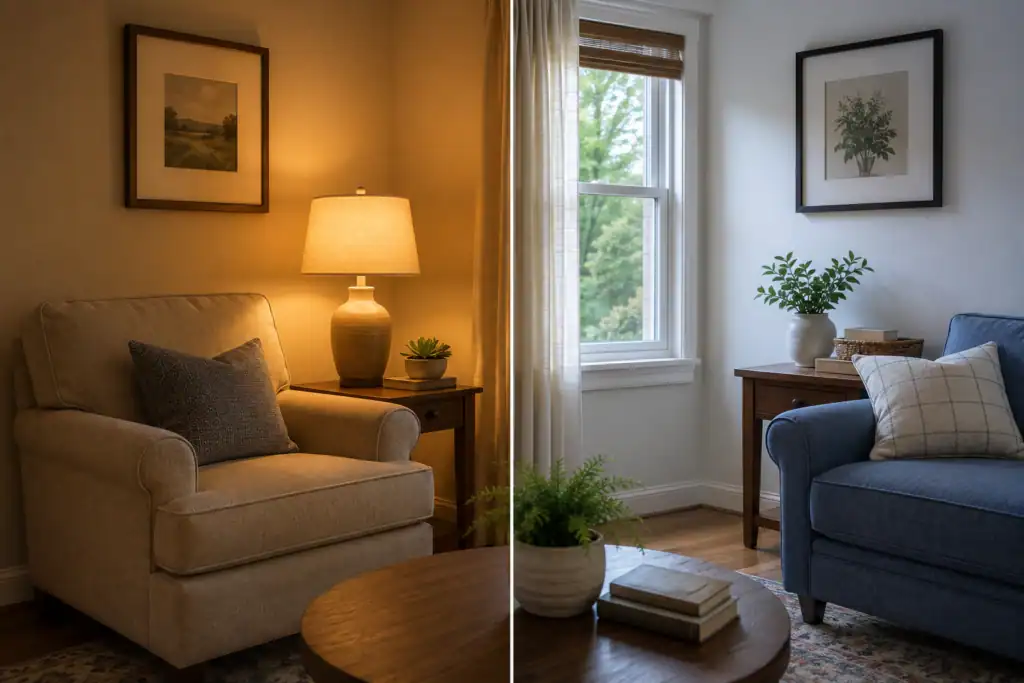
This is the question that trips up more people than any other, and I get why. The packaging just says a number followed by “K” — 2700K, 3000K, 5000K — and nobody explains what it means at the point of purchase.
That number is color temperature, measured in Kelvin, and it describes the tone of the light, not its brightness:
- 2700K–3000K (Soft White / Warm White): The cozy, amber-toned glow closest to an old-fashioned incandescent bulb. Best for bedrooms, living rooms, and anywhere you want to relax in the evening.
- 3500K–4000K (Neutral White): A cleaner, less yellow tone that works well in kitchens, bathrooms, and home offices where you want clarity without the clinical feel.
- 5000K+ (Daylight): A crisp, blue-white light that mimics midday sun. Great for garages, workspaces, and task lighting where you need sharp visibility — less great for anywhere you want to unwind.
My rule of thumb after years of getting this wrong: match the Kelvin to the room’s job, not to whichever bulb happened to be cheapest that week. A daylight bulb in a bedside lamp will leave a room feeling like a dentist’s waiting room. A soft white bulb over a kitchen island can leave food prep areas feeling dim and yellow. Neither is “wrong” in isolation — they’re just mismatched to the space.
The Buying Guide: How to Choose the Right Bulb, Room by Room
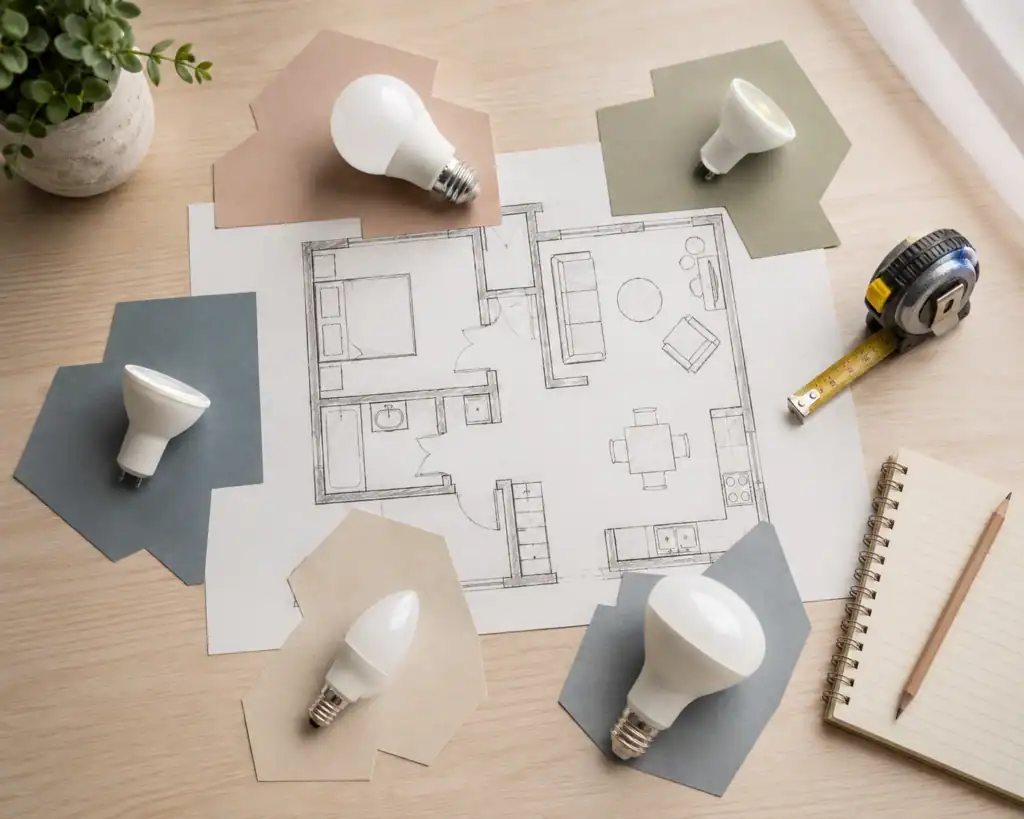
If you take nothing else from this guide, take this section — bookmark it, screenshot it, whatever gets it back in front of you the next time you’re standing under a dead fixture at 9pm. Here’s the decision process I actually walk through now, broken into the four things that matter, in order.
- Start with the fixture, not the bulb. Check the base size (almost always E26/medium base in U.S. homes, but confirm), whether the fixture is enclosed (which affects heat and LED lifespan), and whether it’s on a dimmer switch. A non-dimmable LED on a dimmer circuit will flicker or buzz — this is the single most common return reason for LED bulbs.
- Pick brightness by lumens, not watts. Living rooms and bedrooms generally want 800–1,100 lumens per fixture. Kitchens and bathrooms want 1,200–1,600 lumens for task visibility. Hallways and accent lighting can go as low as 450–600 lumens.
- Pick color temperature by function. Relaxing spaces (bedrooms, living rooms, dining rooms) → 2700K–3000K. Functional spaces (kitchens, bathrooms, garages, offices) → 3500K–5000K. If a room does both jobs — a kitchen you also relax in — a tunable smart bulb solves the tradeoff without buying two sets of bulbs.
- Check CRI before you check price. Color Rendering Index measures how accurately a bulb reveals true color, on a scale to 100. Anything under 80 CRI can make skin tones, food, and paint colors look slightly off. For kitchens, bathrooms (where you’re checking your appearance), and any space with artwork, spend the extra dollar or two for 90+ CRI.
- Confirm certification. ENERGY STAR certification means the efficiency, lumen output, and lifespan claims on the box have been independently verified by the U.S. Department of Energy — it’s the fastest way to filter out inflated marketing numbers from budget no-name brands.
Common mistake to avoid: Buying based on the old wattage number out of habit. A “100W bulb” mindset leads people to buy LEDs that are far brighter than the room needs, wasting the very savings they just switched bulbs to capture. Match lumens to the room, every time.
Do LED Bulbs Really Save You Money? Doing the Actual Math
Skepticism here is fair — LEDs cost more upfront, so “saves money” needs to be more than a slogan. Let’s run real numbers using today’s U.S. average residential electricity rate, which sits at roughly 18.8 cents per kilowatt-hour as of 2026.
Running a 60-watt incandescent bulb for 24 hours:
60 watts × 24 hours = 1.44 kilowatt-hours
1.44 kWh × $0.188 = about 27 cents a day
Running the LED equivalent (about 9 watts) for 24 hours:
9 watts × 24 hours = 0.216 kilowatt-hours
0.216 kWh × $0.188 = about 4 cents a day
That gap looks small until you multiply it across a house. A household running 20 bulbs for an average of 4 hours a day pays roughly $18/month on incandescent lighting versus about $2.70/month on LED — over $180 a year, just from swapping bulbs, before factoring in that LEDs also last 15,000–25,000 hours compared to an incandescent’s roughly 1,000 hours. You’re not buying replacement bulbs nearly as often, either.
To make this concrete, here’s what a single bulb actually costs over a realistic 10-year window, running an average of 3 hours a day — including the bulbs themselves, not just electricity:
| Bulb Type | Bulbs Needed (10 yrs) | Approx. Bulb Cost | 10-Year Electricity Cost | Total 10-Year Cost |
|---|---|---|---|---|
| Incandescent | ~13 bulbs | ~$13 | ~$74 | ~$87 |
| Halogen | ~7 bulbs | ~$14 | ~$53 | ~$67 |
| CFL | ~2 bulbs | ~$6 | ~$18 | ~$24 |
| LED | 1 bulb | ~$4 | ~$11 | ~$15 |
Estimates based on the 2026 U.S. average residential rate of 18.8¢/kWh, 3 hours/day of use, and typical retail bulb prices. Your numbers will shift with your local electricity rate and actual usage hours, but the ranking between bulb types holds steady almost everywhere in the country.
Real-world example: Say you’re lighting a 12-bulb home — living room, kitchen, two bedrooms, hallway, and bathroom fixtures combined. Sticking with incandescent costs roughly $1,044 over 10 years. Switching every one of those 12 bulbs to LED brings that down to around $180 over the same decade — savings of over $860, from a lighting decision that takes about twenty minutes to act on.
Should I get 60W or 100W bulbs?
With LEDs, think in lumens, not watts. An “60W equivalent” LED produces around 800 lumens while drawing 8–9 watts; a “100W equivalent” produces around 1,500–1,600 lumens while drawing 13–15 watts. Choose based on how much light the room needs — 800 lumens suits most bedrooms and living rooms, while kitchens and workspaces usually benefit from 1,200+ lumens.
Why are some people switching back to incandescent bulbs?
You’ll see this claim online, usually tied to complaints about LED color quality, flicker with certain dimmers, or nostalgia for the exact warmth of old bulbs. It’s a small, vocal minority — the efficiency and cost gap is simply too large for incandescent to make sense for most households. If LED color quality is your complaint, look for a Color Rendering Index (CRI) of 90 or higher; it fixes most of the “harsh LED” feeling people associate with cheaper bulbs.
Which is better, an A or F energy rating?
On the EU-style energy label system (increasingly referenced in U.S. product listings too), A is the most efficient and G is the least. Look for A or B-rated bulbs — nearly all quality LEDs fall in this range, while older halogen and incandescent bulbs land at E, F, or G.
What Light Bulbs Are Best for Sleep and Melatonin?
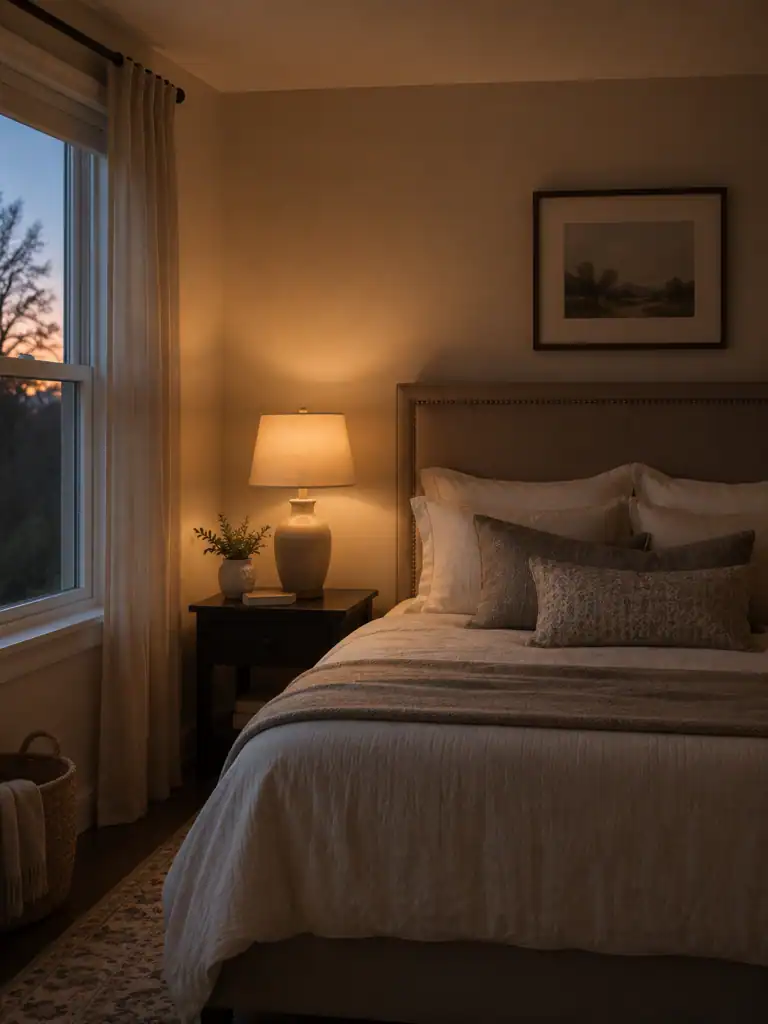
This is the cluster most buying guides skip entirely, and it’s a shame, because the science here is genuinely useful. Your body’s melatonin production — the hormone that tells you it’s time to sleep — is highly sensitive to blue light, the kind concentrated in high-Kelvin “daylight” bulbs and phone screens.
Research comparing lighting types has found that cool white LED and CFL bulbs cause substantially more melatonin suppression than warm white LED, warm CFL, or incandescent light, with blue-heavy light shifting circadian rhythm roughly twice as much as green light and far more than red or amber tones. In practical terms: the same LED technology that’s great for your electric bill can work against your sleep if you pick the wrong color temperature for the bedroom.
What color light is best for sleep and calming for anxiety?
Warm tones in the 2700K range — or dimmer red and amber-leaning light in the evening — have minimal impact on melatonin. Many people find this same warm, low light calming generally, not just at bedtime, since it doesn’t trigger the alertness response that bright, blue-toned light does.
What are circadian-friendly light bulbs?
These are LEDs engineered specifically to limit their blue-wavelength output, sometimes with tunable color temperature so the bulb can shift from energizing daylight tones in the morning to warm, sleep-friendly tones in the evening. If you want one bulb that does both jobs, a tunable “smart” LED with a scheduling app is the simplest way to get it without swapping bulbs by hand.
Do LED lights reduce melatonin?
Only the cool, high-Kelvin ones. A warm-white LED performs almost as well as old incandescent bulbs on melatonin impact, while a daylight LED performs similarly to a cool CFL — both suppress melatonin meaningfully more than their warm counterparts.
A Note for Light-Sensitive Readers: Lupus and Similar Conditions
If you or someone in your home has lupus, this section is for you, and it’s worth reading even if the rest of this guide feels purely practical. A large share of lupus patients experience photosensitivity, and it isn’t just an outdoor, sunscreen-and-hat issue — indoor lighting matters too.
The concern specifically centers on fluorescent bulbs, including CFLs. Their phosphor coating can develop tiny cracks over time, allowing UV rays to escape, and this cumulative UV exposure is a recognized trigger for lupus flares in photosensitive individuals. Standard incandescent bulbs emit very little UV, and LED bulbs emit close to none, which is why lighting organizations focused on lupus recommend LED as the more skin-friendly choice — though it’s worth noting the research base specifically comparing LED outcomes in lupus patients is still developing, so this is a reasonable precaution rather than a guaranteed fix.
If replacing every fluorescent fixture isn’t practical right away, covering existing fluorescent tubes with a UV-filtering shield or diffuser meaningfully cuts exposure in the meantime.
Our Picks: What to Actually Buy
Enough theory — here’s how I’d shop this out by use case:
Best all-around bulb: Philips LED A19 Ultra Definition Soft White

A 100W-equivalent, 2700K soft white LED at 1,500 lumens (11.5W), with a CRI of 90+ — well above the 80 CRI most competitors ship with, which is exactly why it keeps showing up at the top of independent bulb tests. ENERGY STAR certified and dimmable, so it works on standard switches and dimmer circuits alike. This is the safe, correct default for most rooms in a home.
Pros
- 90+ CRI renders skin tones and decor noticeably truer than budget bulbs
- Dimmable and flicker-free, so it works on standard circuits and dimmer switches alike
Cons
- Costs more per bulb than generic multi-packs
$45.41 for the 8-pack ($11.35/bulb)
🏠 Check Price on AmazonBest for kitchens, bathrooms, and task areas: Amazon Basics A19 LED, Daylight 5000K

A 100W-equivalent, 5000K daylight bulb at 1,500 lumens (15W). You want clarity here, not coziness — this is where daylight-range bulbs earn their keep, and Amazon’s own house brand delivers the spec reliably at a lower price than name brands.
Pros
- True 1,500-lumen output — noticeably brighter than budget “100W-equivalent” bulbs that undersize their lumens
- Standard E26 base fits nearly every U.S. fixture
Cons
- Non-dimmable — skip it for any fixture on a dimmer switch
$10.48 for the 6-pack ($1.75/bulb)
🏠 Check Price on AmazonBest for bedrooms and better sleep: Philips Hue White Ambiance A19

A tunable LED that shifts from 2200K warm amber up to 6500K daylight, 800 lumens, fully dimmable. Pair it with the Hue Bridge to automate the evening shift — the app handles the fade to warm light so you don’t have to remember to do it manually. Works via Bluetooth alone for basic on/off and dimming if you’d rather skip the Bridge purchase.
Pros
- Widest tunable range of any mainstream smart bulb (2200K–6500K)
- Automated sunset-to-sunrise scheduling removes the “remembering to switch bulbs” problem entirely
Cons
- Full automation requires the separate Hue Bridge (additional cost)
$39.19 $48.99 for the 2-pack ($19.60/bulb)
🏠 Check Price on AmazonBest for light-sensitive households: Sylvania ECO LED A19, Soft White

Skip fluorescent and CFL entirely. This Sylvania line is explicitly built mercury- and lead-free with no UV or IR emission — a direct match for the precautions covered in the lupus/photosensitivity section above. If any fluorescent fixtures remain elsewhere in the house, add a UV-filtering diffuser as an interim step.
Pros
- No UV or IR emission, mercury-free — the safest indoor option for photosensitive individuals
- 7-year manufacturer rating backs the long lifespan claim
Cons
- Non-dimmable in this specific line
$14.75 for the 8-pack ($1.84/bulb)
🏠 Check Price on AmazonBest budget multi-pack: Amazon Basics A19 LED, Soft White, 24-Pack

800 lumens, 2700K, 9W (60W-equivalent) across a 24-count pack — the lowest per-bulb cost path to upgrading an entire house at once. There’s genuinely little reason to buy incandescent stock today unless it’s for a specialty fixture that requires it.
Pros
- Lowest cost-per-bulb of any option in this guide — ideal for whole-home swaps
- 10,000-hour rated lifespan, roughly 10x a standard incandescent
Cons
- Non-dimmable and no CRI spec published — skip for accent lighting or artwork
$19.19 for the 24-pack ($0.80/bulb)
🏠 Check Price on AmazonConclusion: The Bulb Aisle Doesn’t Have to Be a Guessing Game
Every one of the questions in this guide comes back to the same underlying idea: the “best” light bulb depends entirely on what you’re asking it to do. For your electric bill, that’s LED, full stop — the comparison table above makes it hard to argue otherwise once the numbers are actually side by side. For your sleep, that’s warm-toned, low-Kelvin LED in the evening hours. For a light-sensitive household, that’s LED over fluorescent, every time, no exceptions. And for the room-by-room decision itself, it’s lumens and Kelvin doing the real work, not the old wattage number your brain still defaults to.
Here’s the shortest possible version, if you’re skimming on your way out the door: match lumens to the room, match Kelvin to the mood, buy LED, check for ENERGY STAR and 90+ CRI, and stop thinking about wattage entirely. That’s the whole decision, every time, in every aisle.
If you’re mid-renovation or rethinking a room’s lighting more broadly, our guides on modern lighting ideas for the living room and bedroom LED wall decor lighting go deeper on layering fixtures around the bulbs themselves, while our creative LED strip lighting ideas for bedrooms post is the natural next stop if you want to build out ambient lighting beyond a single bulb swap. And if the real motivation here is a lower power bill across the whole house, not just the lighting circuit, our breakdown of why your electric bill keeps climbing covers the bigger picture — bulbs are one lever, but rarely the only one worth pulling.
What’s actually in your fixtures right now — incandescent leftovers, mismatched daylight and soft white, or have you already made the full LED switch? Drop a comment and let us know what convinced you (or what’s still holding you back), and if this guide saved you a trip back to the store for the wrong Kelvin, share it with whoever in your house keeps buying the cheapest pack on the shelf. We read every comment and it directly shapes what we cover next.
Frequently Asked Questions
Which bulb takes less electricity?
LED, by a wide margin — roughly 85% less than incandescent for the same brightness, and noticeably less than CFL as well.
How much does it cost to run a 60W light bulb for 24 hours?
About 27 cents at the current U.S. average electricity rate of 18.8¢/kWh. The LED equivalent costs about 4 cents for the same period.
What lights don’t use a lot of electricity?
LED bulbs, across every category — general purpose, smart, strip lighting, and outdoor. If a bulb is CFL or incandescent, it’s using meaningfully more electricity than an LED equivalent, even if the packaging calls it “energy saving.”
Do LED bulbs really save money?
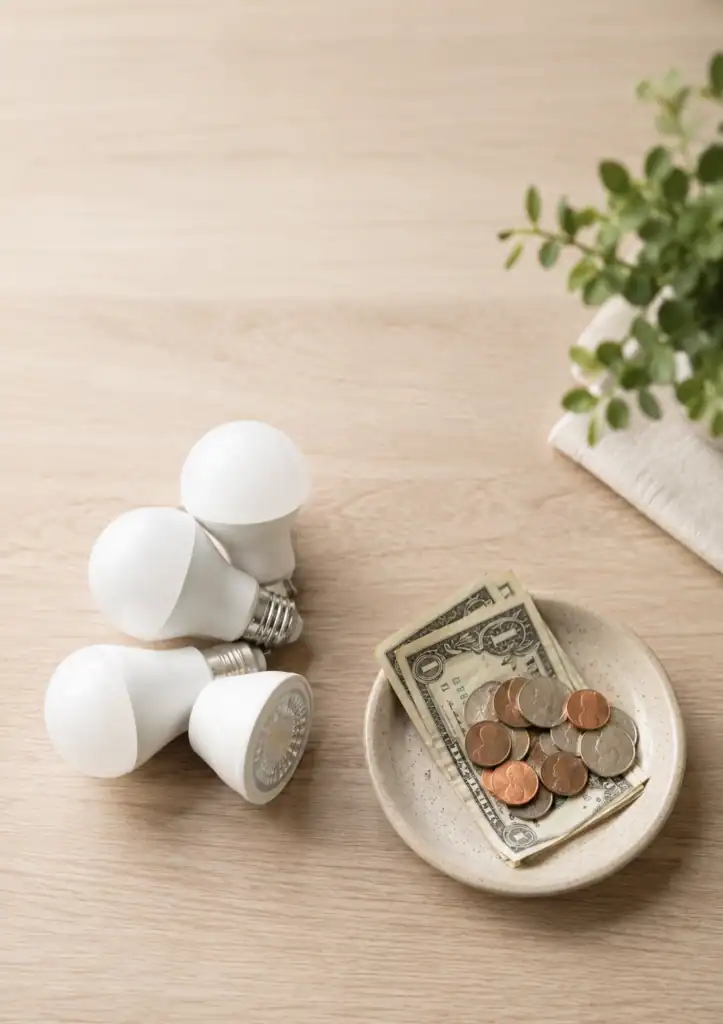
Yes. The 10-year total cost comparison earlier in this guide shows LED coming out ahead of every other bulb type even after accounting for its higher upfront price — the electricity savings and the reduced replacement frequency both add up faster than most people expect.
Which is better, a daylight or soft white bulb?
Neither is universally better — it depends on the room. Soft white (2700K–3000K) suits relaxing spaces like bedrooms and living rooms; daylight (5000K+) suits task-focused spaces like kitchens, bathrooms, and garages.
What is the least toxic light bulb?
LED — it contains no mercury (unlike CFL) and emits negligible UV, making it the safest option both environmentally and for photosensitive individuals.
What color light is calming for anxiety, and what kind of light helps you fall asleep?
Warm, low-Kelvin light in the 2700K range or dimmer amber and red tones. This range avoids triggering the alertness response that cooler, blue-heavy light produces, which is why it’s recommended for both winding down generally and specifically for sleep.
What is the best light bulb for bedtime?
A warm, low-Kelvin (2700K or lower) dimmable LED. The warmer and dimmer the light in the hour before bed, the less it interferes with melatonin production.
Why are people with lupus sensitive to light, and what are the best indoor lights for lupus patients?
Photosensitivity affects a large share of lupus patients as both a symptom and a flare trigger, driven by an autoimmune reaction to UV-related skin cell changes. LED and standard incandescent bulbs are the lowest-UV indoor options; fluorescent and CFL bulbs emit more UV and are the ones to minimize or shield.
Leave a Reply