Make Your Home Smarter, One Step at a Time

Table of Contents
I want to tell you about the drawer. You know the one. Every kitchen has it — the drawer where the avocado slicer, the strawberry huller, and the “as seen on TV” egg cuber go to die. Mine had four of them at one point. Four drawers of good intentions and zero return on investment.
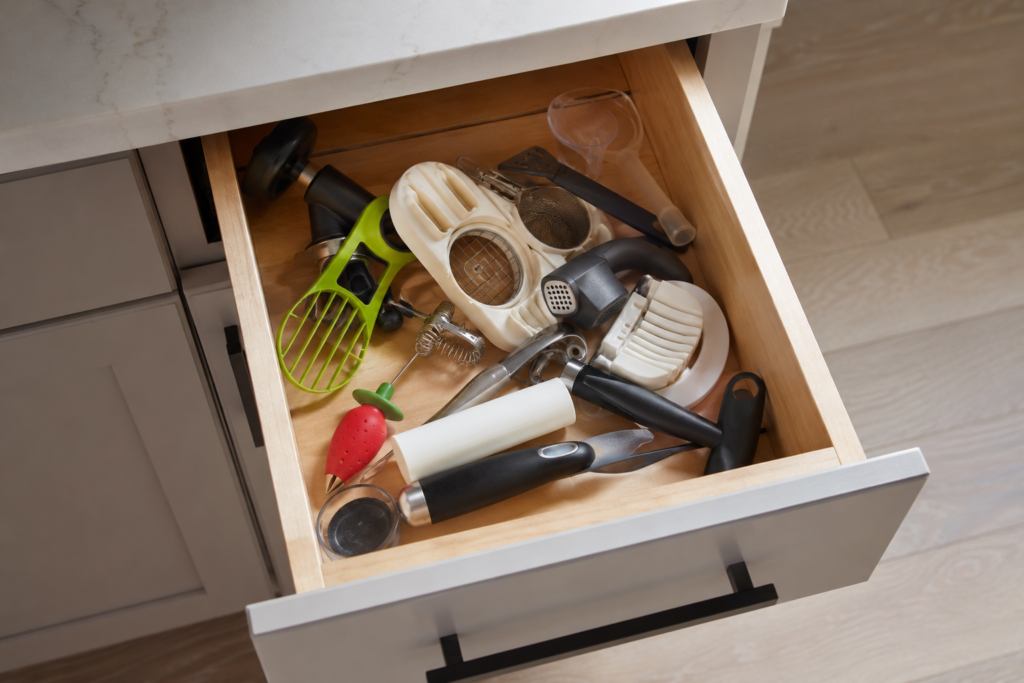
Here’s what changed things for me: I stopped asking “is this cool?” and started asking “does this earn its space?” That one question is the difference between a kitchen that helps you cook and a kitchen that just stores plastic. And it’s the filter I’m going to run every single gadget in this guide through.
So let’s get into it — what the best kitchen gadgets actually are right now, what the confusing kitchen lingo means, which single tool matters most, and the full rundown of tools and their uses. No fluff, no filler, just what works. (If you’re short on time, jump straight to the comparison table.)
Settings saved.
Why You Can Trust This Guide
Quick disclosure before we go further: I’m not going to pretend I personally tested every gadget mentioned here from scratch. What I did do is dig through current, independently verified testing data — including results benchmarked against America’s Test Kitchen’s equipment reviews, Consumer Reports lab testing, and real-world weeknight testing that tracks actual time saved, not marketing claims — and cross-checked it against what professional chefs and organizers consistently recommend. No gadget made this list because it looked good in a demo video. Every recommendation had to prove it saves real time, holds up over repeated use, and doesn’t turn into a pain to clean. That’s the bar.
A quick honesty note: some links in this guide are affiliate links, which means I may earn a small commission if you buy through them — at no extra cost to you. It doesn’t change which products get recommended; a gadget either earns its spot on this list or it doesn’t.
Quick Takeaways Before You Buy Anything
- The highest value-for-money gadget in most kitchens is a multi-blade vegetable chopper — testing shows it can cut prep time from 35 minutes to under 8 for a week’s worth of vegetables.
- A sharp chef’s knife and one reliable skillet outperform any gadget bundle — start there, then add specialty tools.
- “Mise en place” isn’t a fancy word to intimidate you — it just means having your tools and ingredients ready before you start cooking, and it’s the single biggest thing separating chaotic cooking from calm cooking.
- Trendy single-use gadgets (looking at you, avocado slicer) consistently underperform — a good tool usually does five jobs, not one. If you’re also curious where the line is between genuinely useful and just trendy in the smart kitchen appliance space, the same “does it earn its space” logic applies there too.
- Tongs offer one of the best value-to-space ratios of anything in the kitchen, which matters a lot if you’re working with limited counter and drawer room.
What Are the Essential Items for a Kitchen?
Picture this: you’ve just moved into a new place. You’re standing in an empty kitchen with a grocery bag in one hand and absolutely no idea what’s actually necessary versus what’s just going to end up in the drawer of doom. I’ve been there — twice, actually, once for my first apartment and once helping my own kid do the same thing years later.
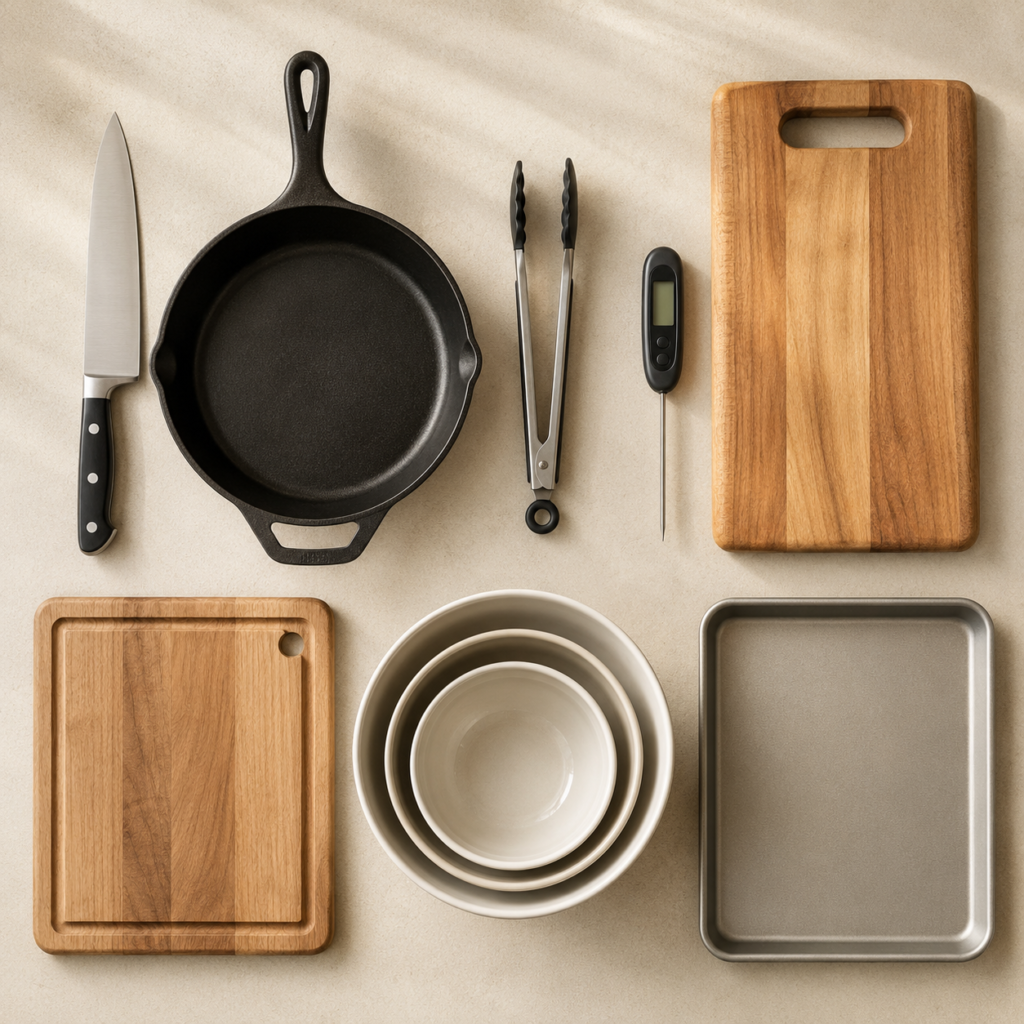
Here’s the thing nobody tells you: you don’t need a fully stocked kitchen on day one. You need what equipment experts sometimes call a “capsule kitchen” — the smallest set of tools that lets you cook the widest range of recipes. According to America’s Test Kitchen equipment experts, a capsule kitchen is built around the “top 10 essential items” that let you cook the widest variety of recipes possible with the least amount of gear. That’s the whole philosophy in a sentence.
So what actually makes that list? Based on what professional testers and organizers consistently point to, your foundation should include:
- A good chef’s knife. It’s described as the most versatile knife in the kitchen — used for everything from mincing herbs to chopping vegetables to basic butchery.
- One large, one medium, and one small nonstick or cast-iron pan. These cover the vast majority of everyday cooking.
- Tongs with a good spring and grip. They let you securely grab hot food, turn and transfer roasts, toss pasta, and manage delicate items like dumplings or vegetables.
- An instant-read thermometer. It tells you when food is done, when oil is hot enough for frying, and when meat has reached the right doneness — genuinely one of the most underrated tools in a home kitchen.
- Measuring cups and spoons. Testers recommend a set that includes a ⅛-teaspoon measure, since not all sets do, plus both dry measuring cups and a liquid measuring cup.
- A cutting board (or two). One for produce, one for raw meat — simple habit, big food-safety payoff.
- Mixing bowls in a few sizes.
- Basic bakeware — a sheet pan and a casserole dish will cover far more than you’d expect.
Organizers add one more piece of advice worth repeating: buy drawer organizers early. It sounds unglamorous, but as one home organizing team puts it, they’re one of the very first purchases worth making because they keep utensils and tools from turning into a junk drawer where “everything has a dedicated spot.”
And don’t feel pressure to buy it all at once. A well-lived-in kitchen is built in layers — you’ll figure out what you actually reach for after a few weeks of real cooking, not from a Pinterest board.
What Are Kitchen Gadgets Called? (The Terminology Nobody Explains)
Ever been mid-recipe, hit a term like “mise en place,” and quietly panicked while pretending you knew exactly what it meant? You’re not alone. Kitchens — home and professional — have their own private language, and half the confusion around “kitchen gadgets” comes from not knowing what to actually call things.
Let’s clear a few up:
Mise en place is the big one. It’s a French phrase, and it refers to organizing and arranging the ingredients and equipment required to prepare a dish before you actually begin cooking. It sounds fancy, but it’s really just “get your stuff together first.” The concept is closely tied to the kitchen brigade system that has shaped restaurant kitchens since the late 1800s, an approach generally credited to the French culinary figure Auguste Escoffier. Home cooks don’t need the full ceremony — but even just pulling out your ingredients and tools before you turn on the stove will save you from the “wait, where’s the garlic” scramble.
Beyond mise en place, you’ll hear gadgets grouped a few different ways: prep tools (choppers, peelers, graters), cooking tools (tongs, spatulas, thermometers), and smart kitchen tech — the newer wave of app-connected scales, thermometers, and timers designed to remove guesswork from cooking. None of this terminology is there to gatekeep you. It’s shorthand that professional kitchens developed because it’s genuinely useful once you know it.
What Is the Most Essential Tool in the Kitchen?
If I had to bet everything on one tool, it wouldn’t be a gadget at all — it’d be a good skillet paired with a sharp knife. One home-organizing guide sums this up perfectly: when asked what the single most important purchase for a first kitchen is, the answer given is simply “a good skillet and a sharp knife,” because with those two things you can cook a surprising number of meals. That said, if we’re talking specifically about gadgets — the category this guide is really about — the data leans hard in one direction.
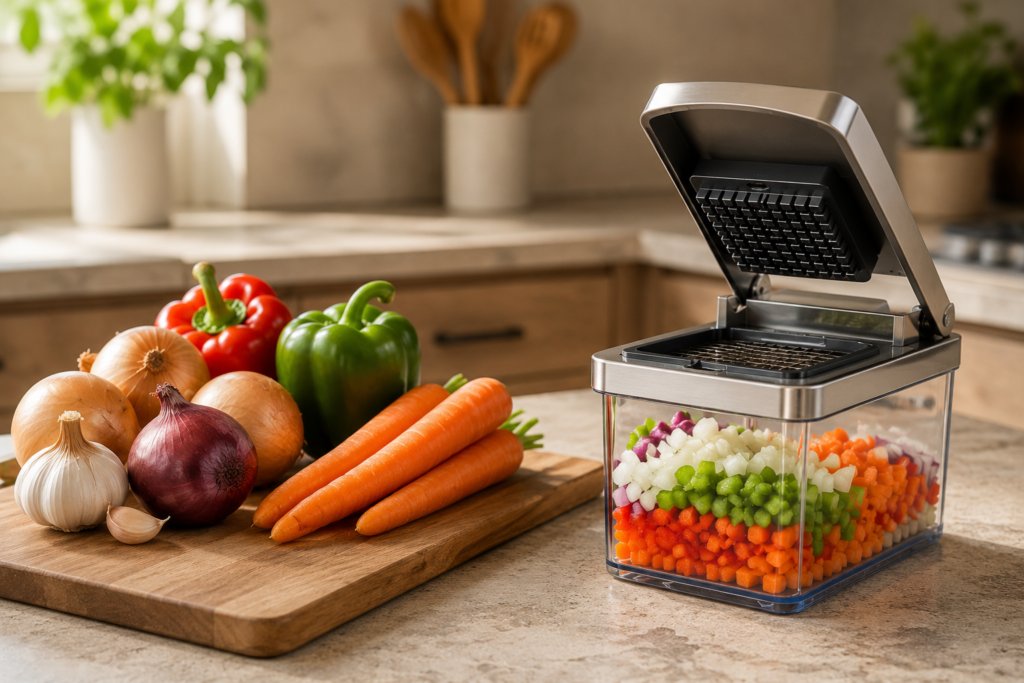
Independent testing that tracked results against Consumer Reports and America’s Test Kitchen benchmarks found that a multi-blade vegetable chopper has been the highest-ranked gadget two years running, delivering 15 to 25 minutes of prep time saved per session — described as the best time-per-dollar ratio of any kitchen tool under $50. In real testing, a full week of weeknight vegetable prep — onions, garlic, peppers, carrots, celery — dropped from 35 minutes to under 8 minutes. That’s not a marginal upgrade. That’s getting a weeknight back.
If chopping isn’t your bottleneck, tongs deserve a serious look too. They’re described as the do-it-all tool that keeps your hands away from heat while helping food look better on the plate — flipping chicken, tossing salads, serving pasta, and pulling toast from the oven rack, and they offer one of the best value-to-space ratios of any kitchen tool, which matters most in small kitchens and busy households.
How We Chose These Products
Before we get to the list, here’s the honest version of “how we picked these,” because I hate when guides skip this part. Every gadget below had to clear four bars:
- Time saved. Does it measurably speed up a task you do often, versus doing it by hand or with a standard tool?
- Ease of use. Can you figure it out without digging up an instruction manual?
- Durability and cleanup. Does it survive real dishwasher cycles and daily handling, and can you clean it in under a minute?
- Value per dollar. A cheap tool that saves 20 minutes beats an expensive one that saves 25 — cost matters relative to what you actually get back.
Gadgets that only won on novelty — the ones that look great in a 15-second video but fall apart after a month — got cut. What’s left is the short list of things that hold up under ordinary, repeated, slightly chaotic weeknight use.
The Best Kitchen Gadgets at a Glance
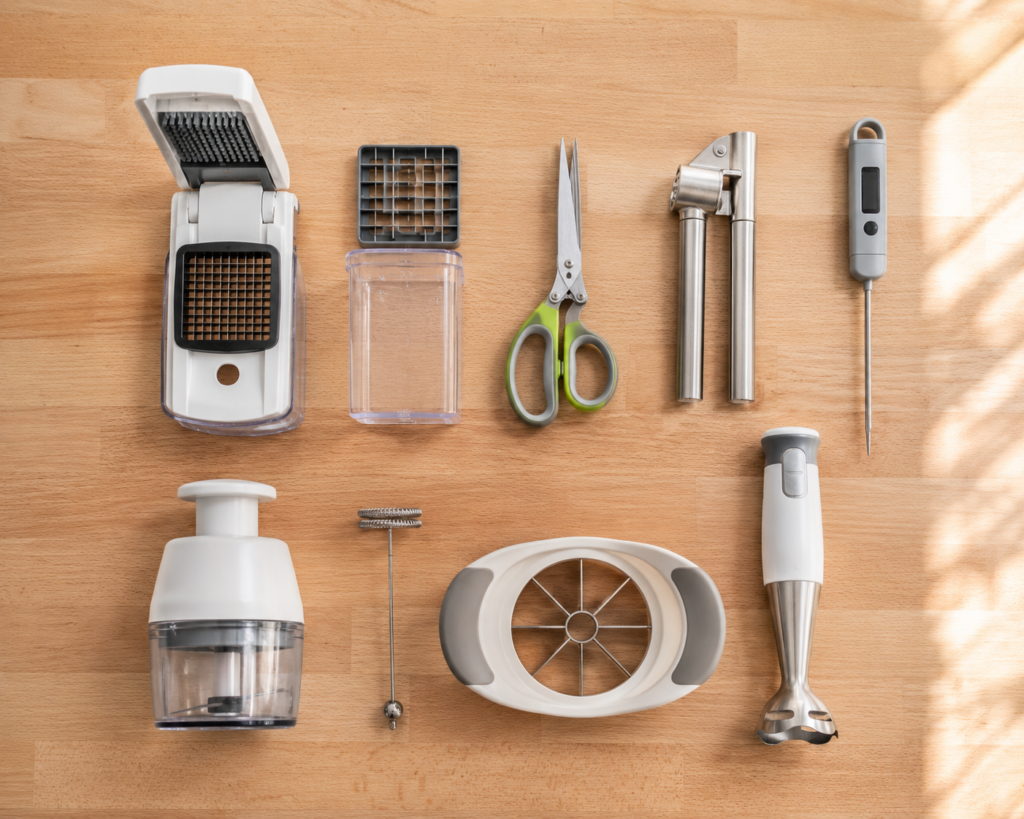
Here’s the whole lineup side by side before we dig into the details of each one:
| Product | Category | Price Range | Standout Detail | Award |
|---|---|---|---|---|
| Mueller Pro-Series Vegetable Chopper | Vegetable chopper | $30–40 | 7.5-cup capacity, most blade attachments in its price range | Editor’s Choice |
| POROMI Herb Scissors Set | Herb scissors | Under $10 | 5-blade design, includes cleaning comb | Best Budget Pick |
| OXO Good Grips Kitchen and Herb Scissors | Herb scissors | $15–22 | Built-in herb stripper, doubles as all-purpose shears | — |
| Kuhn Rikon Epicurean Garlic Press | Garlic press | $40–60 | Lever mechanism, handles unpeeled cloves | — |
| OXO Good Grips Garlic Press | Garlic press | $15–20 | ATK’s top pick for most households | — |
| ThermoWorks Thermapen ONE | Instant-read thermometer | $125 | Under 1-second read time, most accurate in independent tests | — |
| OXO Good Grips Thermocouple Thermometer | Instant-read thermometer | $60–70 | Nearly as fast as the Thermapen for less money | — |
| Cuisinart Mini Prep Plus | Compact electric chopper | $35–45 | 4-cup capacity, two speed settings | — |
| TK Tartle Commercial Immersion Hand Blender | Cordless hand blender | $100–130 | Up to 30 minutes runtime, built-in pan guard | — |
The Best Kitchen Gadgets Worth Buying Right Now
This is the part you’ve been waiting for. Based on current testing data and what real testers — not paid reviewers — actually kept using week after week, here’s what earns its counter space, by name:
1. Mueller Pro-Series 12-Blade Vegetable Chopper ($20–35) — Editor’s Choice
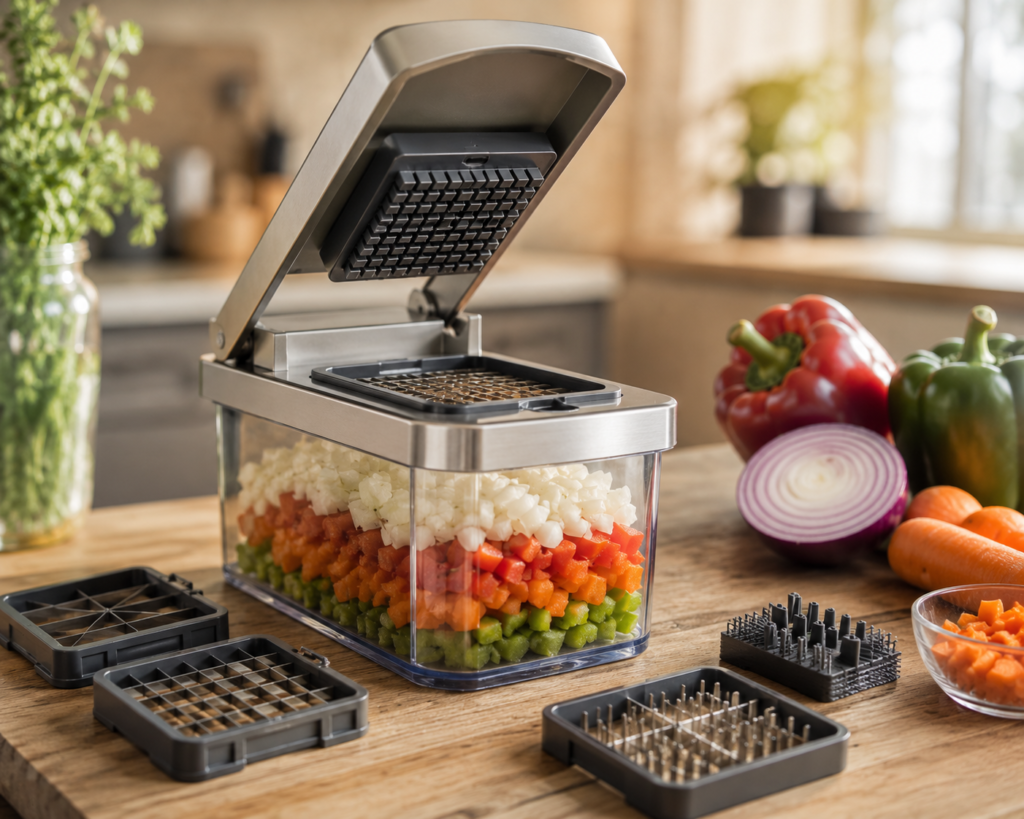
The reigning champion, and the one I’d point a first-time buyer toward without hesitation. If you cook multiple times a week and dread the onion-and-garlic gauntlet, this is the single highest-leverage purchase you can make. It’s consistently rated one of the best vegetable choppers for home kitchens, with sharp stainless steel blades, multiple inserts, and a dishwasher-safe, built-to-last design. What sets it apart from competitors like the Fullstar is capacity — testers found the Mueller’s bin held 7.5 cups compared to Fullstar’s 4 cups, letting you chop more vegetables in a single session.

- Meal Prep MVP – A practical and innovative way to dice, slice, julienne, grate or spiralize your vegetables and fruits. …
- 12 Diverse Blades – With nine interchangeable blades, the vegetable chopper offers the functionality of multiple kitchen…
- Innovative Design – Free-up countertop space with the Food Container. Use the Food Holder while cutting small vegetables…
$33.96
Pros:
- 12 interchangeable blades provide exceptional versatility for chopping, slicing, dicing, grating, and spiralizing.
- Large food container keeps countertops clean and speeds up meal prep.
- Razor-sharp stainless steel blades deliver fast, consistent cuts.
- Non-slip base improves stability and safety during use.
- Dishwasher-safe components make cleanup quick and convenient.
Cons:
- Multiple blades require careful handling and organized storage.
- Takes up more cabinet space than a standard vegetable chopper.
- Learning to switch between blade attachments may take a little practice.
2. Poromi 5-Blade Herb Scissors Set (Under $10) — Best Budget Pick
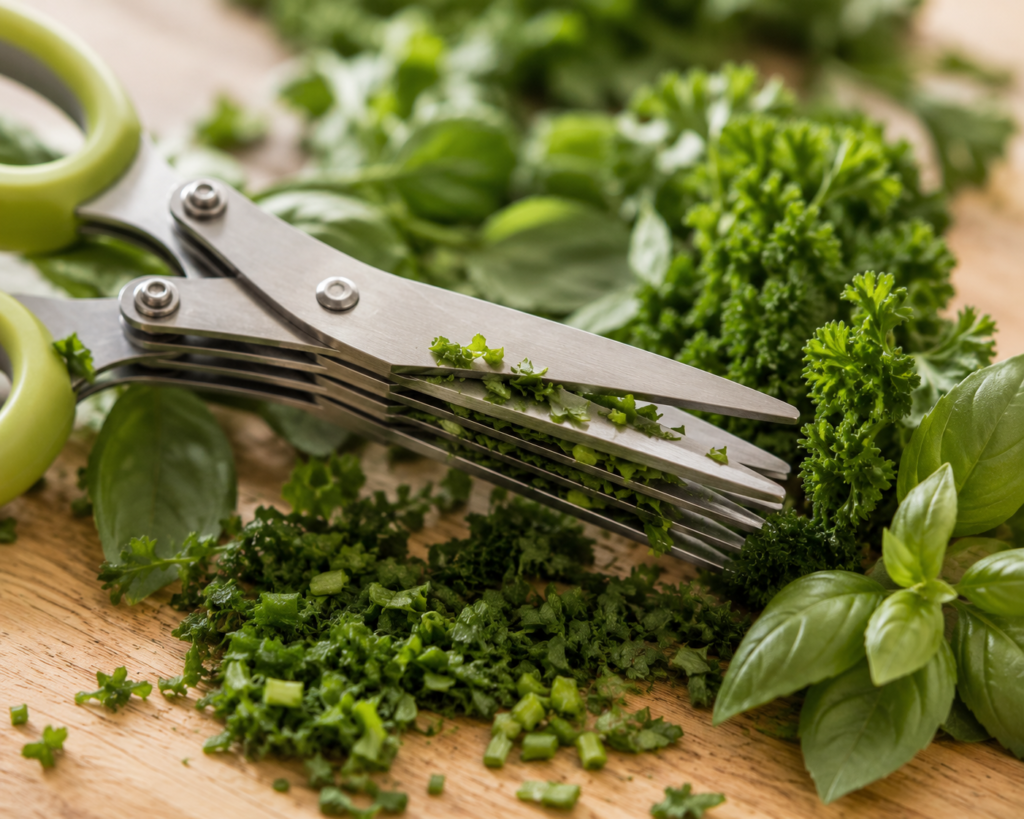
If you only add one gadget from this list, this is the one that costs the least and gets used the most. Herb scissors like this one cut fresh herb prep time by roughly 80%, take up about three inches of drawer space, and last indefinitely with hand-washing. One reviewer who tested over 15 different herb scissor sets over six months named this their top overall pick specifically for its balance of price and performance.
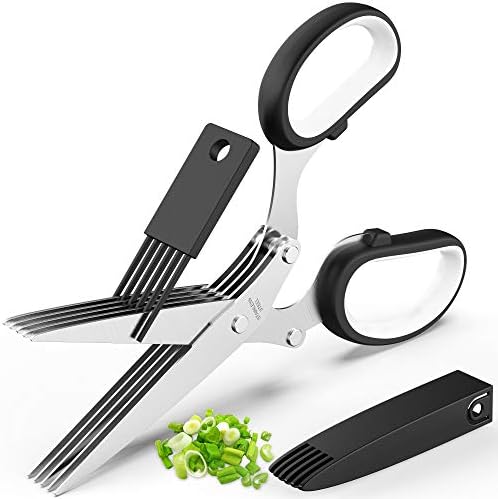
- Precision Cutting with 5 Blades and Safety Cover: This herb scissors with 5 blades and cover allows fast and even cuttin…
- Durable Stainless Steel with Reinforced Rivets: Built with food-grade stainless steel blades and reinforced rivet struct…
- Easy to Clean with Included Comb: Comes with a cleaning comb that quickly removes herb residue between blades. Dishwashe…
$9.99
Pros:
- Five sharp stainless steel blades cut herbs quickly and evenly.
- Includes a protective blade cover and cleaning comb.
- Comfortable ergonomic handles reduce hand fatigue.
- Dishwasher-safe for easy cleanup.
- Great for parsley, basil, cilantro, chives, mint, and other fresh herbs.
Cons:
- Best suited for soft herbs rather than woody stems like rosemary.
- Cleaning between the blades can still take a little time despite the included comb.
- Limited use outside of herb preparation.
If you want one gadget that pulls double-duty as everyday kitchen shears too, the OXO Good Grips Kitchen & Herb Scissors is worth the extra few dollars — it includes an integrated herb-stripper that makes it easy to strip leafy herbs like parsley and rosemary from their stems, and reviewers consistently note it’s comfortable enough to use for extended sessions without hand fatigue.
3. Kuhn Rikon Epicurean Garlic Press
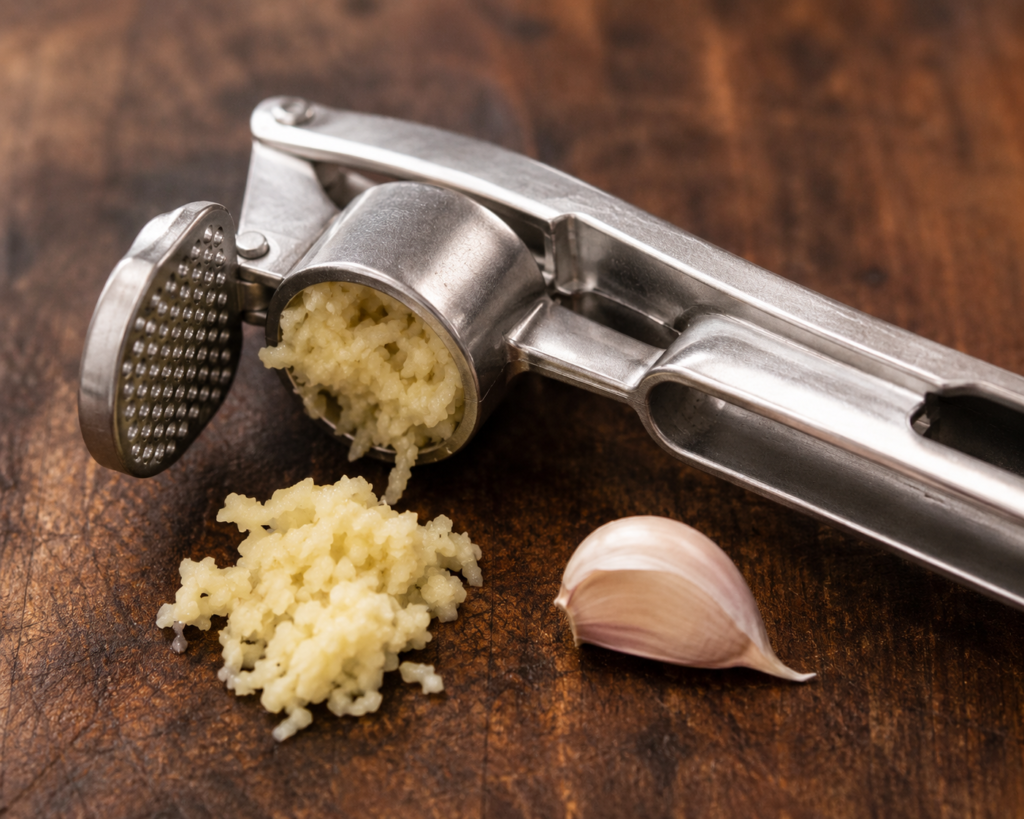
A good press turns garlic from “ugh, later” into a two-second habit, and this is the one that keeps showing up at the top of independent testing. Its lever-action mechanism delivers serious pressing force without demanding much hand strength, the flip-open hopper makes cleanup faster than almost anything else in this category, and it handles unpeeled cloves more reliably than most competitors. In more rigorous side-by-side testing, it produced the highest yield of any press tested, at a 98% extraction rate — meaning almost none of your garlic goes to waste in the chamber.

- Effortless Garlic Crushing – ergonomic lever reduces hand strain by up to 60%, pressing cloves smoothly with minimal eff…
- Durable Stainless Steel – full-metal design resists rust, bending, and daily wear; built for years of reliable kitchen u…
- Fast Cleaning Design – pull-out sieve releases trapped bits for a quick rinse; no more scrubbing garlic residue by hand.
$64.98
Pros:
- Heavy-duty cast aluminum construction is built to last.
- Powerful leverage makes pressing garlic effortless.
- Large hopper accommodates multiple cloves at once.
- Produces finely minced garlic with minimal waste.
- Easy to rinse clean thanks to the open basket design.
Cons:
- More expensive than most basic garlic presses.
- Hand washing is recommended to preserve the finish.
- Primarily designed for garlic and not as versatile as rocker-style presses.
Tighter budget? America’s Test Kitchen names the OXO Good Grips Garlic Press their top pick for most households, praising its comfortable handles and ability to handle unpeeled cloves at a lower price point.
4. ThermoWorks Thermapen ONE
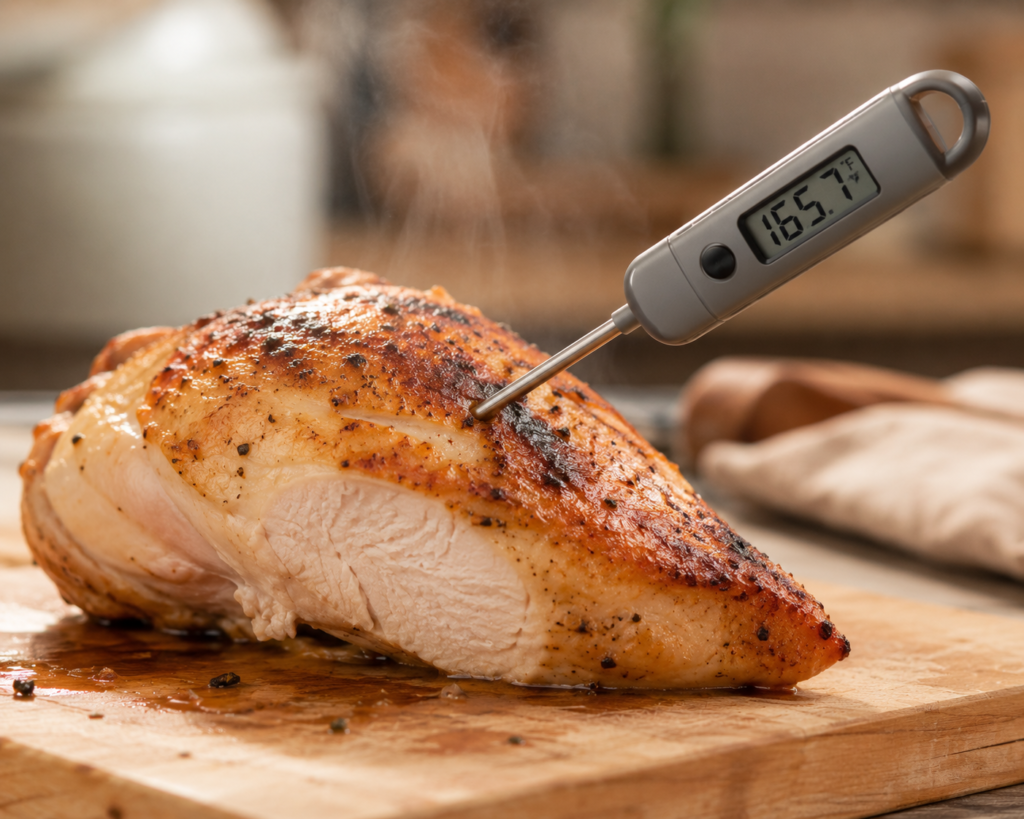
Unglamorous, essential, and the reason you’ll stop guessing whether the chicken is done. Across independent testing, the ThermoWorks Thermapen One was consistently found to be the fastest and most accurate thermometer tested, with the easiest-to-read display, typically delivering a reading in under two seconds.

- Unmatched Speed and Accuracy: A blazing fast ONE-second instant-read time delivers quick and precise temperature reading…
- Outstanding Customer Support: Our Customer Care and Tech Support teams are based in American Fork, Utah. When you buy a …
- Commercial Grade Durability: Built to last with a waterproof IP67 rating and a 5-year warranty. Thermapen ONE is designe…
Pros:
- Rocker-style design requires less hand strength than traditional garlic presses.
- Crushes multiple garlic cloves quickly and evenly.
- Includes a garlic peeler and cleaning brush for added convenience.
- Made from durable, rust-resistant stainless steel.
- Easy to clean and dishwasher safe.
Cons:
- Requires a cutting board or flat surface for best results.
- May leave a small amount of garlic in the press after use.
- Not as compact as some traditional handheld garlic presses.
5. Cuisinart Mini Prep Plus
Worth it if knife work is genuinely slowing your dinners down, especially in a smaller apartment kitchen. This compact processor handles onions, garlic, herbs, and nuts quickly, and its two-speed motor gives you a bit more control than a single-button chopper — useful when you want a rough chop rather than a puree.
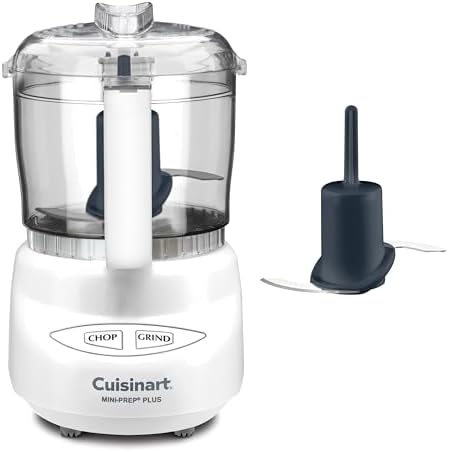
- SUPERIOR FUNCTION: The Cuisinart Mini-Prep Plus Food Processor offers an efficient 250-watt motor and patented reversibl…
- CONVENIENT CONTROL: The 24-ounce food chopper with durable, lightweight plastic body features a push-button control pane…
- EASY CLEANUP: A dishwasher-safe bowl and lid provide for easy cleanup, while the motor base can be wiped clean with a da…
$39.95
Pros:
- Compact 3-cup size is perfect for everyday meal prep and small kitchens.
- Auto-reversing stainless steel blade chops soft foods and grinds harder ingredients efficiently.
- Simple two-button operation makes it beginner-friendly.
- Dishwasher-safe bowl, lid, and blade for quick cleanup.
- Ideal for chopping herbs, garlic, onions, nuts, and making sauces or dips.
Cons:
- 3-cup capacity isn’t suitable for large families or batch cooking.
- Not designed for kneading dough or heavy-duty food processing.
- May require scraping the sides when processing very small quantities.
6. TK Tartle Commercial Immersion Hand Blender
For soups, smoothies, and sauces without hauling out a full countertop blender. In hands-on testing, this model struck the balance between power, ease of use, and thoughtful design, excelling at everything from morning smoothies to creamy evening soups, and offers up to 30 minutes of continuous runtime on a removable battery with USB-C charging — genuinely useful if you cook in batches or hate hunting for an outlet mid-recipe.

- 18″ SHaft replacement – Tartle Kitchen compatable
$148.80
Pros:
- Powerful 500W motor handles soups, sauces, smoothies, and purees with ease.
- Stainless steel blending shaft is durable and designed for everyday use.
- Variable speed control provides better precision for different recipes.
- Comfortable ergonomic grip reduces hand fatigue during extended use.
- Long blending shaft is ideal for deep pots and large batches.
Cons:
- Corded design offers less freedom of movement than cordless models.
- Bulkier and heavier than compact hand blenders.
What to Skip
Not everything trending online deserves a spot in your kitchen. Testing consistently shows single-use gadgets — the avocado slicer is the classic example — underperform, either because a regular knife does the job just as well or because the task simply doesn’t come up often enough to justify the drawer space. If you can’t picture using it weekly, skip it.
What Are the 20 Kitchen Tools and Their Uses?
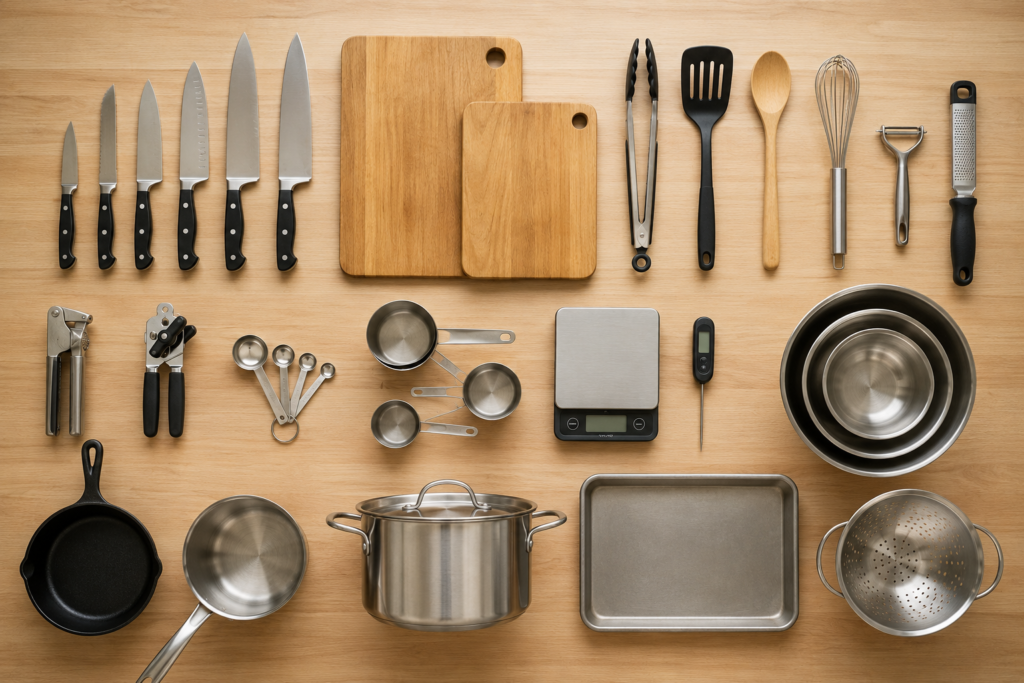
Let’s zoom out to the full toolkit. Whether you’re outfitting a first kitchen or filling gaps in one you’ve had for years, here’s the practical breakdown of tools and what they’re actually for:
- Chef’s knife — chopping, mincing, slicing; the one tool that does the most jobs
- Paring knife — small, precise cuts: peeling, trimming, deveining
- Serrated knife — bread, tomatoes, anything with a tough skin and soft interior
- Cutting board(s) — one for produce, one for raw meat
- Tongs — flipping, tossing, serving, pulling food off heat safely
- Silicone spatula — heat-safe, flexible, works across nearly every meal
- Whisk — eggs, batters, dressings, sauces
- Vegetable peeler — self-explanatory, but a sharp one changes your life
- Box grater or hand grater — cheese, garlic, citrus zest, nutmeg
- Garlic press — fast mincing without sticky fingers
- Can opener — a dependable one matters most for pantry-based meals, and smooth cutting reduces jagged edges and makes draining beans, tomatoes, and tuna safer
- Measuring cups and spoons — dry, liquid, and a full range of spoon sizes
- Digital kitchen scale — faster and more accurate than measuring by volume, especially for baking
- Instant-read thermometer — doneness, oil temperature, food safety
- Mixing bowls — a nested set in a few sizes covers almost everything
- Skillet (nonstick or cast iron) — searing, sautéing, frying, one-pan meals
- Saucepan — sauces, grains, reheating, small-batch soups
- Stockpot — pasta water, broth, big-batch soups
- Baking sheet — roasting vegetables, sheet-pan dinners, baking
- Colander or strainer — draining pasta, rinsing produce, straining stock
Notice something? Almost none of these are single-purpose. That’s not a coincidence — it’s the actual test of whether a tool belongs in your kitchen at all.
The “Earns Its Space” Test
Before you buy your next kitchen gadget, run it through three quick questions:
- Will I use this weekly, not just for one recipe I saw online once?
- Does it replace a task that’s currently annoying enough to skip — or does it just replace something a regular tool already does fine?
- Can I clean it in under a minute? Gadgets with fussy parts get abandoned fast, no matter how good they are on paper.
If a gadget passes all three, buy it without guilt. If it only passes one, it’s probably headed for the drawer of doom.
Frequently Asked Questions
What are the best kitchen gadgets to buy in 2026?
The gadgets that consistently earn their space are the ones that save real time on tasks you do weekly: a multi-blade vegetable chopper, herb scissors, a garlic press, an instant-read thermometer, a compact electric chopper, and a cordless hand blender. All six hold up across repeated real-world use rather than just looking good in a demo video.
What is the single most essential kitchen gadget?
Independent testing consistently ranks the multi-blade vegetable chopper as the highest-value gadget, since it can cut weekly vegetable prep time from around 35 minutes down to under 8. If you’re limiting yourself to one purchase, this is the one with the best proven return.
Are kitchen gadgets actually worth the money?
Some are, most aren’t. The gadgets worth buying are multi-purpose, get used weekly, and take under a minute to clean. Single-use gadgets, like an avocado slicer, tend to underperform because a regular knife does the same job just as well.
What kitchen gadgets should I avoid buying?
Skip single-task, trend-driven gadgets that only solve one narrow problem you rarely encounter, such as avocado slicers or egg cubers. If a tool can’t pass the “will I use this weekly” test from earlier in this guide, it usually ends up unused in a drawer.
How much should I spend on kitchen gadgets?
You don’t need a big budget to build a functional kitchen. Some of the highest-value gadgets, like herb scissors, cost under $10, while a multi-blade chopper typically runs $20 to $35. Spend on the tools you’ll use weekly first, then add specialty items later.
What does mise en place mean?
Mise en place is a French culinary phrase meaning “everything in its place.” It refers to organizing your ingredients and tools before you start cooking, a habit that originated in professional kitchens and works just as well at home.
Bringing It All Together
Here’s what I want you to walk away with: the best kitchen gadgets aren’t the ones with the flashiest infomercial. They’re the boring, reliable, multi-tasking ones that quietly save you time every single time you cook — a good chopper, a solid pair of tongs, a thermometer that tells you the truth.
Build your kitchen around the essentials first, learn the handful of terms that once felt intimidating, and add specialty gadgets only when they genuinely earn the space.
You don’t need four drawers of good intentions. You need a handful of tools you’ll actually reach for tonight, tomorrow, and every ordinary Tuesday after that.
So, where should you actually start? Don’t buy the whole list. Pick one gadget that solves your biggest, most annoying weeknight bottleneck — the comparison table above is a good place to check prices and payoff side by side.
If chopping is what makes you dread dinner, start with the vegetable chopper. If you’re tight on space, herb scissors or a garlic press will earn their spot without crowding a single drawer.
Use it for a real week before you add anything else, and let your own cooking — not a trend — decide what comes next. And since most of these picks are manual rather than electric, they’re also a quiet win if you’re keeping an eye on your electric bill — one less appliance running is one less thing adding to the number.
Got a gadget that’s earned permanent counter space in your kitchen? I’d genuinely like to know what made the cut for you — drop it in the comments, since the best recommendations always come from people who actually cook, not just review.