Make Your Home Smarter, One Step at a Time

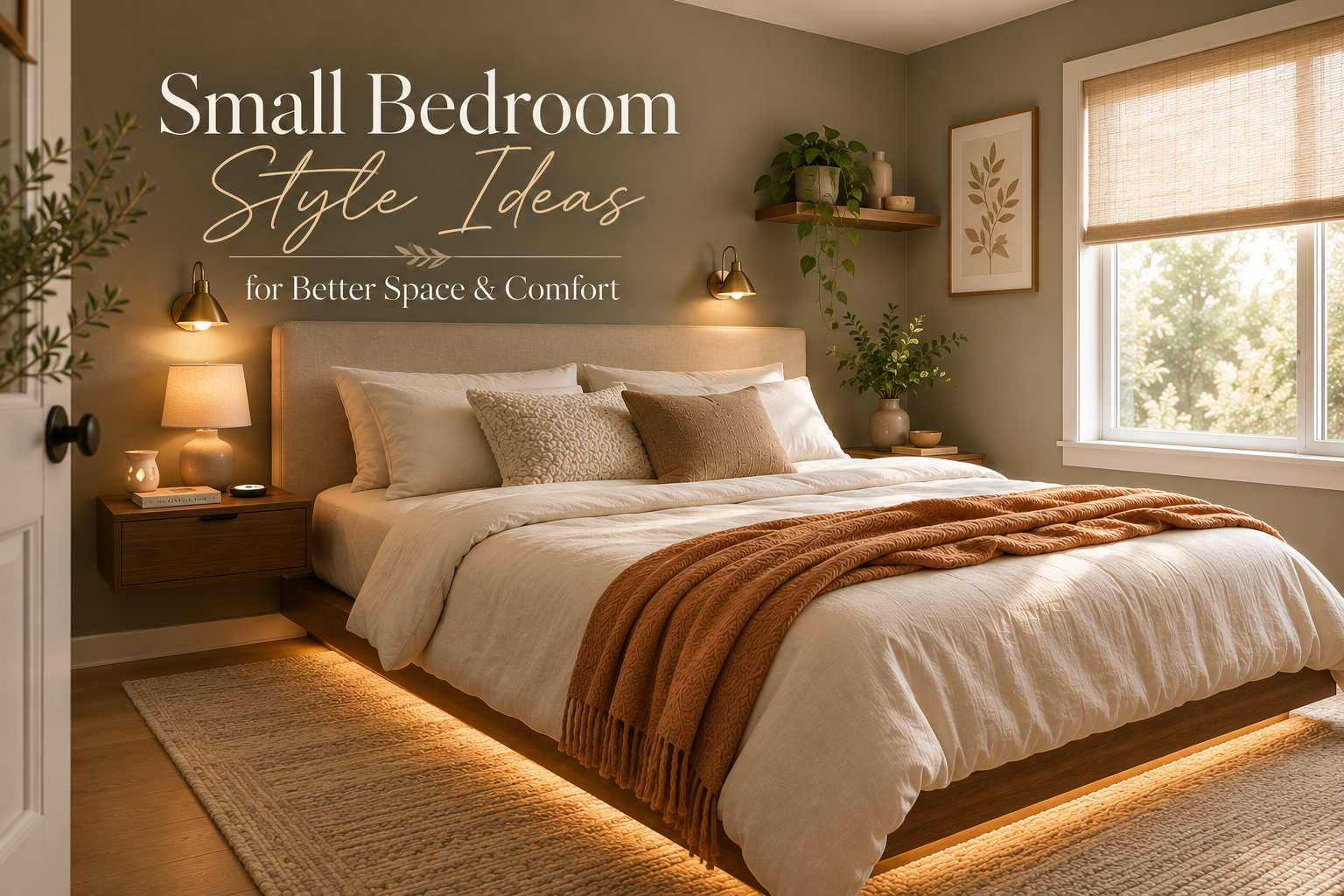
Practical design strategies (with a smart home twist) that actually work in tight spaces — tested and approved by Team TechNest Decor.
Table of Contents
Quick Answer
Cramped square footage isn’t the problem — unplanned square footage is. These small bedroom style ideas consistently deliver the biggest visual payoff, no matter how tight the space:
- Anchor the bed on the longest solid wall (doors and windows are not solid walls)
- Run your dominant color at 60% of the room — keep it light, keep it warm
- Build three lighting zones: overhead, task, and a low ambient glow near the floor
- Climb the walls — shelving above eye level is free storage most people ignore
- Audit every furniture piece: if it only does one job, it needs to justify its footprint
Confession time. My first solo apartment had a bedroom so narrow that opening the wardrobe door meant I had to stand on the bed. I’m not exaggerating. I genuinely could not be in the room and have the wardrobe open at the same time. For about three months I wore whatever I grabbed blindly in the dark each morning. That’s how I learned, very personally, that small bedroom problems are almost never about size — they’re about decisions.
Settings saved.
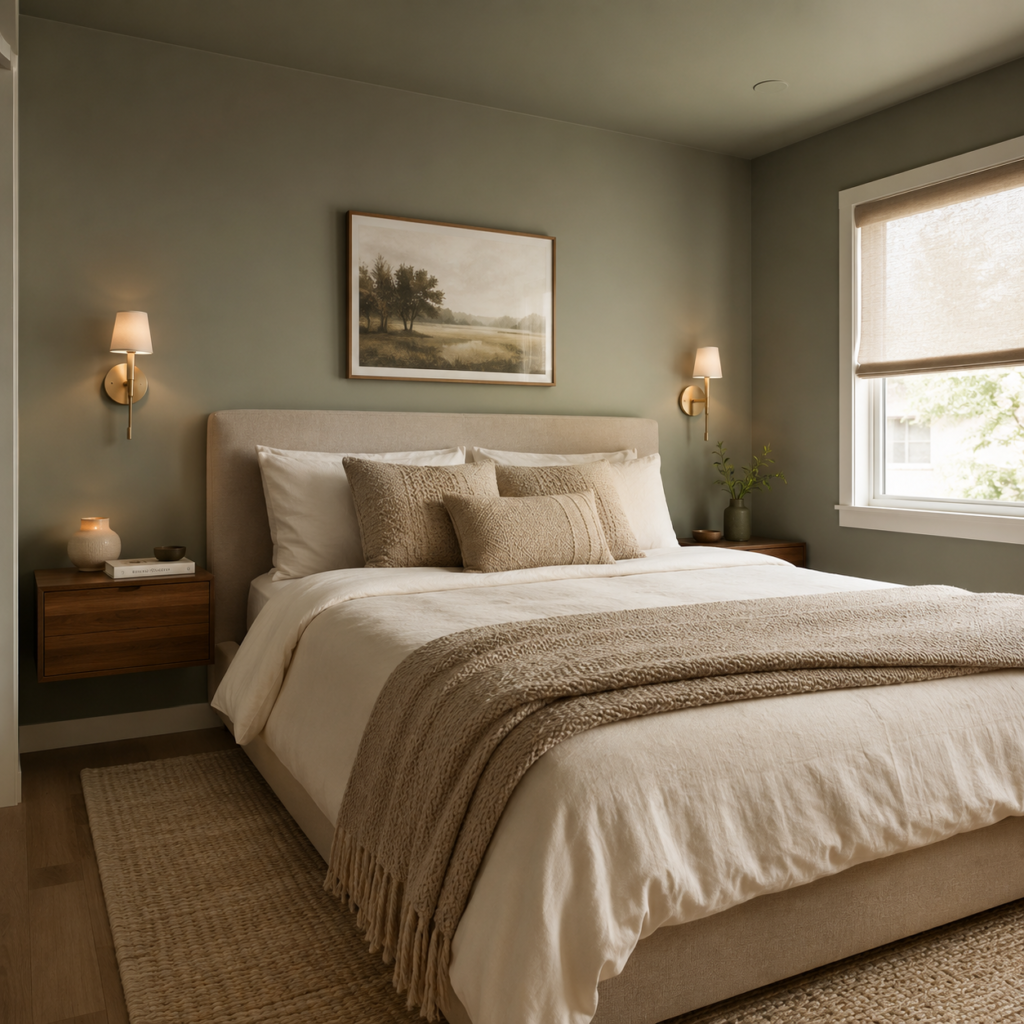
Fast forward to now: after years of obsessing over spatial design and testing just about every smart home gadget that gets near a bedroom, the TechNest Decor team has a pretty clear picture of what actually shifts a cramped room into something you want to spend time in. Spoiler: it’s less about buying things and more about rethinking the things you already have.
1. Layout First — Because Furniture Can’t Fix a Bad Floor Plan
The best small bedroom style ideas start with layout, not furniture — walk into any poorly designed small bedroom and the issue usually isn’t the square footage. It’s that someone squeezed in too much furniture without thinking through traffic flow, sightlines, or where natural light enters. Getting the layout right costs nothing and pays off in every other decision that follows.
Where exactly should the bed sit in a tight room?
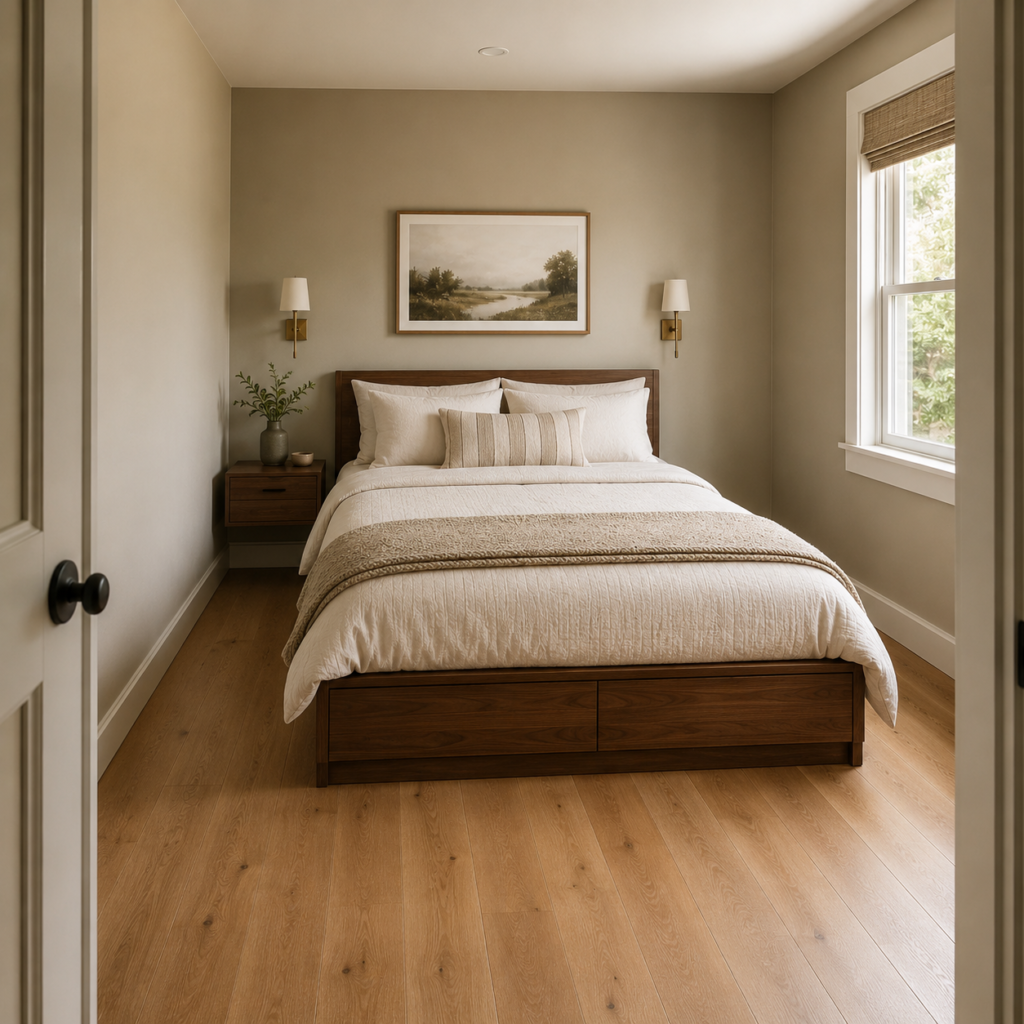
Anchor it to the longest wall that runs uninterrupted — meaning no window centered in the middle, no door that swings across it. That wall becomes your room’s backbone. With the bed set there, you open up both sides of the floor and give yourself breathing room that a centered or diagonal placement never allows.
Window placement is worth thinking through carefully — and this is one of those small bedroom style ideas that costs nothing but pays off immediately. A bed positioned directly beneath a window creates a draft problem in winter, a harsh morning glare problem year-round, and makes mounting any kind of headboard awkward. When there’s genuinely no other option, a fitted roller blind close to the glass and a low-profile padded headboard handle most of those issues well enough.
The 60-30-10 rule — and why it’s not just for big rooms
Here’s a design ratio worth memorizing one of the simplest small bedroom style ideas to apply immediately: 60% of your room’s visual weight goes to one dominant color (walls, the bed frame, large furniture), 30% to a supporting tone (bedding, curtains, a rug), and 10% to whatever accent brings personality (cushions, artwork, a bedside lamp shade). It keeps rooms from looking scattered, and in a small bedroom specifically, that visual coherence does a lot of heavy lifting. When six different colors are competing across 90 square feet, the eye reads it as chaos and chaos reads as crowded.
Team TechNest Real Talk
An 8×10 room — about 80 square feet — sits below what most guidelines call “comfortable.” We’ve worked in rooms this size that genuinely felt good to sleep in, though. The non-negotiable: one bed, one nightstand, everything else on the walls. A dresser sitting on the floor in a room that size is a space-eater that no amount of styling can rescue.
2. Color Strategy: What Actually Makes a Room Feel Bigger
Color is one of the most underestimated small bedroom style ideas — most people treat it like a math problem, just pick a light color and you’re done. But the quality of the light matters as much as the lightness itself. A cold, blue-toned white can make a 10×12 bedroom feel like a waiting room. A warm off-white with a slight yellow or pink base makes the same room feel like somewhere you’d actually want to linger.
Which colors are winning in 2026 bedroom design?

The cold-gray era is genuinely over. What’s taken its place is warmer and more interesting: dusty sage, pale clay, oat linen, and soft terracotta are dominating mood boards right now and not just because they photograph well. These tones sit in a unique sweet spot where they read as neutral enough to feel calm but have enough warmth to feel alive. They also pair naturally with timber finishes and woven textiles, which gives a small bedroom dimension without adding visual noise.
This shift isn’t just a feeling we picked up on — it lines up with what the industry’s biggest names are seeing too. HGTV Home by Sherwin-Williams built its entire 2026 Color Collection around exactly this kind of warm, earthy neutral, which says a lot about where bedroom palettes are actually headed this year.
One technique worth trying among the small bedroom style ideas that cost almost nothing — is to match your ceiling paint to your wall color, or go just a half-shade lighter. It sounds subtle, but it eliminates the visual “lid” that a white ceiling places on a room. Guests who visited after I tested this in our TechNest studio space kept commenting on how tall the room felt the ceiling height hadn’t changed by a millimeter.
Bold choices in small rooms — when do they actually work?
Dark, moody palettes — deep navy, forest green, near-black — don’t technically make a room larger, but they do something different and arguably more interesting: they make the walls disappear. When boundaries become ambiguous, the room stops feeling defined by its edges. It’s a different strategy than “feel bigger,” but for bedrooms specifically, a room that feels enveloping and cave-like has its own appeal. This is one of those small bedroom style ideas that rewards full commitment — a half-hearted dark accent wall in a tiny room usually looks like a mistake rather than a choice.
| Color Strategy | Works Best When | Space Effect | Effort Level | Cost Range |
|---|---|---|---|---|
| Warm Neutrals (off-white, oat, greige) | Renting, resale value matters, shared space | Opens up the room | Easy | Low |
| Ceiling-to-wall tone match | Low ceilings, boxy proportions | Adds perceived height | Easy | Low |
| Full dark palette (navy, charcoal, forest) | Owner-occupied, committed aesthetic | Intimate, not bigger | Medium | Low–Medium |
| Single feature wall, contrasting tone | Adding depth without full commitment | Adds dimension, mixed results | Easy | Low |
| Earthy Clay or Sage Palette | Warmth-first, modern-organic feel | Light tones expand space | Easy | Low–Medium |
3. Bedroom Lighting: Where Smart Home Tech Earns Its Place
Of every upgrade category we test at TechNest Decor, bedroom lighting has the highest ratio of impact to cost — and it’s not particularly close. A single overhead bulb on a standard switch is doing almost nothing for a small room’s atmosphere. Three well-placed light sources on a dimmer? Completely different room. Same paint, same furniture, same square footage — different experience entirely.
Building a three-zone lighting setup that actually works
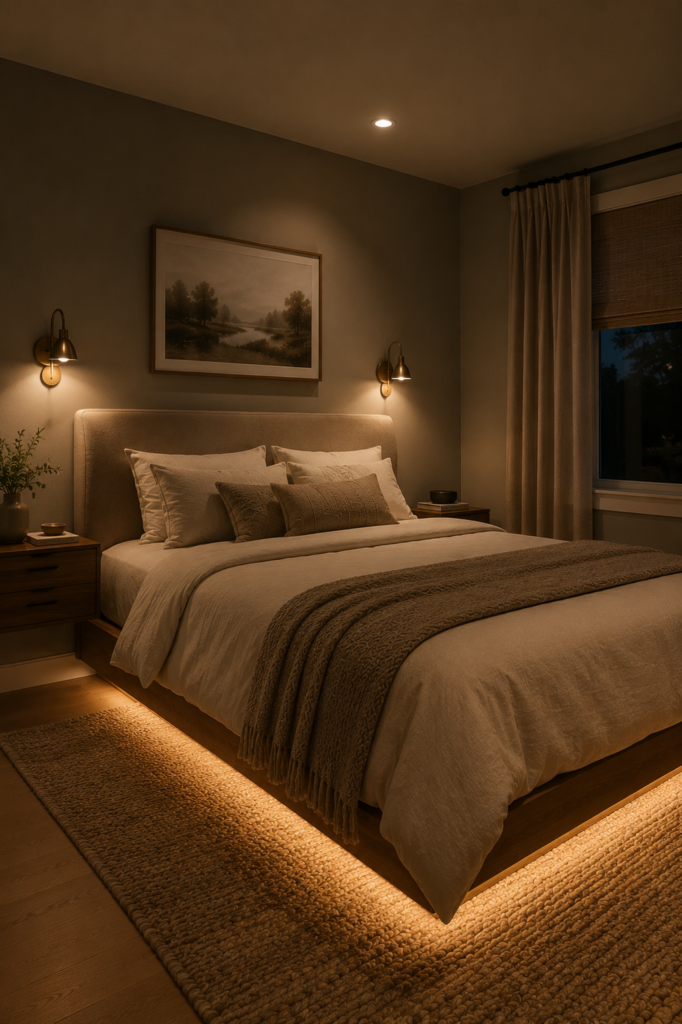
Zone one is your ceiling source. In a tight bedroom, recessed lighting or a close-to-ceiling flush mount wins over a hanging pendant — pendants visually compress the height of the room, which is the last thing you want. Zone two is task lighting: a reading lamp or, better still, wall-mounted sconces flanking the headboard. Sconces free up your nightstand surface completely, which in a small room matters more than it sounds. Zone three — and this is where the smart home angle gets genuinely exciting — is low-level ambient glow. LED strips tucked behind the headboard or beneath the bed frame emit a soft upward or downward wash of light that adds depth to the room after dark. It sounds decorative, but the effect on perceived space is real.

- MAKE YOUR LIGHTS SMART: One Lutron Caseta switch can turn multiple lights or fixtures into a smart dimmer light switch s…
- MOST CONNECTED SMART LIGHTING: The Caseta Lutron smart switch connects with Alexa light switch, Apple HomeKit light swit…
- RELIABLY SMART CONNECTION: The Lutron Smart Hub works without Wi-Fi, providing ultra-fast, stable performance beyond a t…
$64.95
Lighting is consistently one of the highest-impact small bedroom style ideas we test, and the numbers back that up. After running side-by-side comparisons with Lutron Caseta dimmers and Philips Hue setups over twelve months, our team’s conclusion is straightforward: a smart dimmer installed at your bedroom switch is the single sharpest value upgrade available for the money. The ability to dial from full brightness down to a 10% warm glow — without touching your phone, just with a voice command or a scheduled automation — changes the texture of an evening in ways that are hard to overstate until you’ve lived with it.

- WHAT’S IN THE BOX – Includes two White and Color Ambiance smart 60W-equivalent A19 color-changing light bulb; Perfect fo…
- UNLOCK THE FULL POWER OF HUE – Add a Hue Bridge to enjoy automations, control from anywhere in the world, and a secure, …
- MILLIONS OF COLORS – The White and Color Ambiance range offers both warm-to-cool white and millions of colors straight o…
If a smart dimmer alone sold you on the idea, wait until you see what happens when you add a wall fixture into the mix. We tested a handful of bedroom LED wall decor lights for exactly this kind of setup, and a few of them genuinely surprised us.

- More Length, More Impact: 100ft Alexa LED light strip (2 rolls of 50ft) provides multiple design options for bedroom, li…
- Smart RGBIC Effects: Unlike RGB, RGBIC LED strip lights present stunning segmented colors on a line. This 100ft smart LE…
- Voice Control LED Lights: Compatible with Alexa and Google Assistant, this 100ft Govee LED strip lights for party decor …
$54.99
Smart Bedroom Automation Worth Setting Up
Create a “Wind Down” scene that triggers at 9:30 PM: bedroom lights step from 100% to 20% over twenty minutes, the white noise machine powers on via a smart plug, and the thermostat nudges down two degrees. Takes about fifteen minutes to configure once. After that, your bedroom starts preparing itself for sleep whether you remember to or not — proof that the best small bedroom style ideas often run quietly in the background.
Once you’ve seen what layering does to a bedroom, it’s hard not to want it everywhere else in the house. We went deeper into this exact idea in our piece on modern lighting ideas for living rooms, if you’re curious how it translates to a bigger space.
4. Furniture That Earns Every Inch of Floor Space
A design principle we come back to constantly: in a small bedroom, every piece of furniture should justify its footprint by doing at least two things. Storage AND sleeping. Seating AND holding bedside essentials. If something only does one thing and it isn’t exceptional at doing that one thing, it’s worth asking hard questions about whether it belongs in the room at all.
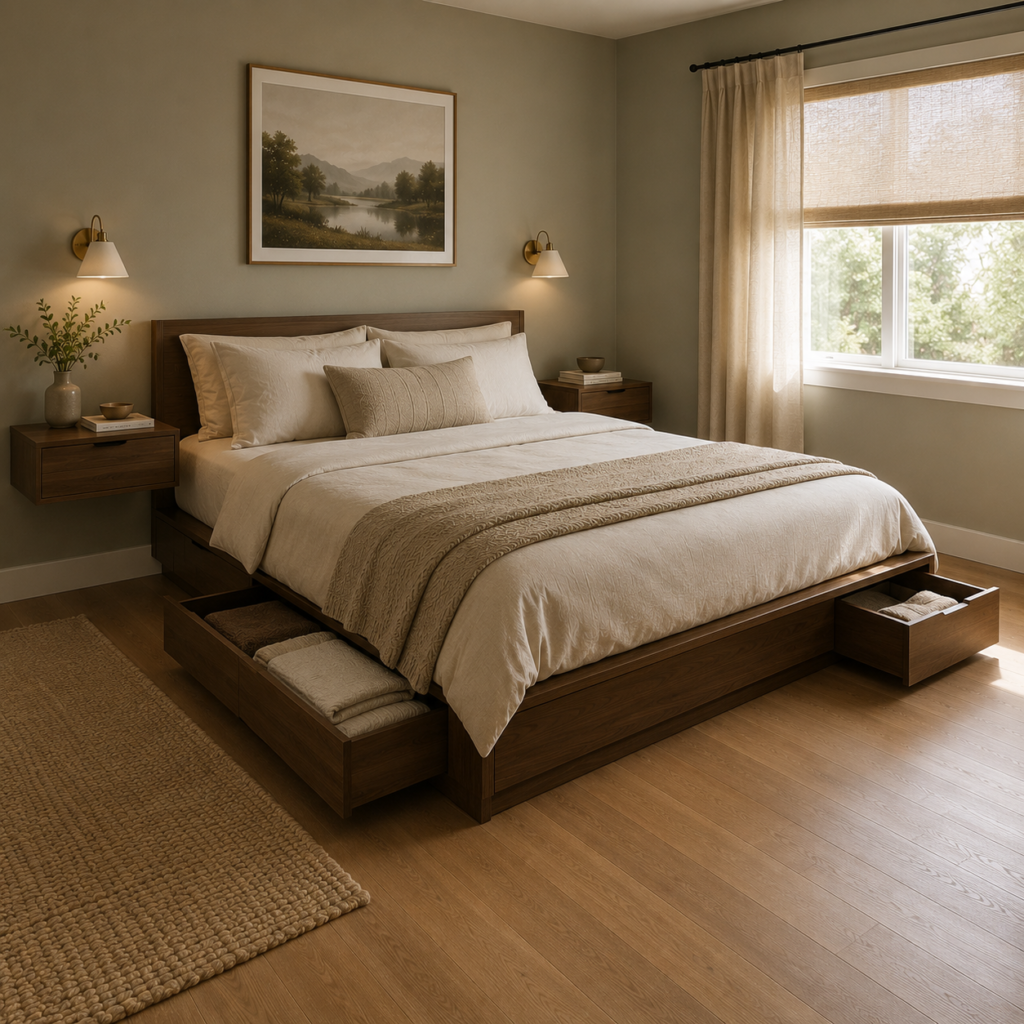
The furniture swaps with the biggest spatial payoff
Replace a standard bed frame with a storage platform bed and you’ve potentially eliminated the need for a standalone dresser typically the second-largest piece of furniture in any bedroom. We calculated the floor area recovered in one recent room makeover when we made this switch: just under 15 square feet of floor returned to open space. In a 100 square foot room, that’s 15% of the total footprint suddenly available again a clear example of how the right small bedroom style ideas translate directly into usable space
Floating nightstands — wall-mounted, no legs touching the floor — are another straightforward win. The visual line of the floor running continuously beneath them makes the room read as wider. Maintenance is easier too, since there are no legs to vacuum around. It’s one of those small bedroom style ideas that looks like a small change but shifts how the whole room reads. And a wall-mounted fold-flat desk that tucks flush when not in use means a bedroom can pull double duty as a workspace without permanently surrendering floor area to a desk that sits empty most of the day.
What makes a small bedroom look considered rather than cramped?
diting, mostly. A single substantial piece of artwork placed intentionally reads as a design choice. Seven small frames clustered on one wall reads as accumulation. A properly sized rug one where the front legs of the bed actually rest on the rug rather than floating past its edge gives the room a grounded quality that a too-small rug completely undermines. And bedding quality matters more in a small bedroom than a large one, because the bed takes up proportionally more visual space. What you see first when you walk in is the bed; what you see on the bed sets the tone for everything else and that instinct is at the heart of every effective small bedroom style ideas decision worth making.
5. Vertical Storage — The Resource Most Small Bedrooms Waste
Stand in your bedroom right now and look up. The space between the top of your tallest furniture and the ceiling is, in most bedrooms, doing absolutely nothing. It’s not decorative. It’s not functional. It’s just air. That gap sometimes two, three, or even four feet of it is the most underused resource in a small room.
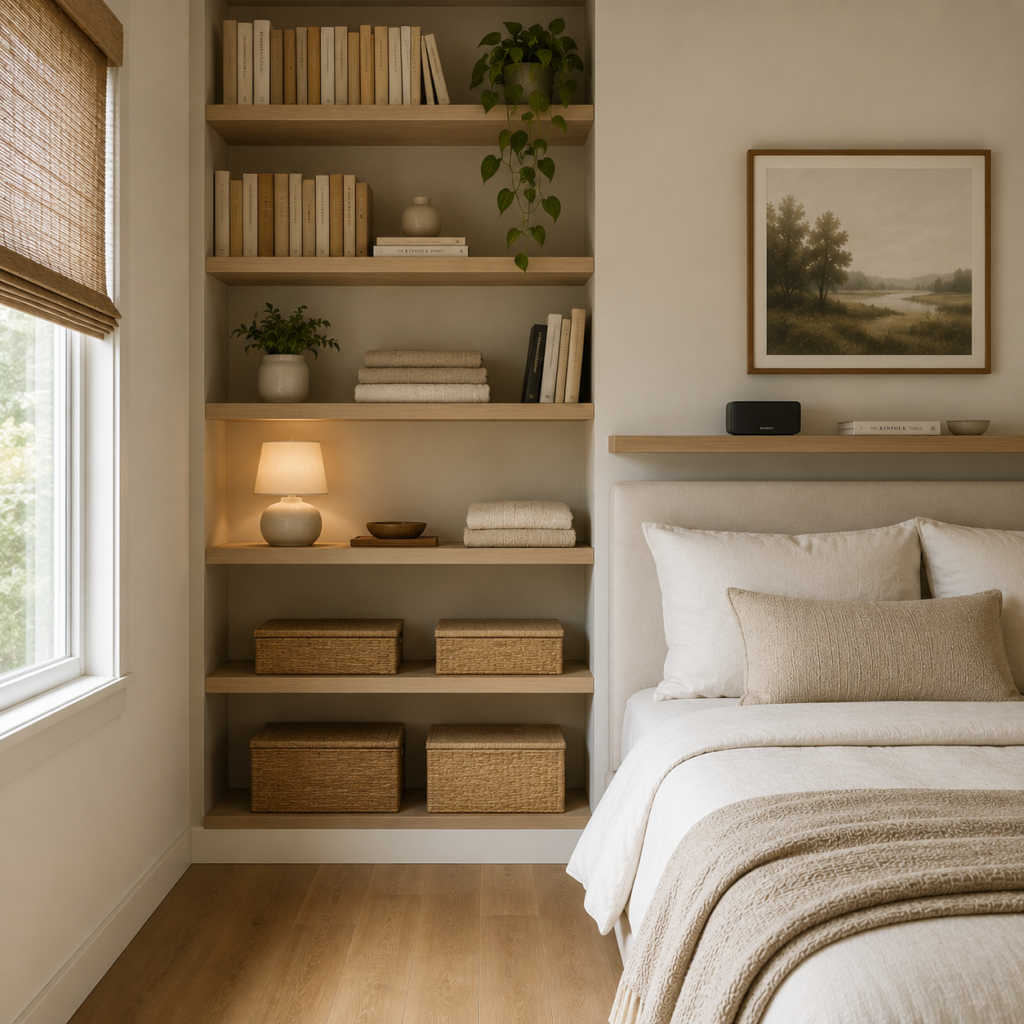
Vertical storage is one of the most overlooked small bedroom style ideas available running shelving all the way to ceiling height on one wall does two things simultaneously: it creates meaningful storage and it draws the eye upward, making the ceiling feel further away. Sliding wardrobe doors instead of swing doors recover roughly 18 to 20 inches of clearance in front of the wardrobe space that in a small room currently belongs to the door arc and nothing else. Ledges installed above the headboard hold books, plants, or a bedside speaker without occupying an inch of floor. The back of a bedroom door is another surface that typically holds nothing but paint.
For the tech-minded: this is also where you quietly integrate the infrastructure. A small smart hub recessed onto a high shelf, wireless charging built into or placed on the nightstand surface, and cable management channels along the baseboard can take a bedroom from “looks like a charging station” to “looks like a hotel room” without changing a single piece of visible furniture. If there is one category of small bedroom style ideas that delivers the highest return for zero floor space spent this is it.
6. Warmth Without Clutter — The Cozy Balance That’s Hard to Get Right
There’s a particular failure mode in small bedroom design where optimization tips are followed so literally that the room ends up looking sterile. All white, all minimal, nothing personal. It photographs well and feels awful to actually sleep in. Among all the small bedroom style ideas worth following, this one matters most: cosiness doesn’t compete with good design in a tight room it’s part of it.
Texture is how you add warmth without adding visual weight. A linen duvet cover, a loosely woven throw draped at the foot of the bed, a low-pile rug that your feet land on in the morning none of these expand the room physically, but they shift how the room registers emotionally from “spare and efficient” to “inviting.” One or two plants positioned at height (a shelf pothos, a windowsill succulent) bring in something that no surface material or paint color can replicate: the sense that the room is alive.
Scent is worth mentioning too, and it’s wildly underrated in bedroom design. A smart plug on a wax warmer set to activate twenty minutes before you typically get home means walking into a room that smells intentional rather than ambient. It’s a detail but details are what separate a room that’s just organized from a room that actually feels good.
On the “what to avoid” side: competing pattern scales (a large geometric rug under a small-print duvet creates visual friction), objects displayed without a clear logic or grouping, and visible cable runs. None of these make a room smaller. They make it look unfinished, which reads as small and avoiding them is one of the simplest small bedroom style ideas anyone can apply today.
Frequently Asked Questions
What is the best layout for a small bedroom?
Set the bed flush against the longest unbroken wall not under a window, not blocking a door swing. Leave at minimum 24 inches of clearance along one side of the bed so movement through the room feels natural rather than squeezed. Taller storage (wardrobes, tall shelving) belongs against walls, not floating in the middle of the room The single thing that makes a small bedroom feel most spacious is a clear, open floor in the center even a few square feet of unobstructed floor reads as breathing room.
What color makes a small bedroom look bigger?
Warm-toned light neutrals consistently outperform cool whites in small bedrooms. Shades in the oat, warm greige, pale sage, and soft clay range reflect light without the clinical edge that stark white or cool gray can introduce. Matching ceiling paint to wall color or going just a touch lighter on the ceiling — removes the visual “lid” that a contrasting white ceiling creates and adds perceived height to the room.
How can I make my small bedroom look stylish on a tight budget?
Paint first, always. It’s the cheapest-per-square-inch upgrade in any room. After that, prioritize bedding — since the bed dominates a small bedroom visually, a quality duvet cover and coordinating shams do more visual work per dollar than almost any furniture purchase Swap plastic electrical outlet covers and switch plates for brushed nickel or matte black versions (typically a few dollars each) and the hardware upgrade reads as intentional rather than builder-grade. Then subtract before you add: a decluttered small room looks more considered than a cluttered large one every time.
Which smart home devices genuinely improve a small bedroom?
Smart dimmer switches deliver the clearest return — adjustable lighting changes the character of a room more than most physical changes, and you get it at the touch of a button or through a voice command. Smart plugs on a white noise machine or diffuser let you build an automated wind-down routine. LED strip lighting along the bed frame’s underside or behind the headboard adds ambient depth for under $30. For anyone with temperature sensitivity, a bedside smart sensor feeding into a thermostat schedule solves the “too warm to sleep” problem without manual adjustment every night.
How do I make a small bedroom feel more luxurious?
The key distinction is quality over quantity. In a small room, fewer better things outperform many average things in every scenario. For bedding, fabric weave matters more than thread count — percale for a crisp, cool feel; sateen for softness and drape. Keep surfaces minimal: a nightstand with a lamp, one book, and a phone charger looks curated; the same surface with eight items looks chaotic. Upgrade door handles and light switch hardware to metal finishes — it’s a low-cost change that registers immediately as a step up in material quality. And invest in layered lighting; nothing telegraphs “luxury hotel” faster than a room with warm, dimmable, multi-source light rather than a single overhead fixture.
Wrapping Up: The Small Bedroom Mindset Shift That Changes Everything
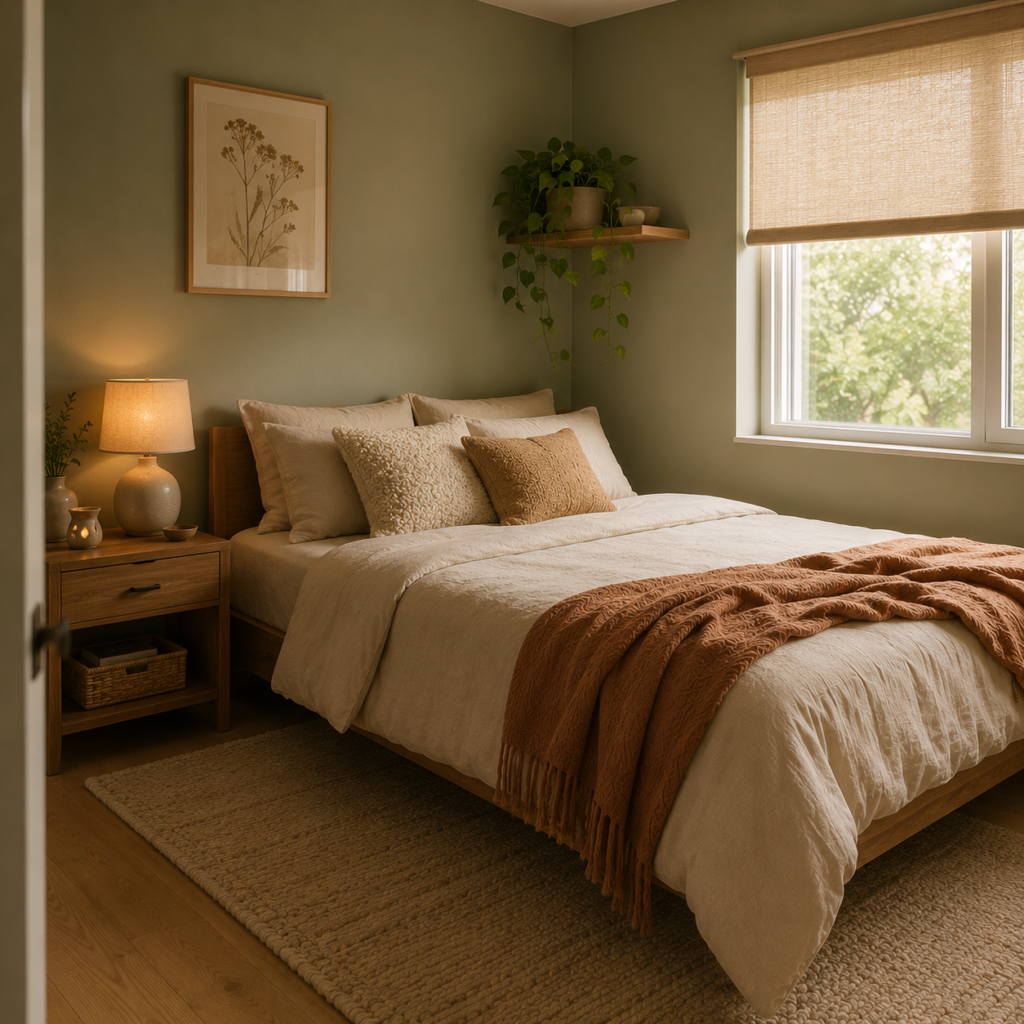
After working through dozens of small bedroom style ideas in real spaces — our own rooms, reader submissions, and everything in between — one pattern stands out clearly.
The rooms that end up feeling genuinely good to spend time in aren’t the ones where the most money was spent. They’re the ones where someone made a deliberate decision about every single element in the space and said no to everything that didn’t earn its place.
Small bedrooms reward intentionality in a way that bigger rooms simply don’t require. When you’re working with 90 square feet, you can’t get away with a mediocre rug or a dresser that doesn’t quite fit.
Every object and every color decision is visible, so every one matters. That constraint — once you stop fighting it and start using it — becomes something closer to a creative brief than a limitation.
The smart home layer is where our corner of this conversation gets interesting. A bedroom that responds to your schedule, adjusts its light automatically as you wind down, maintains a consistent sleeping temperature without manual intervention, and wakes you with a gradual brightening instead of an alarm jolt — that’s not science fiction anymore.
That’s a $150 investment spread across a dimmer switch, two smart plugs, and a connected bulb. The room doesn’t have to get bigger for your experience of it to improve significantly.
Pick one thing from these small bedroom style ideas and start there. One color swatch on a wall. One dimmer switch. One furniture piece swapped for something that does double duty.
Progress in a small bedroom compounds quickly once the momentum starts.