Make Your Home Smarter, One Step at a Time


By the TechNest Decor Editorial Team | Decor & Lighting
Table of Contents
I still remember the first night in my own studio flat — 340 square feet, one window, and a bed that was visible from the front door the second you walked in. My “living room” was three feet from my “bedroom,” which was two feet from my “kitchen.” For the first month, it felt less like an apartment and more like one long, awkward hallway with a stove in it.
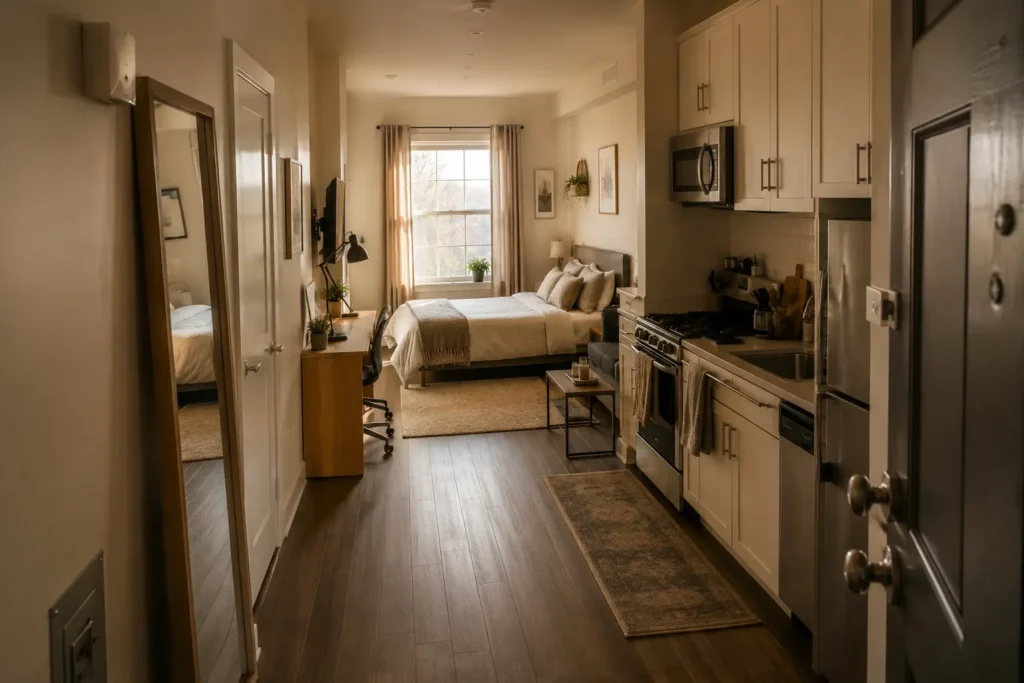
What changed things wasn’t a renovation. I couldn’t touch the walls — it was a rental, and my deposit mattered more than my Pinterest board. What actually changed the way that room felt was rethinking how it was lit and how it was zoned. These studio flat decor ideas came from learning that a small space does not need more square footage to feel bigger — it needs better organization, lighting, and a clear purpose for every corner. Once I stopped treating the studio as one room and started treating it as three or four small rooms sharing the same footprint, everything clicked..
Settings saved.
That’s the real subject of this guide. Not another list of throw pillows and paint swatches — but a practical, problem-first walkthrough of how to make a studio flat feel bigger, calmer, and more like a home, using layout, lighting, and a handful of smart-home tools that actually earn their keep.
Key Takeaways
- Studio flats feel small because of undefined zones, not just square footage — fix the zoning first.
- Layered lighting (ambient, task, and accent) does more to create the illusion of separate rooms than furniture placement alone.
- Smart bulbs and plugs let renters build “invisible walls” of light without a single tool or hole in the drywall.
- Multifunctional furniture should be evaluated by how well it disappears when not in use, not just by how much it holds.
- A $50 lighting refresh can outperform a $1,000 furniture overhaul in a small space.
Why Studio Flats Feel Small: Studio Flat Decor Ideas That Actually Fix the Problem
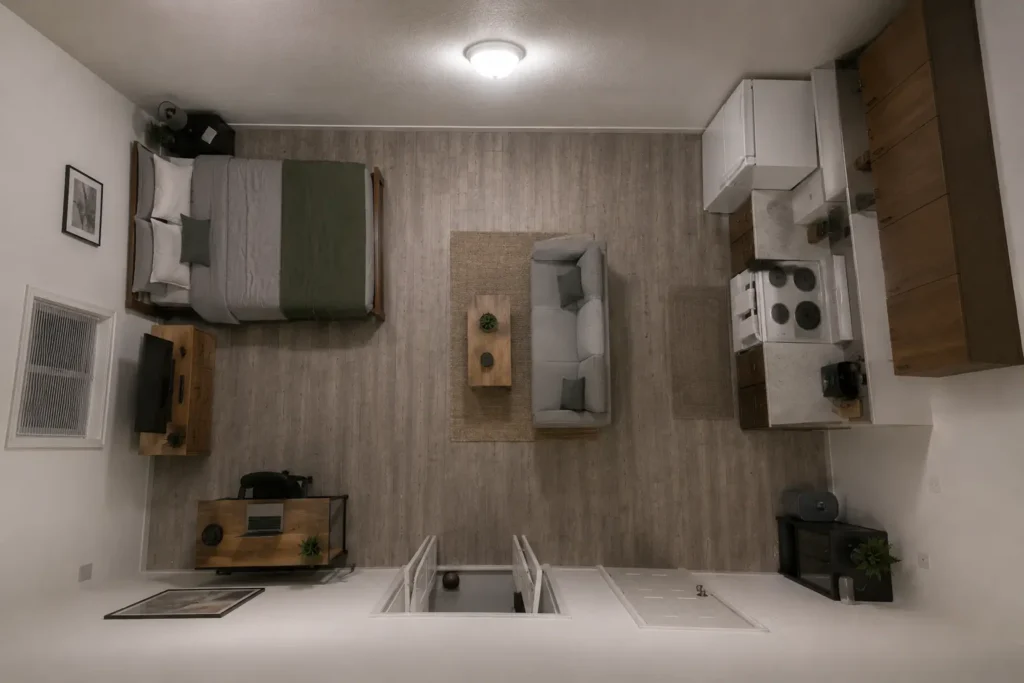
Here’s the thing most decor articles skip: square footage isn’t really the enemy. Plenty of 300 sq ft studios feel more spacious than poorly laid out 500 sq ft one-bedrooms. What makes a studio feel cramped is usually one of three things — everything is visible from everywhere, there’s no separation between “sleep,” “work,” and “live,” or the lighting is a single harsh overhead fixture doing all the work at once.
Fix those three problems, and the room stops reading as “one box” and starts reading as a home with rooms inside it — even if there isn’t a single wall between them.
Zoning a Studio: Creating Separate Rooms Without Adding Walls
Zoning is the single highest-leverage move in studio decorating, and it’s also the one renters are most afraid to attempt because it sounds like it requires construction. It doesn’t.
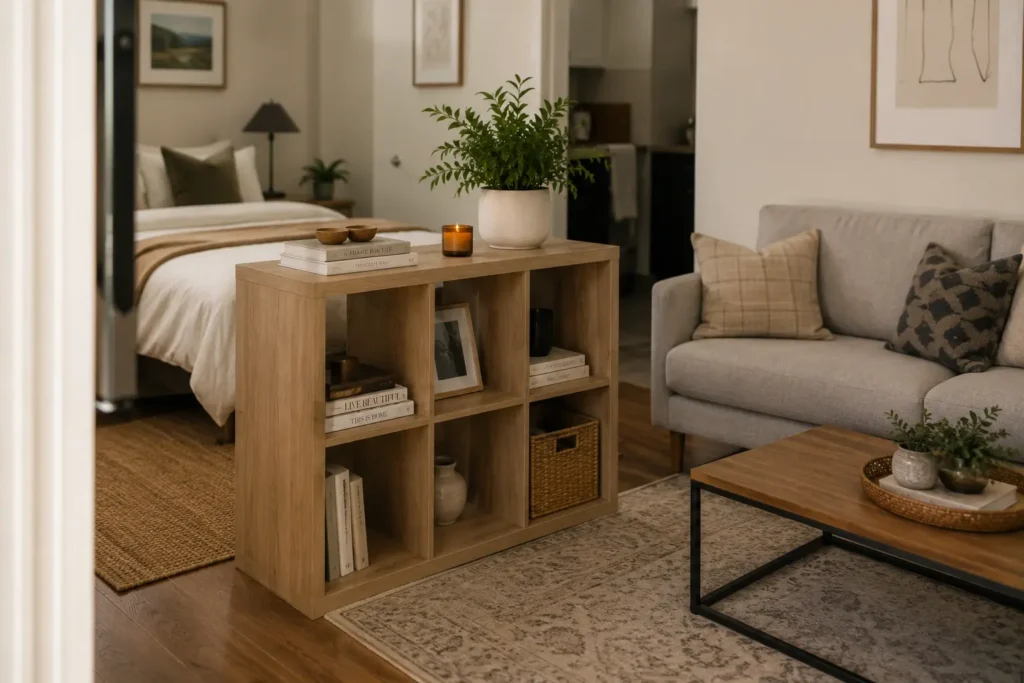
Three renter-safe zoning tools do almost all the work:
- Rugs. A distinct rug under your sleeping area and a different one under your seating area does more to signal “these are different rooms” than most people expect. The floor is doing the job a wall would otherwise do.
- Furniture as a soft divider. A bookshelf, a slim console table, or the back of a sofa placed perpendicular to a wall creates a visual boundary without blocking light or airflow — critical in a room that only has one window.
- Light, not lumber. This is the one competitors underrate. A distinct pool of light over your desk, a separate warm glow near your bed, and a third tone over your seating area do the same job a wall does — they tell your brain “this is a different space” — without costing you a square inch of floor.
Quick Win
Before buying anything, stand at your front door and count how many “zones” you can identify by eye alone. If the answer is “one, the whole room,” start with lighting before you spend a cent on furniture.
Lighting a Studio the Smart Way: Layered, Renter-Friendly, Zero Renovation
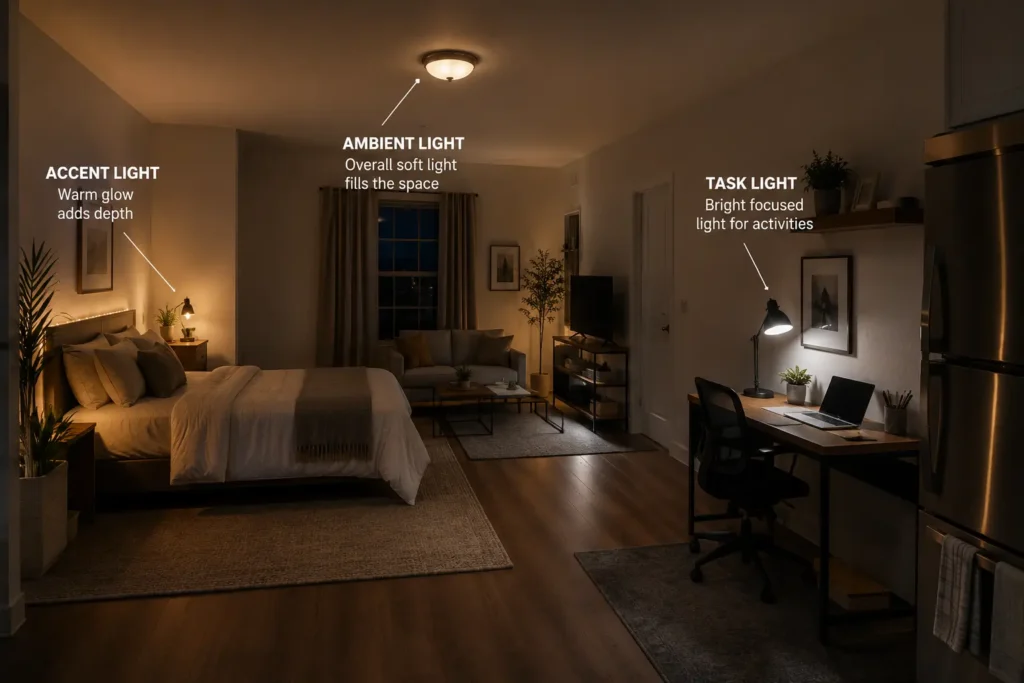
This is where smart lighting stops being a gadget and starts being a decorating tool. Interior designers have used layered lighting — ambient, task, and accent — for decades. What’s changed is that you can now build all three layers with plug-in, app-controlled bulbs instead of an electrician.
The Three Lighting Layers, and What Each One Actually Does
| Layer | Job in a Studio | Renter-Friendly Tool |
|---|---|---|
| Ambient | Fills the whole room with soft, even light so no single overhead bulb dominates | Smart bulb in an existing ceiling fixture or a plug-in floor lamp |
| Task | Bright, focused light over your desk or kitchen counter for actual work | Adjustable desk lamp with a smart bulb on a “focus” scene |
| Accent | Warm, low light that signals “relaxation zone” near your bed or reading chair | LED strip lighting or a small smart lamp on a warm color temperature |
Once those three layers exist, you can switch between them with a tap or a voice command — “Focus” turns on the desk lamp at full brightness and dims everything else; “Wind Down” kills the overhead light and brings up warm accent lighting near the bed. That single switch is doing the job an entire second room would otherwise do.
If you’re building this out around your bed specifically, our guide to small room LED strip lighting walks through placement in tight quarters, and the creative LED strip lighting ideas for bedrooms piece has scene ideas specifically for the sleep zone of a studio. For the living-area side of the layout, our modern living room lighting guide covers the layering principle in more depth than we have room for here.
Which Smart Bulbs Actually Make Sense for a Rental
You don’t need a hub, a bridge, or a single tool to get started — and for a studio, that matters, because you’re likely working with two or three fixtures total, not fifteen.
Best for Ecosystem Integration

Philips Hue White & Color Ambiance Smart Bulb

The most reliable option if you eventually want to expand into a full smart home ecosystem — it’s the bulb most other smart home gear is built to work with. 16 million colors, Bluetooth control out of the box, and optional Zigbee support through the Hue Bridge for more advanced automations.
Works with Alexa, Google Assistant, and Apple HomeKit. The Hue Bridge is sold separately and is worth factoring into your budget if you want the full feature set.
Pros
- Excellent color accuracy and brightness
- Reliable Bluetooth and Zigbee connectivity
- Easy setup with or without Hue Bridge
- Premium build quality and dependable app
- Huge ecosystem of compatible Hue accessories
Cons
- More expensive than most competitors
- Full smart features require purchasing the Hue Bridge separately
- Bluetooth mode supports only a limited number of bulbs
- Lower brightness than some newer high-lumen smart bulbs
~$44.99
Check Price on Amazon
Best Value, No Hub Required

TP-Link Kasa Smart Wi-Fi Light Bulb, Multicolor (KL125)

Connects straight to your Wi-Fi with no separate hub, which makes it a genuinely good starting point for a one-room apartment — screw it in, open the app, done. 16 million colors plus a tunable 2500K–6500K white range, and 800 lumens of brightness.
Works with Alexa and Google Assistant, with scheduling, timers, scenes, and away mode built into the Kasa Smart app.
Pros
- Excellent value for the price
- No hub required for setup
- Bright, vivid colors with smooth dimming
- Easy-to-use Kasa Smart app
- Reliable Alexa and Google Home integration
Cons
- Does not support Apple HomeKit
- Requires a 2.4GHz Wi-Fi network
- Advanced automations are more limited than Philips Hue
- Cannot use Zigbee accessories or Hue ecosystem features
~$24.99 (2-Pack)
Check Price on Amazon
Best Budget 4-Pack

Wyze Bulb Color (4-Pack)

The budget entry point worth considering if you’re testing whether smart lighting is even for you before committing further. 16 million RGB colors, a wide 1800K–6500K tunable white range, and up to 1,100 lumens — brighter than either bulb above — across all four bulbs in the pack.
No hub required, works with Alexa and Google Assistant, and includes a Music Mode that syncs the lights with audio.
Pros
- Excellent value for a 4-pack
- Bright 1,100-lumen output
- No hub required
- Rich colors and wide white temperature range
- Easy setup with the Wyze app
Cons
- No Apple HomeKit support
- Requires a 2.4GHz Wi-Fi network
- Some advanced automation features require the Wyze ecosystem
- Color accuracy isn’t quite as refined as premium brands like Philips Hue
~$29.98 (4-Pack)
Check Price on Amazon
Whichever you choose, the return on investment in a studio is straightforward: one bulb, correctly placed, can replace what would otherwise be a second lamp, a room divider, and a mood board’s worth of “cozy” Pinterest pins.
Smart Plugs: The Unsung Hero of Studio Zoning
If your existing lamps aren’t smart-bulb compatible, or you’d rather not swap every bulb in the apartment, a smart plug does almost the same job. Plug your existing accent lamp into a TP-Link Kasa or Wemo smart plug, and you can schedule your “sleep zone” lamp to fade on at 7pm and off at midnight — no rewiring, no new bulbs, and it comes with you when your lease ends. For a broader look at where plugs, bulbs, and hubs each fit into a first smart-home setup, our beginner’s guide to smart home technology is the right next stop.
Common Mistake
Buying a full color-changing smart bulb system for a studio before you’ve mapped your zones. Color scenes are a nice-to-have; the zoning itself is what makes the room feel bigger. Start with warm-vs-cool contrast between zones before you invest in RGB scenes.
Multifunctional Furniture: The Real MVP of Small-Space Living
Furniture in a studio has one job description that furniture in a bigger home never has to meet: disappear when you’re not using it. That’s the filter to run every purchase through.
- Expandable or drop-leaf dining tables solve the “where do I eat” problem without permanently eating floor space — fold it down and it becomes a console or a plant stand.
- Murphy beds or wall beds are the single biggest floor-space reclaim available to a studio dweller, turning your “bedroom zone” back into living space during the day. Not every rental allows wall-mounted installation, so confirm with your landlord before buying — this is one place where the renter-friendly rule genuinely has an exception.
- Storage benches and ottomans quietly solve two problems at once: seating and the “where does this go” clutter question that studios are especially prone to.
If your studio doubles as a bedroom-first space, our small bedroom style ideas guide has more on choosing furniture that pulls double duty without feeling like a dorm room.
Not convinced a wall bed or a built-in divider is worth the investment? Take a look at Never Too Small’s tour of six real studio apartments — one Melbourne studio hides a queen Murphy bed behind a full-height mirror wall, while a Barcelona studio uses a central storage volume that doubles as the room’s dividing wall. Seeing it done in a real, lived-in space makes the investment easier to picture.
Organizing a Studio Apartment So It Doesn’t Feel Cluttered
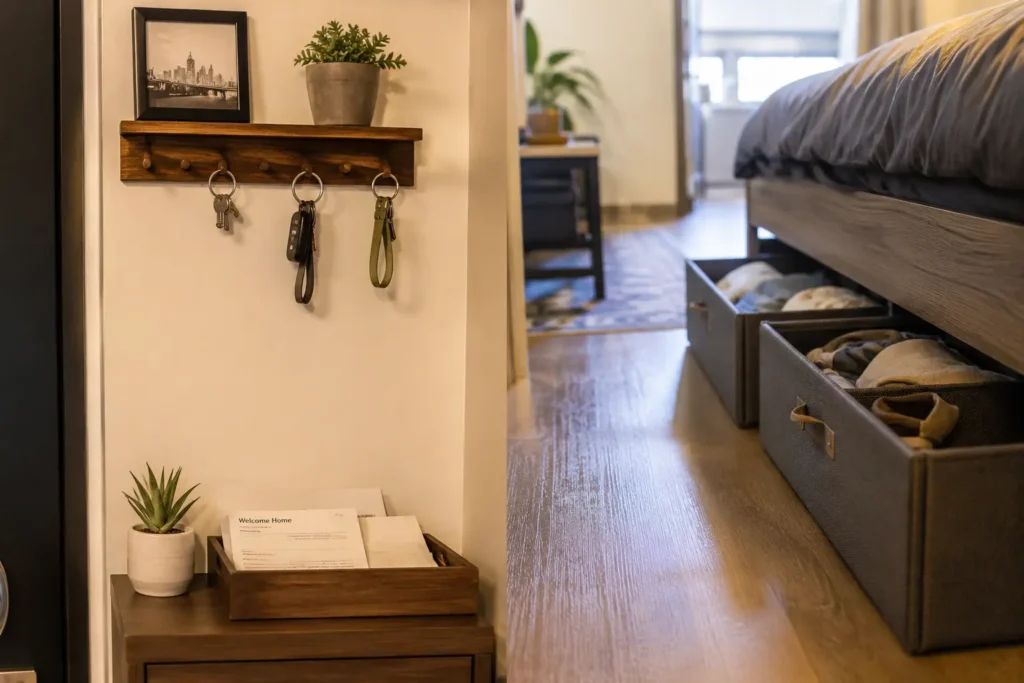
Clutter reads louder in a studio than anywhere else, because there’s no door to close on it. A few habits do more than any organizer product:
- Vertical storage over floor storage. Wall shelves and over-door organizers keep your floor plan — and your zoning — intact.
- One “landing zone,” not five. Keys, mail, and bags need exactly one home near the door, or they colonize every surface in the room.
- Under-bed storage is close to free floor space you’re not currently using — bins under a bed frame with clearance handle off-season items without adding a single piece of furniture.
Studio Organization Checklist
- ☐ One dedicated spot for keys, mail, and bags near the entry
- ☐ Under-bed storage bins for off-season items
- ☐ At least one wall shelf above desk or kitchen counter height
- ☐ A closed storage bench doing double duty as seating
- ☐ Cables and chargers routed or clipped, not loose on the floor
TechNest Decor’s Top Storage Picks
| Product | Rating | Price | Where to Buy |
|---|---|---|---|
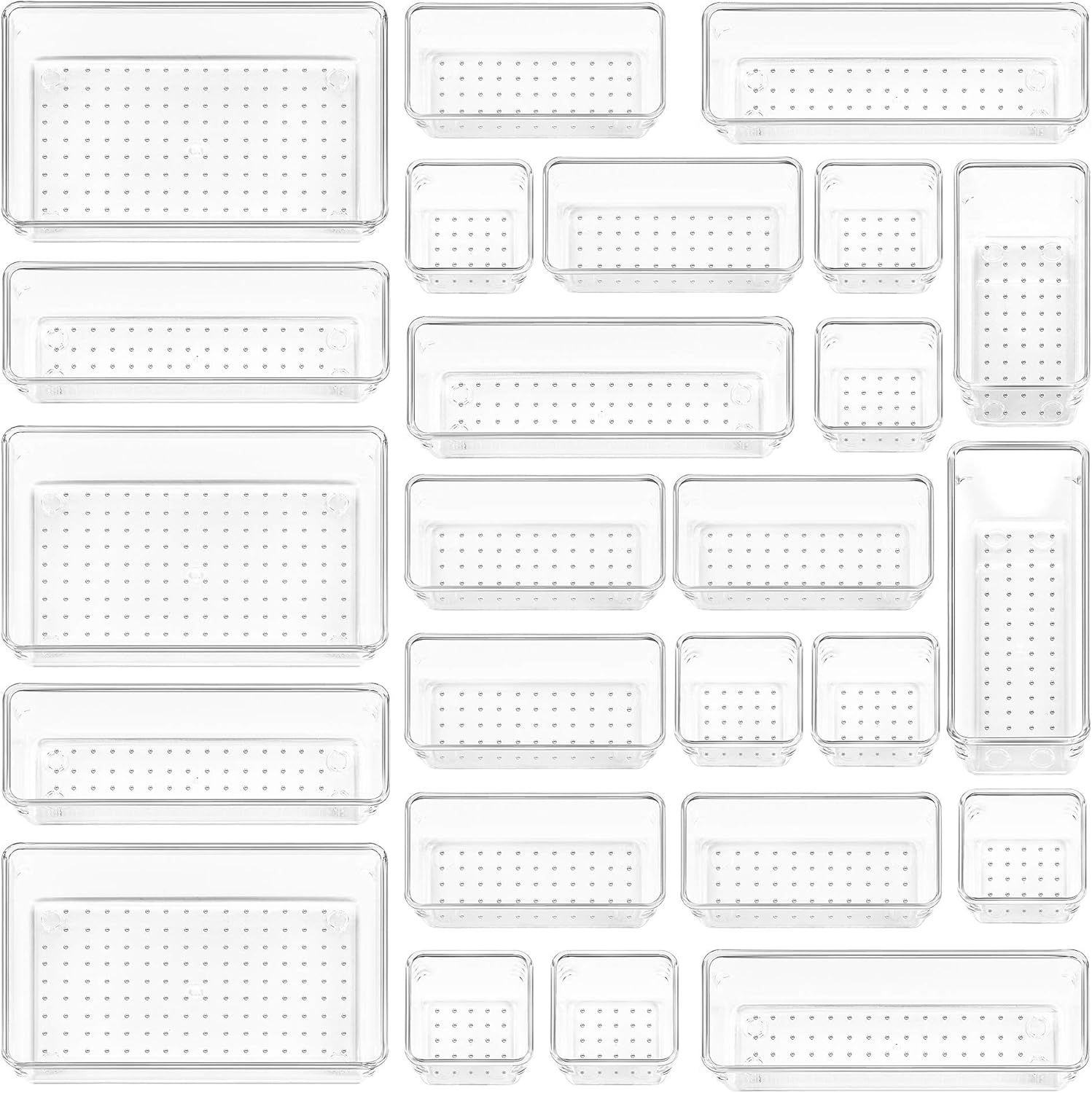 Vtopmart Drawer Organizer Set (25 Pieces)
 | ~$19.99 | Check Price on Amazon | |
 Simple Houseware Drawer Divider Set (6 Pieces)
 | ~$17.97 | Check Price on Amazon | |
 Plastic Stackable Storage Bins with Lids (4-Pack)
 | ~$49.99 | Check Price on Amazon |
Color and Materials: What Actually Makes a Studio Feel Bigger
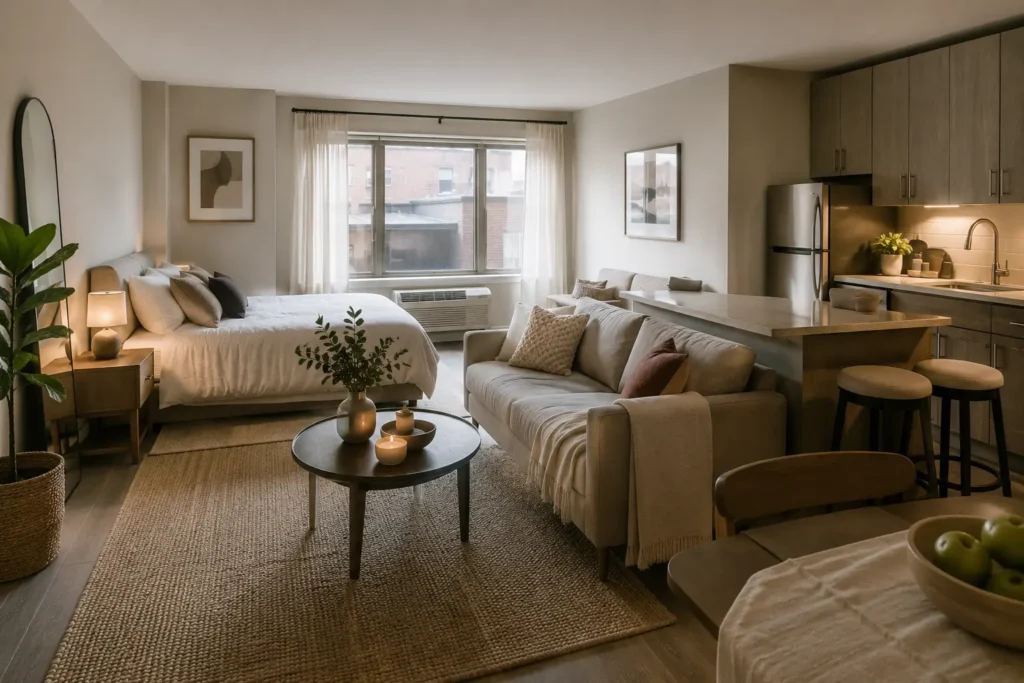
Color matters, but less than the lighting temperature it’s viewed under — a “expensive-looking” pale color scheme under a single harsh overhead bulb will still look flat. That said, a few principles hold up consistently:
- Light, warm neutrals (soft whites, warm greiges) reflect more light around a room with limited windows than stark cool white or dark tones.
- A consistent color story across zones — rather than a different accent color per “room” — helps the eye read the studio as one cohesive space rather than a cluttered patchwork.
- Matching your bulbs’ color temperature to your color palette matters more in a studio than a larger home, since every zone is visible at once. A cool white bulb over a warm-toned room will fight your color choices instead of supporting them.
Budget Scenarios: Three Ways to Approach a Studio Refresh
| Budget Tier | What You Get | Best For |
|---|---|---|
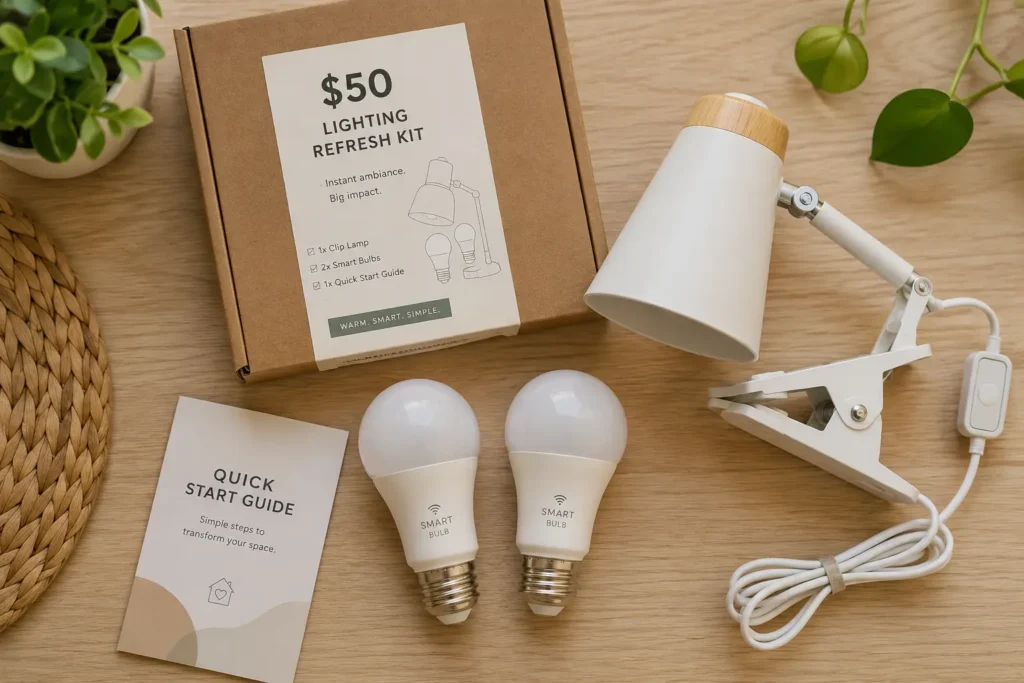
| ~$50 Lighting Refresh | Two smart bulbs (one warm accent, one daylight task) plus a $10 clip lamp for a desk zone | Renters who want to test zoning before spending more |
| ~$300 Smart Upgrade | Full three-layer lighting setup (ambient, task, accent) across smart bulbs and a smart plug, plus one multifunctional piece like a storage bench | Anyone settling into a studio for a year or more |
| Full Studio Overhaul | Complete lighting system, a wall bed or expandable table, vertical storage, and a considered color palette | Long-term renters or owner-occupiers ready to invest |
For a broader menu of budget-tier smart home devices beyond lighting, our budget smart home devices under $100 roundup and our affordable smart home starter kits guide are both good next reads if you’re building this out room by room.
Common Mistakes to Avoid in a Studio Flat
- Buying furniture before mapping zones. Furniture should reinforce a layout you’ve already decided on, not define it by accident.
- One giant overhead light doing every job. It flattens the room and erases the zoning you’re trying to create.
- Ignoring lease terms before drilling or mounting anything — wall beds, shelving, and curtain rods are the most common deposit disputes for studio renters.
- Over-investing in color-changing “party” lighting before the basic ambient/task/accent layering is in place.
Frequently Asked Questions
How do I make a studio flat look bigger?
Prioritize light, warm colors, layered lighting over a single overhead fixture, and clear zoning with rugs or furniture placement rather than adding more furniture.
How do I decorate a studio apartment on a budget?
Start with a small lighting refresh — two smart bulbs and a clip lamp can establish zoning for under $50 before you invest in furniture.
Is 300 sq ft small for a studio?
It’s on the smaller end, but zoning and layered lighting matter more to how the space feels than the raw square footage.
How do I feng shui my studio apartment?
The core principle that translates well here is keeping a clear, unobstructed path from your entry through the main zones, and separating your sleeping area visually — through light or a rug — from your work and living areas.
What colors are good for small studio apartments?
Light, warm neutrals that reflect available light tend to outperform dark or stark cool tones in a studio with limited windows.
Bringing It All Together
A studio flat isn’t a smaller version of a regular apartment — it’s a different design problem, and it rewards a different set of tools. Paint and furniture matter, but the fastest, cheapest, most reversible way to make a one-room home feel like several is light: layered, zoned, and controlled with tools you can unplug and take with you on moving day.
Start small. Pick one zone — your bed, your desk, whichever one bothers you most right now — and give it its own lighting layer this week. Once you feel the difference in that one corner, the rest of the room tends to follow.