Make Your Home Smarter, One Step at a Time

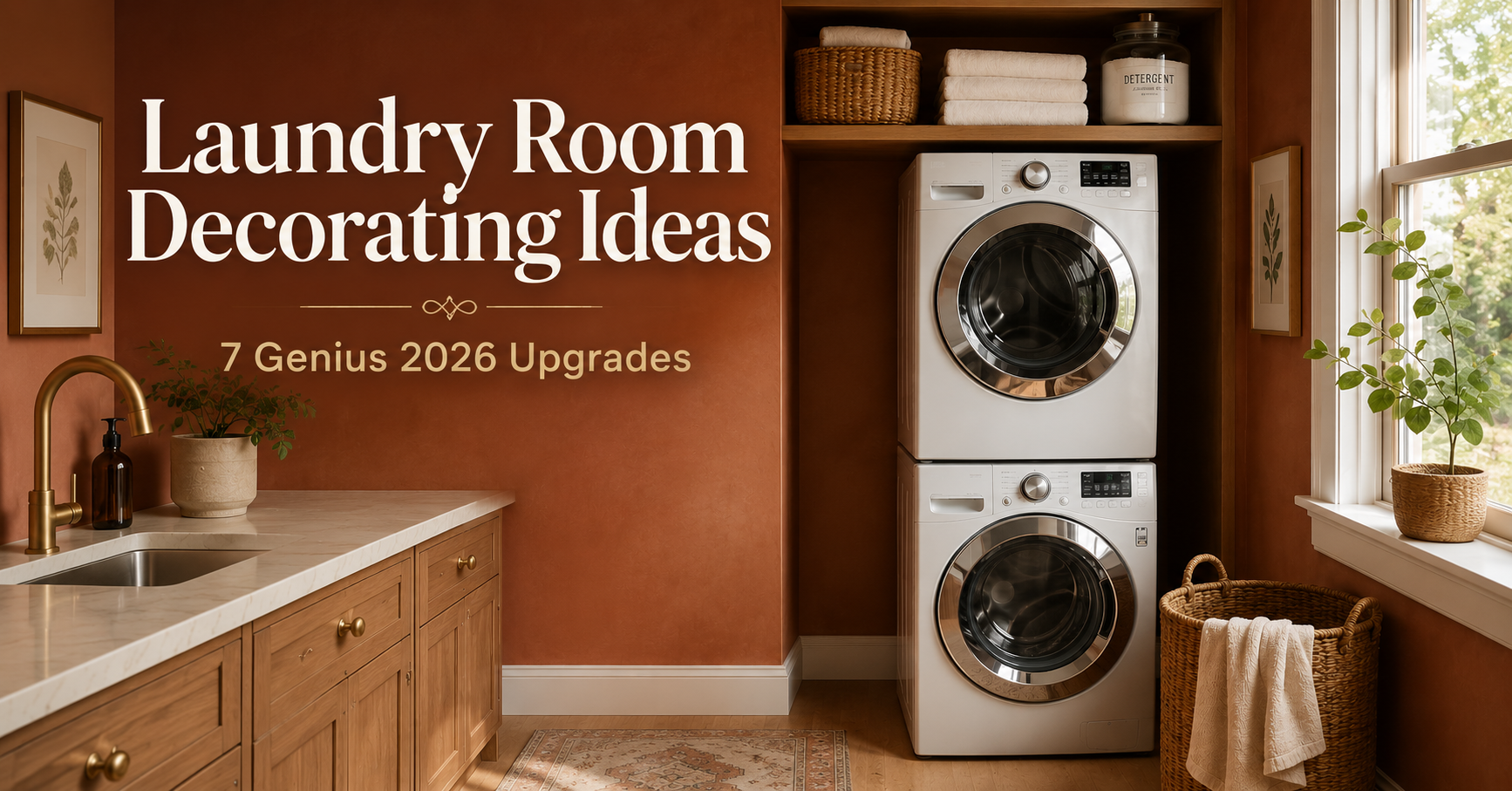
Table of Contents
Let’s be honest: the laundry room is where good design intentions go to die. It’s the room you finish last, decorate with leftover paint, and apologize for whenever someone opens the door by accident. We get it. We’ve seen hundreds of laundry rooms in our research on laundry room decor for this site, and 90% of them have the same three things in common — wire shelving from 2015, a single bare bulb, and a laundry basket sitting on the floor because nobody planned for one.
Here’s the thing though: laundry rooms are having a moment in 2026. Not a “trendy Pinterest moment” — an actual functional redesign moment, where people are finally treating this room like real square footage instead of a hallway you walk through to get to the garage. And honestly? It doesn’t take much to flip it from “I avoid this room” to “I kind of like being in here.”
This guide walks through exactly what’s working right now in laundry room decor — the colors, the layout fixes, the dead-space tricks, and the mistakes we’d tell you to skip if you were standing in our kitchen asking. No fluff, no 47-item mood boards you’ll never actually buy from. Just what actually moves the needle.
Settings saved.
Key Takeaways
- Every laundry room needs four things before decor even matters: good lighting, closed storage, a folding surface, and a hamper system that isn’t “the floor.”
- Warm, muted tones (think clay, sage, warm taupe) are replacing the cold gray-and-white combo that dominated the last decade.
- The 3-color rule (60-30-10) works just as well in an 8×6 laundry room as it does in a living room — maybe better, since there’s less furniture to compete with.
- Dead space — above the machines, beside them, under the sink — is almost always recoverable with the right shelf or rod, no contractor needed.
- The biggest mistake isn’t a color choice. It’s skipping ventilation and task lighting in favor of looks.
What Should Every Laundry Room Have, Honestly?
Before we get to paint chips and shelf styling, let’s deal with the unglamorous stuff, because no amount of decor fixes a room that doesn’t function. If your laundry room is missing any of these, start here — not with a Pinterest board.
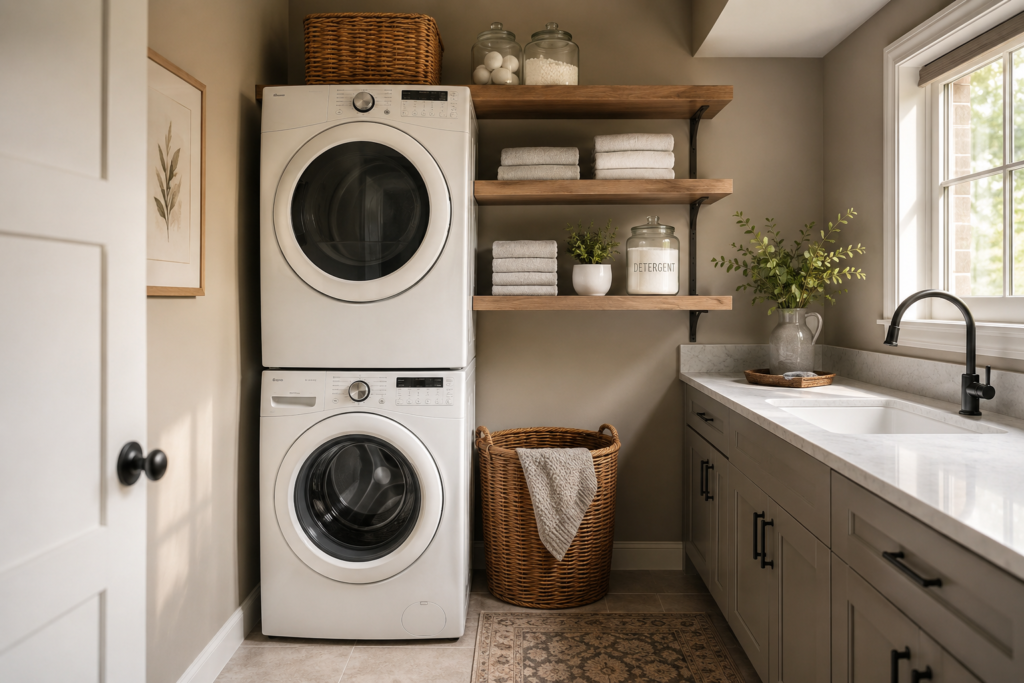
A real folding surface. Even a 24-inch shelf over the dryer counts. If you’re folding on top of the washing machine while it vibrates, you already know why this matters.
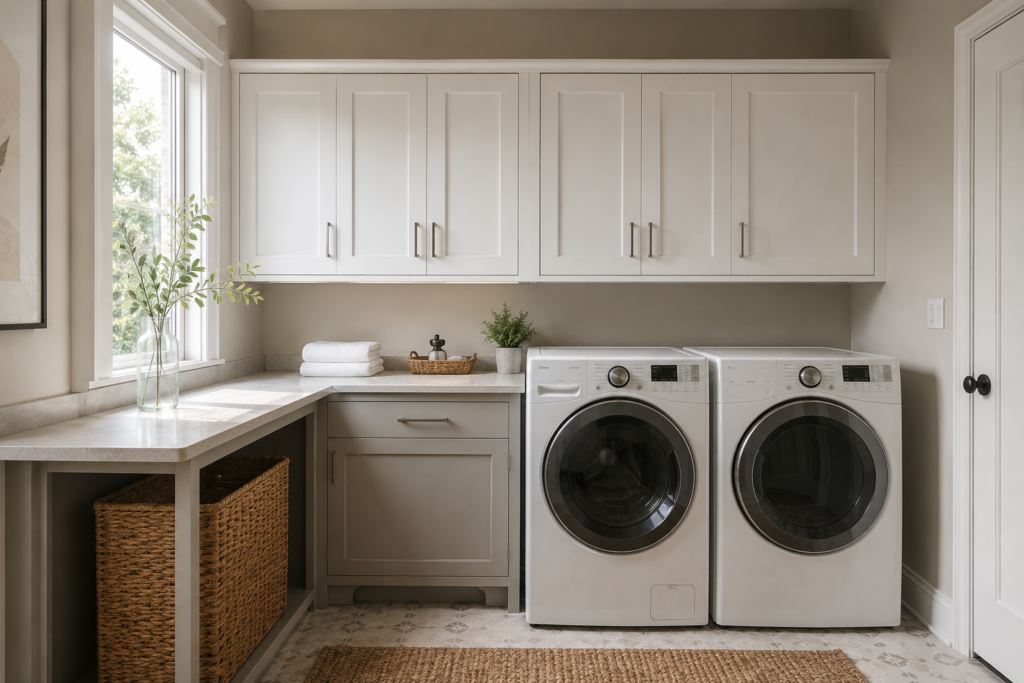
Closed storage for detergent and supplies. Open shelving looks great in photos and terrible six months later when it’s covered in dust and mismatched bottles. A few cabinets — even basic stock ones from a hardware store — instantly make the room look intentional instead of improvised. This is the kind of laundry room decor detail that quietly separates a finished space from an unfinished one.
A hamper system that isn’t a pile. Built-in laundry bins, a rolling cart, or even labeled canvas bins on a shelf — anything that gets clothes off the floor changes how the whole room reads.
Proper lighting. Most laundry rooms run on one overhead fixture that was clearly an afterthought during construction. Swapping it for a flush-mount fixture with a higher lumen output, or adding a small under-cabinet strip light over the folding counter, makes the room feel finished rather than forgotten. If you want a deeper dive on layering light properly, our modern lighting guide covers principles that translate directly to small utility spaces too.
Ventilation that actually works. This one’s not optional. Moisture buildup from the washer and dryer is the single biggest reason laundry rooms look tired fast — peeling paint, musty smell, warped cabinets. According to the EPA’s guidance on moisture and mold control, excess indoor humidity is one of the leading causes of mold growth in enclosed spaces — exactly why an exhaust fan or even a cracked vent makes every other decorating choice last longer
Laundry Room Decor Trends Actually Worth Following in 2026
If you scroll design accounts right now, you’ll notice laundry rooms have quietly stopped looking like hospital supply closets. A few shifts we’re seeing repeatedly:
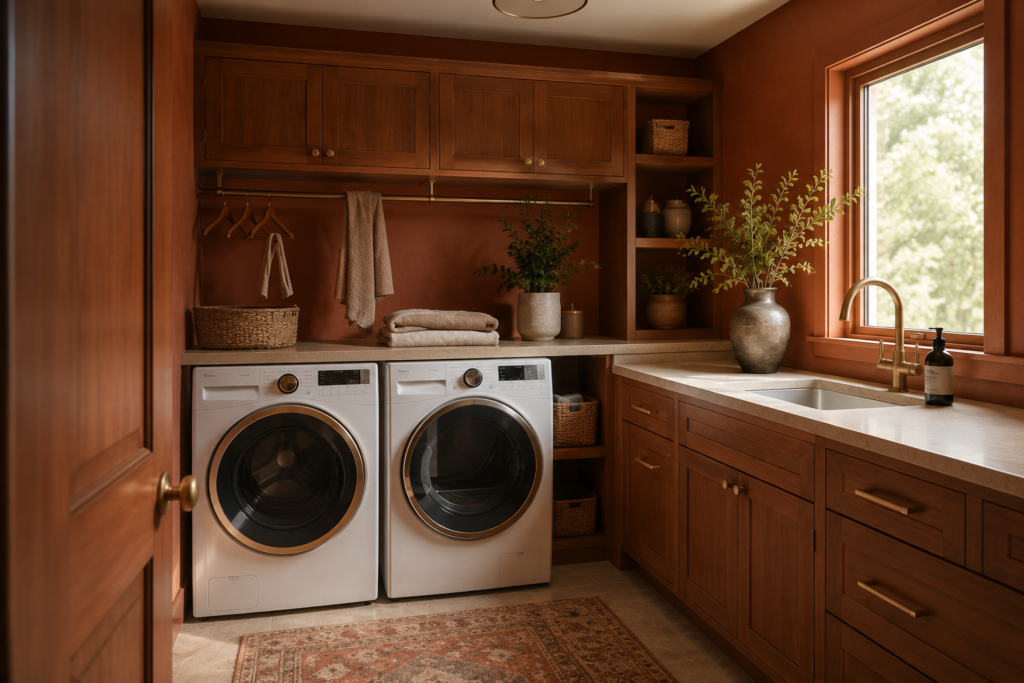
Warm tones are replacing cold gray. Gray dominated laundry and utility spaces for almost a decade because it was “safe.” In 2026, that safety is shifting toward warmer neutrals — terracotta, warm taupe, soft olive, and muted clay. They read as more lived-in and less clinical, which matters in a room people now actually spend time in rather than just passing through.
Layout is prioritizing flow over symmetry. Instead of cramming the washer and dryer side-by-side against one wall purely because that’s “how it’s done,” more layouts now build the folding zone into the actual workflow — machines, then a counter, then storage, in the order you’d use them. It sounds obvious. Almost nobody does it until they’re forced to rethink the room.
Hardware and fixtures are getting upgraded on purpose. Cabinet pulls, faucet finishes, even the light switch plate — small detail upgrades that used to be skipped entirely in utility spaces are now treated the same way kitchens treat them. It’s a cheap swap with a disproportionately big visual payoff.
Multi-use furniture is showing up more. Rolling carts that double as folding stations, stools that store ironing boards underneath, cabinets with built-in hampers — the trend is less “decorate the laundry room” and more “make every inch pull double duty.”
What Color Actually Looks Good in a Laundry Room?
This is the question we get asked the most, and the honest answer is: it depends less on the room and more on a few simple rules that work almost everywhere.
The 60-30-10 rule still wins. Pick one dominant color for roughly 60% of the room (usually walls), a secondary color for 30% (cabinets, trim), and an accent for the remaining 10% (hardware, a rug, a piece of art). This is the same “3-color rule” that shows up constantly in design searches, and it works in a small laundry room arguably better than in a large living room — there’s simply less surface area for things to clash.
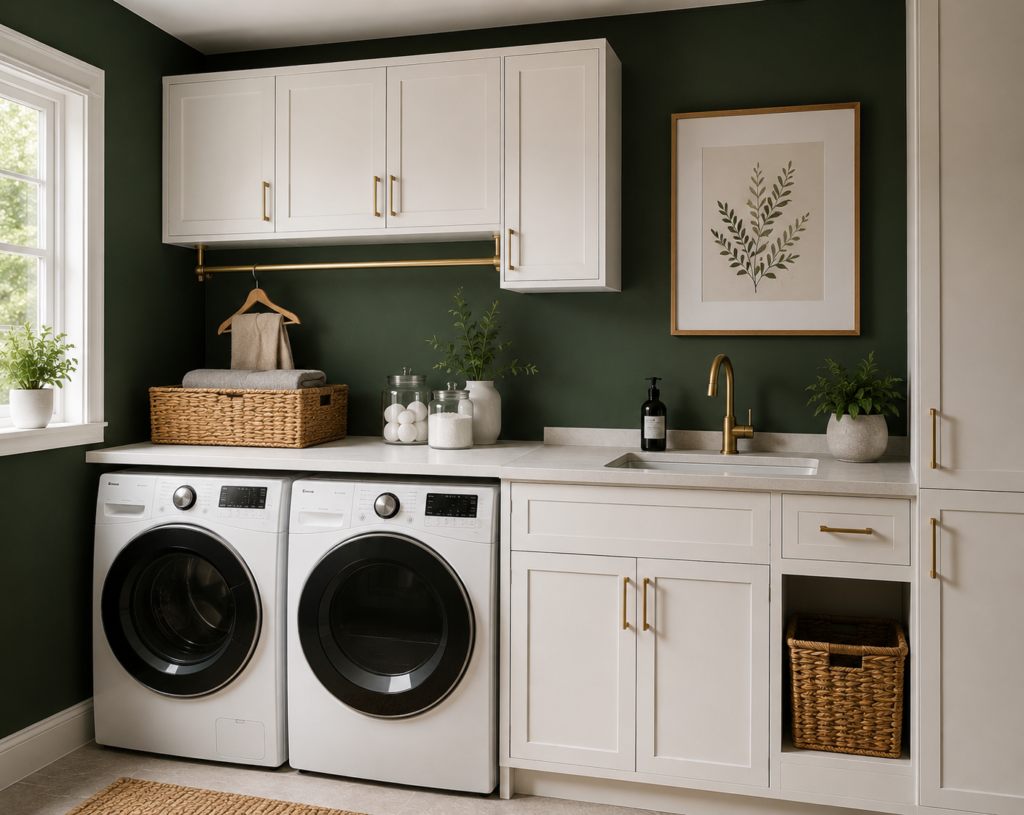
Colors that read as “expensive” in small spaces tend to be deep, saturated, and slightly muted rather than bright. Think deep forest green, navy, charcoal with warm undertones, or a rich terracotta — not pastel or stark white. Saturated color in a small room reads as confident and designed on purpose, while a half-hearted pastel often reads as unfinished.
Calming colors — soft sage, pale blue-gray, warm beige — work well if the laundry room doubles as a mudroom or transition space where you want a breather, not a statement. This is more about how you use the room than a hard rule, and it’s one of the more forgiving choices in laundry room decor if you’re unsure where to start.
Colors that genuinely clash: the classic offenders are cool gray paired with warm yellow undertones, or stark white cabinetry against a warm-toned wood floor with no transitional color between them. If something feels “off” in a laundry room and you can’t pinpoint why, it’s almost always an undertone mismatch — one element leaning warm, another leaning cool, with nothing bridging them.
DIY Upgrades and Wall Decor That Don’t Look Like Afterthoughts
You don’t need a renovation budget here. Some of the highest-impact laundry room decor upgrades are weekend projects:
Peel-and-stick wallpaper on just one wall (usually the one behind or above the machines) is still one of the best dollar-for-dollar upgrades in any small room. It’s renter-friendly, removable, and instantly kills the “builder-grade” look.
Open shelving with a curated few items — not a cluttered display, just two or three things: a labeled jar for dryer sheets, a small plant that tolerates low light, maybe a framed print. Laundry rooms don’t need much wall decor to stop feeling sterile; they need the right two or three things.
A runner rug. Cheap, instant texture, and it covers whatever flooring you inherited from the builder that you’re not ready to replace yet.
Repainting cabinet fronts instead of replacing them. If your cabinets are structurally fine but visually dated, a fresh coat in a current tone (see the color section above) does 80% of what a full replacement would, for a fraction of the cost. This is one of the simplest laundry room decor updates with the best return for the effort.
A small countertop appliance or charging station if space allows — it sounds unrelated to “decorating,” but a room that does something extra useful automatically feels more finished. If you’re curious how small-space multitasking design works in other rooms, our small bedroom design guide has several space-stretching ideas that apply just as well here.
How to Use Dead Space in a Laundry Room
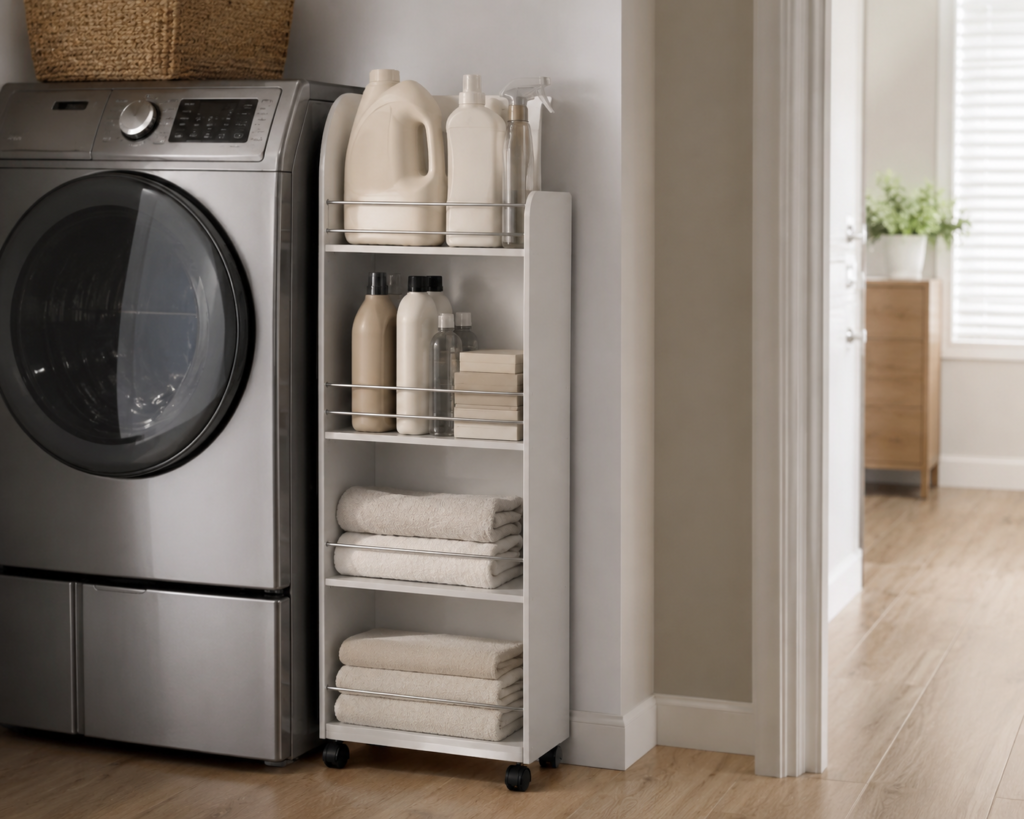
This is where most laundry rooms quietly waste square footage:
Above the machines. The single most underused zone in almost every laundry room. A shallow shelf or cabinet here holds detergent, dryer sheets, and stain remover without eating into floor space — a small but easy laundry room decor win.
The side gap between the dryer and the wall. A narrow rolling cart (often called a laundry caddy) slides into gaps as small as 6 inches and instantly adds storage that didn’t exist before.
Over the door. An over-the-door rack or hooks for an ironing board, broom, or hanging-dry items uses space that’s otherwise completely wasted.
Under the utility sink. If there’s a sink, the cabinet underneath is almost always underutilized. Stackable bins or a pull-out drawer system fix that fast.
The general decorating ratio to keep in mind here is similar to the broader interior design rule of giving roughly 70% of the room to function and 30% to visual interest — in a laundry room specifically, that often skews even further toward function, closer to 80/20, simply because the room’s job is to work hard, not to be a showpiece.
Common Laundry Room Mistakes (That Have Nothing to Do With Color)
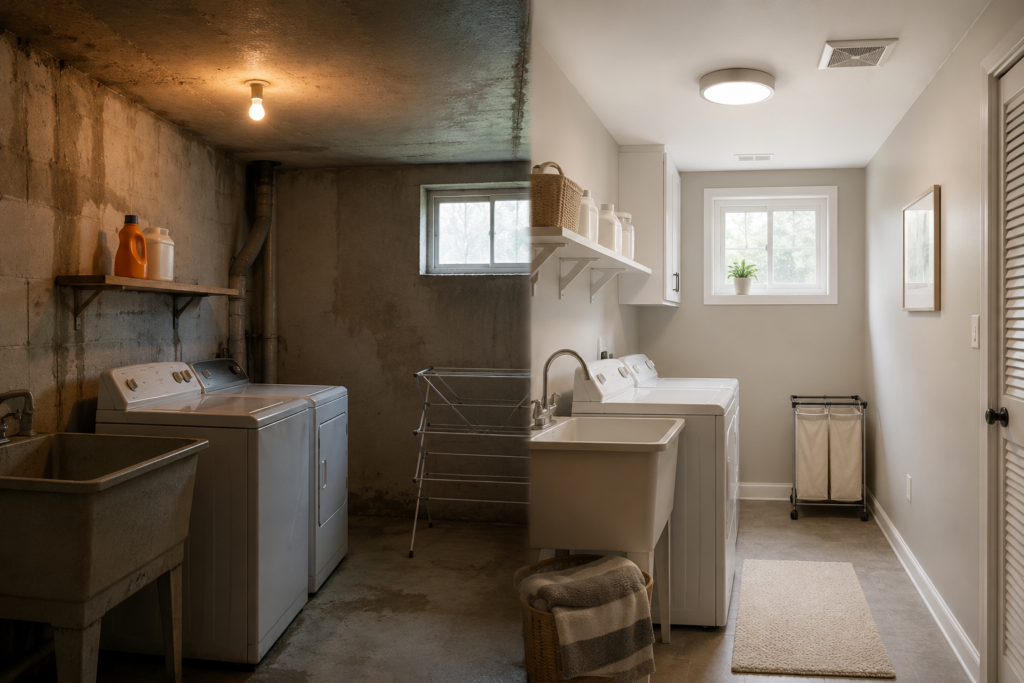
Most “ugly” laundry rooms aren’t actually ugly because of paint choices — they’re ugly because of function problems that show up visually:
Skipping ventilation. Already mentioned above, but it’s worth repeating: this is the number one cause of a laundry room looking tired within a year, regardless of how it was decorated.
No dedicated folding surface. Without one, flat surfaces get colonized by clutter — mail, random tools, half-folded clothes — and the room never looks finished no matter what’s on the walls.
Storing the wrong things in there. Laundry rooms often become dumping grounds for items that don’t belong — paint cans, pet food, tools. If it’s not laundry-related or cleaning-related, it usually doesn’t belong in this room, and removing it does more for the room’s appearance than any decor purchase.
Treating lighting as an afterthought. One dim bulb in the center of the ceiling means every shadow, stain, and mismatched item shows up worse, not better.
One more thing worth a mention if you’re upgrading appliances alongside the decor: older dryers can quietly run up your utility bill more than people expect. If energy costs are part of why you’re rethinking this room, our breakdown on why electric bills run high is worth a read before you commit to a new appliance purchase.
Frequently Asked Questions About Laundry Room Decor
What should every laundry room have at minimum?
Every functional laundry room needs four basics before any decor: a real folding surface (even a shelf over the dryer works), closed storage for detergent and supplies, a hamper system that gets clothes off the floor, and proper lighting. Skipping any of these means the room will still look unfinished no matter what colors or decor you add.
What color should I paint a small laundry room?
The 60-30-10 rule works best: one dominant color for about 60% of the room (usually walls), a secondary tone for 30% (cabinets, trim), and an accent color for the remaining 10% (hardware, a rug, art). In 2026, warm muted tones like clay, sage, and warm taupe are replacing the cold gray-and-white look that dominated for the past decade.
How do I use dead space in a small laundry room?
The most overlooked zones are above the machines, the side gap between the dryer and the wall, over the door, and under the utility sink. A shallow shelf above the machines, a narrow rolling cart in side gaps as small as 6 inches, or stackable bins under the sink can recover storage without needing a contractor.
What’s the biggest mistake people make in laundry room design?
Skipping ventilation. Moisture buildup from the washer and dryer is the number one reason laundry rooms look tired within a year — peeling paint, musty smell, warped cabinets — regardless of how well the room was decorated. Fixing function (lighting, ventilation, storage) before adding decor matters more than any color choice.
Final Thoughts
A laundry room doesn’t need to be beautiful in the way a living room is beautiful. It needs to function well, look intentional, and not make you wince every time you open the door. Get the basics right first — lighting, ventilation, storage, a folding surface — and then layer in color and small laundry room decor touches on top. That order matters more than people think. Decorate a dysfunctional room and it’ll still feel off no matter how good the paint color is. Fix the function first, and even a small amount of decor will look like it belongs there.
Start with one change this weekend — repaint the cabinets, add a shelf above the machines, swap that one sad overhead bulb. Small, function-first laundry room decor upgrades compound faster than people expect, and laundry rooms respond to effort more visibly than almost any other room in the house, simply because expectations for them start so low.
What’s the one thing about your laundry room that’s bugged you the longest? Drop it in the comments — there’s a good chance we’ve already solved it for someone else and can point you the right direction.